Data democratization means giving approved employees access to trusted data so they can answer questions, spot patterns, and make decisions without waiting for constant support from IT or data teams.
Many businesses collect useful data but keep it locked inside tools, reports, or technical teams. When employees cannot find or understand the information they need, decisions slow down, and opportunities are missed.
For companies in the USA, data democratization matters because teams often work across many tools, locations, departments, and compliance requirements. Access needs to be easier, but it also needs to be safe and well managed.
In this article, we will explain what data democratization means, why it matters, its benefits and risks, the key principles behind it, and how teams can make data easier to use without losing control.
What is data democratization?
Data democratization is the process of making trusted data accessible to approved business users, not only analysts, IT teams, or data specialists.
It does not mean giving everyone unrestricted access to every dataset. Good data democratization gives the right people access to the right data with the right context.
A strong data democratization approach usually includes:
- Clear access rules
- Data governance
- Data literacy
- Self-service analytics
- Searchable data sources
- Documentation
- Data quality checks
- Security and privacy controls
The goal is simple: help employees use data confidently without creating confusion, risk, or inconsistent reporting.
What are the benefits of data democratization?
The biggest benefit of data democratization is faster access to useful information. Teams can explore data, answer common questions, and act with more confidence.
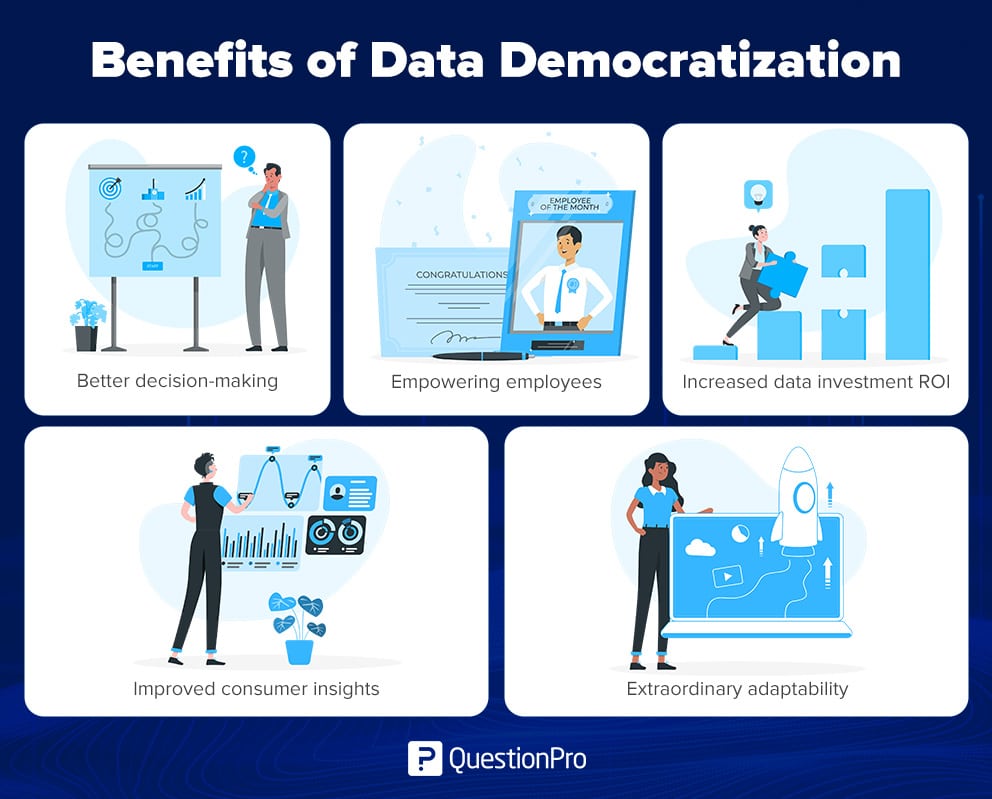
Key benefits of data democratization:
- Better decision-making: Teams can use reliable data to understand what is happening, compare options, and make decisions with more confidence.
- Empowering employees: Employees can investigate questions on their own instead of depending only on analysts, IT teams, or technical specialists for every answer.
- Increased data investment ROI: Data platforms, dashboards, and analytics tools deliver more value when more people across the business can actually use them.
- Improved consumer insights: Customer-facing teams can spot needs, complaints, buying patterns, and consumer behavior changes sooner when they have easier access to customer data.
- Extraordinary adaptability: Businesses can respond faster when markets, customers, or operations change because teams are not waiting too long for basic information.
The benefit is not access alone. The real value comes when data access is paired with clear definitions, trusted sources, governance rules, and enough training to help people interpret the data correctly.
What are the risks of data democratization?
Data democratization can create risk when access expands faster than governance, training, and data quality.
The most common risks of data democratization:
- People using outdated or incomplete data
- Teams defining the same metric in different ways
- Sensitive data being shared too widely
- Employees misreading charts or survey results
- Duplicate dashboards causing confusion
- Low trust when numbers do not match
- Privacy or compliance problems
For US companies handling customer, employee, healthcare, financial, or research data, access controls and privacy rules are especially important.
Data democratization vs. data governance
Data democratization and data governance are not opposites. Data democratization focuses on making data easier to access and use. Data governance focuses on keeping data accurate, secure, consistent, and properly controlled.
Both are needed. Without democratization, data stays locked away. Without governance, data access can create confusion and risk.
| Data democratization | Data governance |
|---|---|
| Expands access to approved users | Sets rules for safe and correct use |
| Helps teams find and use data faster | Defines ownership, quality, and security standards |
| Supports self-service analytics | Controls permissions and privacy |
| Encourages broader data use | Reduces misuse and inconsistent reporting |
| Focuses on usability | Focuses on trust and control |
A healthy data strategy uses both. Teams should make data easier to use while protecting sensitive information and maintaining clear definitions.
For a deeper explanation of the relationship, QuestionPro’s guide on data management vs data governance explains how governance sets the framework while management turns those rules into practice.
What are the key principles of data democratization?
The key principles of data democratization help teams make data easier to find, explore, test, and use without losing control.
These principles also prevent democratization from becoming messy access to disconnected reports.
1. Data discovery
Data discovery means helping users find the data, reports, dashboards, or insights they need.
This can include searchable repositories, clear folder structures, tags, filters, catalogs, and documented data sources.
Good discovery reduces repeated requests like:
- Where is the latest report?
- Which dashboard should I use?
- Who owns this metric?
- Is this data still current?
2. Data exploration
Data exploration means giving users tools to examine data, filter views, compare segments, and identify patterns.
This does not mean every employee needs to become a data scientist. It means business users should be able to answer practical questions without waiting for every small analysis.
Useful exploration tools include:
- Dashboards
- Survey analytics
- Filters and segments
- Cross-tabs
- Visual reports
- Searchable insights
3. Data experimentation
Data experimentation means using data to test ideas before making bigger decisions.
For example, a marketing team may test a message with survey feedback before launching a campaign. A product team may compare user segments before changing a feature. A customer experience team may test whether a service change improves satisfaction.
Experimentation works best when teams can access reliable data quickly and understand the limits of that data.
4. Data automation
Data automation means using technology to reduce manual data collection, cleaning, reporting, or distribution.
For research teams, automation in market research can reduce repetitive work and help insights move faster from collection to action.
Common automation examples include:
- Scheduled reports
- Survey alerts
- Automated dashboards
- Data cleansing rules
- Sample selection workflows
- AI-assisted summaries
5. Data literacy
Data literacy is the ability to read, understand, question, and communicate with data.
It matters because access alone does not make people better decision-makers. Teams also need to know what a metric means, when data is reliable, and when a chart may be misleading.
Basic data literacy training should cover:
- Metric definitions
- Survey sample size
- Correlation vs. causation
- Data bias
- Dashboard interpretation
- Privacy rules
6. Controlled access
Controlled access means giving users the data they need while protecting sensitive information.
This may include role-based permissions, approval workflows, audit logs, anonymized data, and limits on exports.
Controlled access helps businesses share data safely without exposing customer records, employee details, financial data, or confidential research.
How can businesses implement data democratization safely?
Businesses can implement data democratization safely by starting with a clear access strategy, trusted data sources, and simple rules for how data should be used.
A practical rollout can follow these steps:
- Identify priority users: Decide which teams need better access first.
- Choose trusted data sources: Start with clean, reliable, and useful datasets.
- Define ownership: Assign owners for dashboards, reports, metrics, and repositories.
- Set access rules: Decide who can view, edit, export, or share data.
- Document key metrics: Explain definitions, sources, update dates, and limitations.
- Train users: Teach teams how to read dashboards, ask better questions, and avoid common mistakes.
- Monitor usage: Track which data is used, where people struggle, and which requests repeat.
- Improve over time: Update dashboards, remove outdated reports, and refine permissions.
Start small. A well-managed pilot is better than opening access to every dataset at once.
What are examples of data democratization?
Examples of data democratization include any setup where approved users can access trusted information without waiting for technical teams to create every report.
Common examples include:
- Sales teams viewing pipeline dashboards
- CX teams tracking customer satisfaction trends
- HR teams reviewing employee engagement results
- Product teams exploring feature usage data
- Marketing teams comparing campaign performance
- Research teams searching past survey findings
- Executives reviewing live business dashboards
For market research teams, democratization often means making past studies, survey results, customer quotes, and insights searchable across the business.
This helps teams avoid repeating research that already exists and makes customer evidence easier to reuse.
How can QuestionPro InsightsHub support data democratization?
Data democratization works better when teams have one trusted place to find, understand, and reuse research knowledge. For research and insights teams, QuestionPro InsightsHub can support this by centralizing survey findings, project materials, reports, and customer insights in a searchable repository.
This matters because research often gets scattered across slide decks, spreadsheets, folders, and one-off reports. When insights are hard to find, teams may repeat work, miss useful evidence, or make decisions without the full context.
A research repository can support data democratization by helping approved users:
- Find past studies faster
- Reuse survey findings
- Compare insights across projects
- Keep research materials organized
- Share customer evidence with stakeholders
- Reduce repeated research requests
This keeps the focus on the concept first and the product second.
Conclusion
Data democratization is not about giving everyone unlimited access to everything. It is about helping approved teams use trusted data safely and confidently.
The strongest programs combine access, governance, documentation, data literacy, and self-service analytics. That balance helps employees answer questions faster without creating chaos.
For companies that rely on customer, research, product, or operational data, democratization can turn scattered information into shared knowledge that supports better daily decisions.
Frequently asked questions (FAQs)
Data democratization is important because it reduces reporting bottlenecks, helps teams answer questions faster, and increases the value of existing data tools and research.
The main risks are poor data quality, inconsistent metric definitions, privacy issues, sensitive data exposure, and users misinterpreting data without enough context or training.
Data governance supports data democratization by setting rules for ownership, quality, access, privacy, and security. It helps teams share data safely and consistently.
An example is a research team using a searchable insights repository so marketing, product, and customer experience teams can find past survey results and customer feedback without asking analysts for every file.