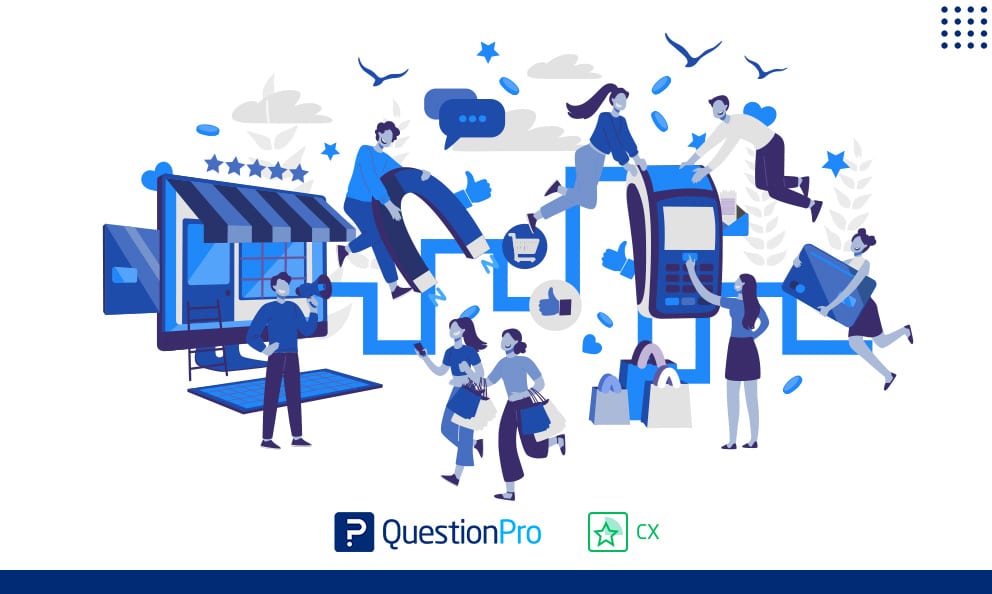
The buyer journey is the path a person follows from realizing they have a problem to choosing a solution. Every purchase has one, from a $5 coffee subscription to a six-figure software contract.
Most of that path happens before a buyer ever speaks to your team. Buyers research alone, compare quietly, and often arrive with a favorite already in mind.
In this blog, we break down the stages, show real examples, and walk through how to map and measure the journey.
What is the buyer journey?
The buyer journey is the research and decision process a potential customer goes through, from recognizing a need to making a purchase. It covers everything before the sale, which is why marketers also call it the buying process or the path to purchase.
The journey is shaped by what the buyer believes, fears, and finds along the way. A buyer might read a blog post, ask a colleague, watch a review, and test a free trial before any vendor knows they exist.
Marketers use the model to match content and outreach to the buyer’s current question. Someone who has just noticed a problem needs a clear explanation. Someone about to sign needs proof and pricing.
What are the stages of the buyer journey?
The classic buyer journey has three stages: awareness, consideration, and decision. Each stage is defined by the question the buyer is trying to answer, not by what your team wants to say.
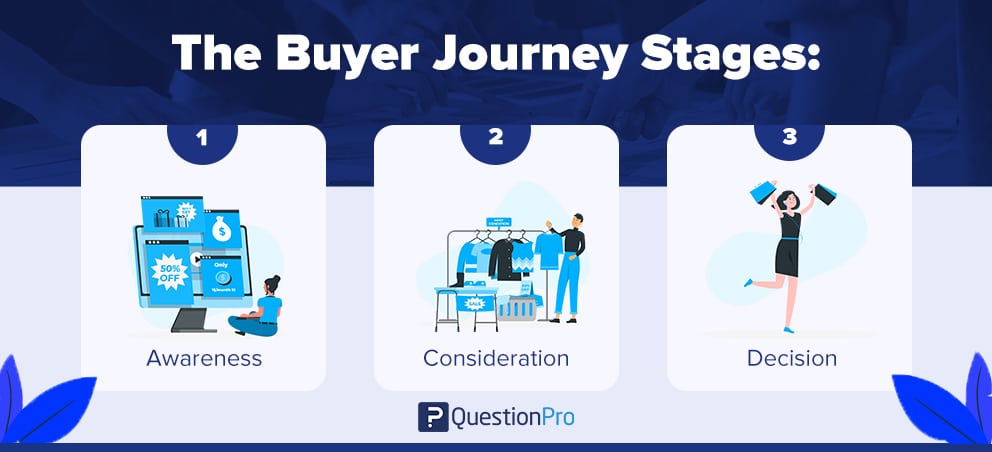
| Stage | Buyer’s core question | What the buyer does | Content that helps |
|---|---|---|---|
| Awareness | “What is going wrong, and why?” | Searches symptoms, reads explainers, asks peers | Educational blogs, checklists, short videos |
| Consideration | “What are my options?” | Compares approaches, reads reviews, joins webinars | Comparison guides, case studies, expert talks |
| Decision | “Which one should I pick?” | Requests quotes, runs trials, builds a business case | Pricing, demos, references, implementation plans |
Some models add a fourth stage for post-purchase experience, and others add loyalty and advocacy. Those extra stages belong to the customer journey, covered further below.
What happens at each stage of the buyer journey?
Each stage has its own mindset, search behavior, and risk. Knowing all three helps you publish the right answer at the right moment.
Awareness stage
At awareness, the buyer feels a pain or sees an opportunity but cannot name the fix yet. A facilities manager notices that complaints about office temperature keep rising. A founder sees sign-ups drop and does not know why.
Searches here are about symptoms, such as “why is my team’s morale low.” Your job is to explain the problem clearly and without a sales pitch.
Typical awareness signals include:
- Searches phrased as problems, not product names
- Downloads of checklists, templates, or benchmark reports
- Short visits to educational blog posts
Consideration stage
At consideration, the buyer has named the problem and now compares ways to solve it. They weigh categories first, then vendors. Reviews, side-by-side comparisons, and peer opinions carry the most weight.
This is the stage where most of your competitors are visible too. Specific, honest content wins here because it helps the buyer narrow the list.
Decision stage
At decision, the buyer is choosing one option and trying to justify it. They look for pricing, implementation effort, references, and risk. In B2B, they also prepare a case for colleagues who must approve the spend.
Friction costs the most here. A confusing pricing page or a slow reply can undo months of earlier work.
Decision-stage buyers usually need three things:
- A clear price or a price range
- Proof from similar customers
- A realistic picture of setup time and effort
How is the buyer journey different from similar terms?
People often use the buyer journey interchangeably with the customer journey, the sales funnel, and other models. They overlap, but each answers a different question.
| Term | Whose view it takes | Where it starts and ends | Main use |
|---|---|---|---|
| Buyer journey | The buyer’s research and decision path | Problem awareness to purchase | Planning content and outreach |
| Customer journey | The full relationship with a brand | First contact to loyalty and advocacy | Improving retention and experience |
| Sales funnel | The seller’s pipeline stages | Lead to closed deal | Forecasting and sales management |
| Purchase journey | The consumer’s shopping path | Need to checkout and reflection | Retail and e-commerce planning |
| Consumer decision journey | A looping, non-linear loop of choices | Trigger to repeat purchase | Understanding brand switching |
The simplest rule: the buyer journey is what the buyer does, the sales funnel is what the seller tracks, and the customer journey continues after the sale. For a full side-by-side, see this guide on buyer journey vs customer journey.
What are examples of a buyer journey?
Examples make the stages concrete. These two are illustrative scenarios, not case studies of named companies.
A B2C example: Buying running shoes
- Awareness: A runner develops sore knees and searches “why do my knees hurt after running.”
- Consideration: An article points to worn-out shoes. She compares cushioning types, watches review videos, and reads store ratings.
- Decision: She narrows to two pairs, checks the return policy, and buys the pair with free exchanges.
- After the sale: A follow-up email asks how the shoes feel, which feeds the customer journey, not the buyer journey.
The whole path may take two days. Her biggest risk was fit, so return policy content won the sale.
A B2B example: Selling web design to e-commerce brands
A web design agency sells conversion-focused redesigns to online stores. The buyer is an e-commerce director, and the journey runs for weeks.
Early on, the director sees cart abandonment rising and reads about checkout friction. She then compares agencies, in-house fixes, and template tools. Finally, she asks for two client references and a scoped estimate, then presents both to her CFO.
The agency that publishes checkout benchmarks, comparison pages, and transparent pricing shows up at every step. Pairing that with a simple reference program shortens the final stage.
How does the B2B buyer journey differ from B2C?
B2B journeys are longer, more collaborative, and more research-heavy than B2C ones. The data shows how crowded the buying side has become.
- More people: Forrester reports that a typical business purchase involves 13 internal colleagues and nine external influencers.
- Earlier decisions: A 6sense survey found buyers complete nearly 70% of the buying process before contacting sales.
- Preference for self-service: Gartner found that 61% of B2B buyers prefer a rep-free buying experience.
- Higher stakes: A wrong choice affects budgets, teams, and careers, so proof matters more than polish.
B2C buyers decide faster and lean on emotion, price, and convenience. For committee roles, mapping steps, and a CX software example, read our dedicated guide to the B2B buyer journey.
Is the buyer journey linear?
No. Real buyers loop, skip, and double back. B2B buying does not play out in any predictable, linear order, with buyers revisiting each of six buying jobs at least once.
A buyer may reach the decision stage, hear a new objection from a colleague, and return to comparing options. Someone else may skip awareness completely because a friend already named the product.
The three-stage model is a planning tool, not a script. Build content for each stage, but expect buyers to move between them in any order. The consumer decision journey model captures this looping behavior for consumer purchases.
How is AI changing the buyer journey?
AI tools now sit at the start of many journeys. Generative AI searches are the starting point for B2B buyers, which moves early research away from classic search results.
For marketers, three shifts matter:
- Answers replace clicks: Buyers read an AI summary, so your content must be clear enough to be quoted.
- Shortlists form earlier: Brands that AI tools mention in the first answer get considered, and others may never appear.
- Humans still verify: Research found that 69% of B2B buyers turn to sales reps to validate AI-generated insights.
The takeaway is practical. Write self-contained answers, publish consistent facts across your site, and keep your sales team ready for buyers who arrive well informed.
Step-by-step guide to mapping the buyer journey
A buyer journey map is a visual of the stages, questions, touchpoints, and emotions a buyer moves through. Building one takes six steps.
- Pick one buyer segment.
Start with a single buyer persona, such as “operations manager at a 200-person company.” A map for everyone describes no one. - Set the scope.
Define the first trigger and the final purchase. Decide whether post-purchase belongs in this map or a separate one. - Collect real buyer input.
Interview recent buyers and survey new customers. Ask what prompted the search, where they looked, and who influenced them. - List touchpoints per stage.
Include search, social, reviews, peers, your website, sales calls, and trials. - Mark pain points and gaps.
Note where buyers got stuck, confused, or dropped out. Flag stages where you have no content at all. - Assign actions and owners.
Turn each gap into a task with a named owner and a date.
Test the map against 8 to 10 recent buyers. If their stories do not match, rewrite the map before building content on it.
Which stage of the buyer journey should you fix first?
Fix the stage where buyers leave in the largest numbers or hesitate the longest. Fixing awareness while decision-stage friction remains only sends more people into a leaky process.
Use these rules to prioritize:
- Few visitors, healthy conversion later: Invest in awareness content and search visibility.
- Plenty of traffic, few demo or trial requests: Strengthen consideration with comparisons, case studies, and clearer positioning.
- Many trials or demos, few closes: Fix decision friction, including pricing clarity, security answers, references, and speed of reply.
- Wins that do not renew: The problem lives in the customer journey, so shift focus to onboarding and support.
Check the numbers each quarter. A stage that was healthy last year can become the bottleneck after a new competitor or pricing change.
How do you measure the buyer journey?
You measure the buyer journey by tracking one or two indicators per stage and pairing them with direct buyer feedback. Numbers show where buyers drop. Surveys show why.
| Stage | Behavior metrics | Question to ask buyers |
|---|---|---|
| Awareness | Organic sessions, branded search growth, share of voice | “Where did you first hear about us?” |
| Consideration | Content-to-lead rate, comparison page views, trial or demo requests | “Which other options did you evaluate?” |
| Decision | Win rate, sales cycle length, proposal-to-close rate | “What almost stopped you from buying?” |
Collect responses from every new customer within 30 days of purchase, while memory is fresh. Review them quarterly. Once you have 100 or more responses, patterns in sources, rivals, and objections become reliable enough to act on.
What mistakes should you avoid with the buyer journey?
Most failures come from treating the model as a neat diagram instead of a research project. These are the common ones.
- Mapping from internal opinion: Teams guess how buyers behave. Talk to recent buyers instead.
- Treating the journey as linear: Buyers loop, so every page should work as an entry point.
- Writing only for the bottom stage: Product pages alone ignore the people still defining their problem.
- Ignoring the buying committee: In B2B, the person you talk to rarely decides alone.
- Letting messages drift: 69% of buyers see inconsistencies between a seller’s website and what sellers say.
- Never updating the map: Channels, competitors, and AI tools change, so review it twice a year.
How can QuestionPro help you understand the buyer journey?
QuestionPro helps you replace guesses about the buyer journey with direct buyer feedback at each stage. QuestionPro Customer Experience lets teams survey new buyers, tag responses by journey stage, and track satisfaction at each touchpoint.
Its journey mapping software goes one step further. You can build and visualize a journey, then add feedback indicators to each phase:
- Net Promoter Score (NPS): A 0 to 10 measure of how likely people are to recommend you
- Customer Satisfaction (CSAT): How happy buyers are with a specific touchpoint
- Customer Effort Score (CES): How hard it was to complete a task
The result is a map that shows where buyers struggle, based on what they told you. A simple starting point is a three-question survey sent after purchase: what triggered the search, which options they compared, and what almost stopped them.
Why the buyer journey is a habit, not a diagram
A buyer journey map is only useful while it reflects how people actually buy. The teams that benefit most treat it as a living research practice: ask buyers, adjust content, check results, and repeat.
The model also reminds teams to see their product through the buyer’s eyes. People do not wake up wanting your software. They wake up with a problem, and the journey is the story of how they solve it.
If you want to extend the map past the sale, the customer journey map and the purchase journey guides pick up where this one ends.
Frequently Asked Questions (FAQs)
It varies widely. A low-cost consumer purchase can finish in minutes or days, while complex B2B deals often take months. Length depends on price, risk, and the number of people who must approve the decision, so measure your own average.
A buyer persona describes who your buyer is, including role, goals, and concerns. The buyer journey describes what that person does while buying. Personas tell you who to write for, and the journey tells you when to publish each message.
Yes. A buyer who gets a trusted recommendation may skip awareness and begin at consideration. A repeat customer may jump straight to decision. Plan for entry at any stage by making every key page understandable on its own.
Marketing usually leads because it creates the content buyers find first. Sales, product, and customer success each own parts of it. The strongest programs assign one coordinator who gathers buyer feedback and shares findings across all four teams.
Review the map at least twice a year, and sooner after a pricing change, major competitor launch, or new sales channel. Refresh it with a small batch of recent buyer interviews or survey responses to confirm that the stages still match reality.