



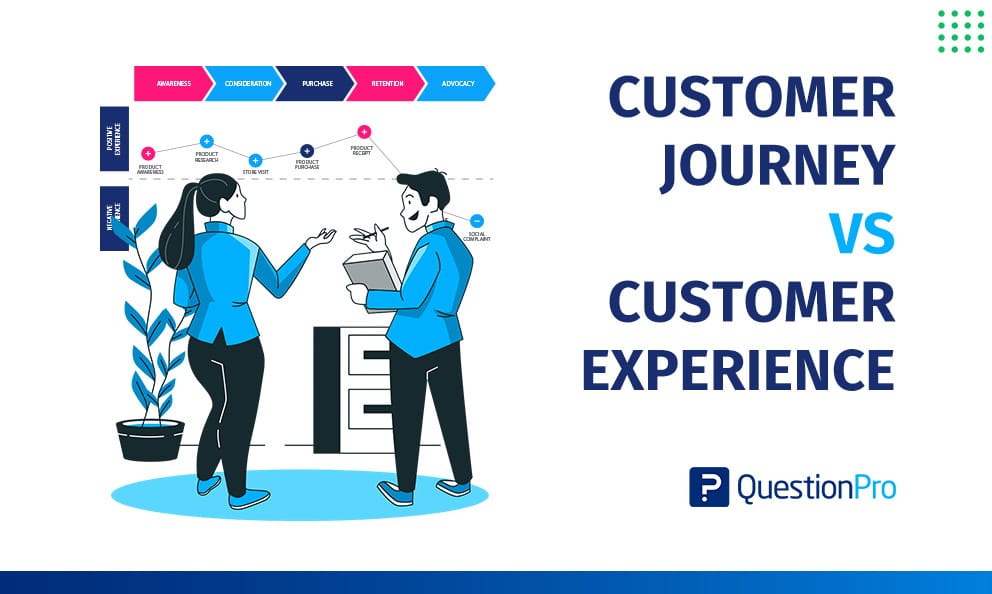
Customer journey vs customer experience is one of the most mixed-up pairs in CX. The customer journey is the path a person takes with your brand. The customer experience is how that person feels and what they remember about it.
You can map every step of a journey and still deliver a poor experience. In this blog, we break down the definitions, a side-by-side comparison, real examples, the metrics for each, and a practical way to use both.
What is the difference between customer journey and customer experience?
The customer journey is what customers do across all interactions with a business. Customer experience is what they perceive and feel while doing it. One describes the path. The other describes the quality of the trip.
| Aspect | Customer journey | Customer experience |
|---|---|---|
| Core question | What steps does the customer take? | How does the customer feel about those steps? |
| Nature | Observable sequence of actions and interactions | Subjective perception and emotion |
| Scope | Stages from awareness to advocacy | Every interaction, across every channel |
| Typical tool | Customer journey map | Surveys, feedback and sentiment analysis |
| Key metrics | Conversion, drop-off, time to complete a stage | NPS, CSAT, customer effort score |
| Who controls it | The business can design and shorten it | The business can influence it, never fully control it |
| Output | A visual map of touchpoints and pain points | A measured level of satisfaction and loyalty |
What is a customer journey?
A customer journey is the full set of actions and interactions a customer has with your company, before, during and after a purchase. The actions can be real or possible. They include a search, an ad click, a store visit, a support call and a renewal.
Teams usually visualize the journey as a customer journey map. A map plots each step against the customer’s goals, channels, emotions and pain points. Building one starts with a buyer persona, which is a research-based profile of a typical customer. If you want a walkthrough, see how to create an effective customer journey in six steps.
What are the stages of a customer journey?
Most models use five stages. Names vary, but the logic stays the same.
- Awareness: The customer realizes a need or discovers your brand.
- Consideration: The customer researches and compares alternatives.
- Purchase: The customer decides and buys.
- Retention: The customer uses the product and gets support.
- Advocacy: The customer recommends you or leaves a review.
A touchpoint is any single point of contact inside these stages, such as a web page, an email or a phone call. Touchpoints make up journeys. They also shape experience.
What is customer experience?
Customer experience (CX) is the sum of a customer’s perceptions after any rational, physical, emotional or psychological interaction with a business. Those perceptions shape behavior. They also create the memories that drive loyalty, repeat purchases and word of mouth.
CX covers every channel and stage. Because it lives in the customer’s head, no company controls it. You can still shape it in three ways:
- Design good moments: Plan the interactions you want customers to remember.
- Remove friction: Cut steps, waits and confusing choices.
- Fix what hurts: Act on complaints and low scores quickly.
You cannot dictate how someone feels. You can only earn a better feeling.
CX is the outcome. The journey is where you earn that outcome.
For a broader foundation, read the complete guide to customer experience.
How do customer journey and customer experience work together?
The customer journey is the framework used to manage customer experience. You map the journey to find where experiences take shape, then measure and improve those moments. Neither works well alone.
- A journey map without feedback is a guess about what customers do.
- Feedback without a journey is a pile of scores with no context.
- Both together show which stage is weak, why it is weak and what to fix first.
The data backs the journey-level view. Research found that performance across whole journeys is 35% more predictive of customer satisfaction than performance at individual touchpoints. The same research found it is 32% more predictive of churn. Fixing one great touchpoint matters less than fixing the whole path.
Several neighboring terms get swapped for these two. Here is how each one differs.
- Touchpoint: One interaction inside a journey, such as a chatbot reply. Touchpoints are the parts. The journey is the whole.
- User experience (UX): How easy and pleasant it is to use a product or interface. UX sits inside CX. Our guide on customer experience vs user experience covers the split in detail.
- Customer service: Help given when something goes wrong or a question arises. It is one contributor to CX, not the whole of it. See customer experience vs customer service.
- Customer lifecycle: The long-run stages of a relationship, from acquisition to churn. It is a business-centered view. The journey is customer-centered.
- Customer journey analytics: The analysis of journey data to find drop-offs and friction. It supports journey work and CX work.
What does the difference look like in real life?
Hold the journey constant and change the experience, and the gap becomes obvious. The steps stay the same. The feelings do not.
Restaurant: Same journey, different experience
Picture a loyal customer of a taco restaurant. The tacos are the best in town. The waiters are rude and the food takes forever.
- Journey: Arrive, order, wait, eat, pay, leave. It repeats every visit.
- Experience: One great moment (the food) and one painful one (the service).
If the wait keeps frustrating the customer, they will try a competitor, and the journey ends. A great product did not protect loyalty from a weak service touchpoint.
Software: A smooth journey, a poor moment
A US software company maps its trial journey: sign-up, onboarding, first project, upgrade. Conversion looks healthy through onboarding. Then a survey after the first project shows customers feel lost.
Journey data showed where people were. The feedback explained how they felt. The fix was a guided first-project tutorial, not a new pricing page.
Healthcare: The journey spans more than the visit
A patient’s journey runs through five steps:
- Finding a provider and booking
- Check-in
- The visit itself
- Billing
- Follow-up care
A clinical visit can go well while a confusing bill ruins the experience. Mapping the full path shows that billing, not the exam room, is the weak link.
How do you measure customer journey and customer experience?
You measure journey performance with behavioral and stage-level data. You measure experience with feedback that captures how customers feel. Use both, and tie each score to a stage.
| Measure | What it tells you | Type |
|---|---|---|
| Stage conversion rate | Share of customers who move to the next stage | Journey |
| Drop-off rate | Where customers abandon the path | Journey |
| Time to complete a stage | Speed and friction in a step | Journey |
| Net Promoter Score (NPS) | Likelihood to recommend, on a 0 to 10 scale | Experience |
| Customer Satisfaction Score (CSAT) | Satisfaction with a specific interaction | Experience |
| Customer Effort Score (CES) | How easy a task felt | Experience |
For formulas and benchmarks, read how to measure customer experience. A good practice is to ask a short CSAT or CES question at the end of each key stage. Then read journey data and feedback side by side.
How do you use both to improve CX? Step by step
Start with the journey, then layer experience data on each stage. This order stops you from fixing the wrong problem.
- Define one persona and one journey.
Pick a customer segment and a goal, such as “new customer completes first order.” - Map the stages and touchpoints.
List what the customer does, on which channel, at each step. - Add feedback at every stage.
Place a short survey at each key moment, such as after checkout or a support chat. - Find the gaps.
Compare drop-off points with low satisfaction scores. Where they overlap, you have your priority. - Fix, then re-measure.
Change one thing, then check whether the stage score and conversion improved. - Close the loop.
Follow up with unhappy customers quickly. This is called closed-loop feedback.
Should you focus on the customer journey or customer experience first?
Start with the journey if you cannot yet describe what customers do. Start with experience measurement if you already know the path but not how it feels. Most teams need both within a quarter.
Use these rules to decide.
- No map exists: Build the journey map first. You need a frame to attach feedback to.
- A map exists but scores are unknown: Add NPS, CSAT or CES at each stage.
- Scores are low but the cause is unclear: Run a journey analysis and open-ended feedback at the weakest stage.
- Churn is the main problem: Focus on the retention and support stages, where loyalty is won or lost.
For deeper work on the first path, see customer journey analysis.
What are the common mistakes when treating them as the same thing?
The most common mistake is believing a journey map is the same as a CX program. A map shows steps. It does not show whether customers are happy.
- Mapping from the inside out: Teams draw the journey from internal process charts instead of customer research. The map then shows how the company works, not how customers behave.
- Measuring only the end result: One overall NPS score hides the stage where the damage happens. Tie scores to stages.
- Treating CX as only customer service: A friendly agent cannot repair a confusing checkout or a slow delivery.
- Mapping once and filing it away: Customer behavior and channels change. Review each map at least once a year and after any major product change.
How does QuestionPro connect customer journey and customer experience data?
QuestionPro Customer Experience lets you place feedback at each key point of a mapped journey. You can measure satisfaction by stage, trigger alerts when a detractor appears, and follow up with promoters. This turns a static map into a living view of both what customers do and how they feel.
Use the Journey Management Tool to build and track the map. Use the QuestionPro Customer Experience platform to gather the feedback that scores each stage. Together they answer two questions: where are customers, and how do they feel there?
The real answer to customer journey vs customer experience
The journey tells you where customers are. The experience tells you how they feel there. A business that watches only one will keep missing the other.
Treat the journey as your map and the experience as your measure of success. Then act on three habits:
- Build the map from real customer research.
- Add feedback to every stage.
- Fix the moments where the two disagree, because that is where loyalty is won or lost.
Frequently Asked Questions (FAQs).
Yes. The journey is the sequence of interactions, and the experience is the perception those interactions create. Most CX programs use journey mapping as their main planning tool, so the journey sits inside the broader work of managing experience.
Yes. A journey can be short and efficient, yet one step, such as a rude call or surprise fee, can frustrate customers. Efficient steps do not guarantee good feelings, which is why you need feedback.
Map the journey first so you know which moments matter. Then measure experience at each of them. If you already have survey scores but no map, build one to explain why scores run high or low.
Review it at least once a year and after any major change, such as a new channel, pricing model or product launch. Fast-moving businesses, such as e-commerce and SaaS, often refresh the highest-traffic journeys every quarter.
Ownership is usually shared. Marketing often owns the early journey, product owns usage, and support owns service moments. Many US companies appoint a CX leader or a Chief Customer Officer to unite these teams around one set of customer metrics.



