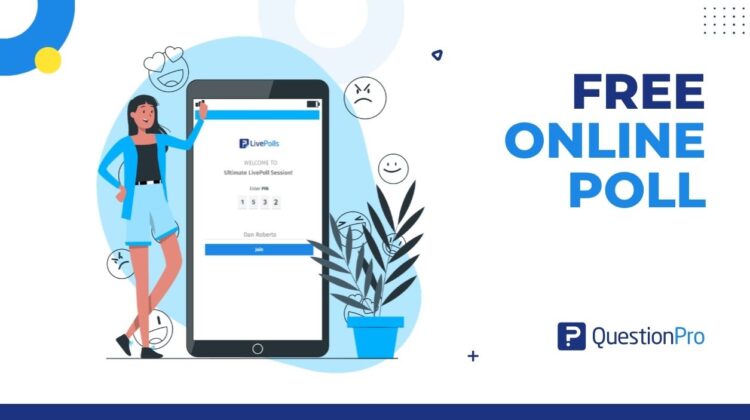
A free online poll is one of the fastest ways to find out what people actually think. It can predict how an election will go, tell you if a new product idea is worth building, or simply settle what the team orders for lunch. The appeal is speed: ask one sharp question, share the link, and watch answers roll in within minutes.
Most people assume writing a poll is easy, since it is just one question. In practice, a poorly worded poll produces confusing data and low response rates. A well-built one produces a clean, quotable answer you can act on immediately.
This guide covers what a free online poll is, how it differs from a survey, the question types that work best, and a step-by-step process for building one that gets real, usable answers.
What is a free online poll?
A free online poll is a single question, or a short set of questions, distributed over the internet at no cost, with results collected and displayed in real time. Respondents typically pick from a small set of closed-ended answers rather than typing a long response.
Polling itself is not new. According to Pew Research Center, the word “poll” originally meant “head,” because early polls literally counted heads at public meetings to gauge opinion. Today’s online polls do the same job with far less friction, using a poll link instead of a show of hands.
Online feedback polls now show up everywhere: election forecasts, product feedback widgets, social media stories, and internal company check-ins. Businesses use a free online poll to gather primary data for decisions like launching a product, testing a new market, or checking in with customers, without the time or cost of a full research project.
Poll vs survey: What is the difference?
People often use “poll” and “survey” interchangeably, but they serve different jobs. A poll is built for a fast, single-topic read on opinion. A survey is built for deeper, multi-question research.
| Aspects | Poll | Survey |
|---|---|---|
| Length | 1 to 3 questions | Multiple questions, often grouped by topic |
| Goal | Quick opinion snapshot | Detailed insight and analysis |
| Question type | Almost always closed-ended | Mix of closed and open-ended |
| Typical use | Social media, live events, quick checks | Customer research, employee feedback, academic studies |
| Time to complete | Under 30 seconds | A few minutes or more |
If you need a fast read on one question, a poll is the right tool. If you need to understand the reasons behind an opinion, an online survey is the better fit.
Why businesses and researchers use free online polls
A free online poll converts a passive audience into active participants with almost no friction. People like giving opinions, and a poll gives them a 10-second way to do it.
Common reasons teams run online polls include:
- Gathering fast feedback on a website, blog post, or app feature
- Testing a headline, price point, or product concept before launch
- Predicting outcomes, such as election results or event turnout
- Running an internal voting poll to make a team decision
- Keeping an audience engaged during a webinar or live event
The same poll data that feels lightweight to a respondent can be genuinely useful to a business. A single well-placed question can validate a product direction or flag a problem before it grows.
Types of poll questions you can use
Most poll makers offer a small set of closed-ended question types. Picking the right one shapes how easy the poll is to answer and how clean the results will be.
| Question type | Best for | Example | ||||||||||||||||||
|---|---|---|---|---|---|---|---|---|---|---|---|---|---|---|---|---|---|---|---|---|
| Single choice | One clear preference | “Which logo do you like best?” | ||||||||||||||||||
| Multiple choice | Selecting more than one option | “Which of these features do you use?” | ||||||||||||||||||
| Rating scale | Measuring satisfaction or agreement | “Rate our service from 1 to 5.” | ||||||||||||||||||
| Ranking | Ordering options by preference | “Rank these three plans by preference.” |
| Scenario | Example poll question | Why it works |
|---|---|---|
| Product feedback | “Which feature should we build next?” | Turns product decisions into direct audience input |
| Event engagement | “What session are you most excited about today?” | Keeps a live audience involved during downtime |
| Internal culture check | “What would make your workday better?” | Surfaces quick, honest employee sentiment |
| Election forecasting | “Which candidate do you support in the upcoming election?” | Produces a fast public opinion snapshot |
| Website engagement | “Was this article helpful?” | Adds a low-effort feedback loop to content |
A poll used for an internal culture check does not need to be serious to be useful. One company announcing a new CEO ran a lighthearted poll asking employees what would make their workday better, with options like “a boss with a sense of humor” alongside more practical choices. The playful framing still produced a real signal about what employees valued.
Common mistakes to avoid with online polls
Online polls offer a quick way to collect feedback, but small design flaws can easily undermine your results. To gather clean, reliable data that you can actually use, steer clear of these five common polling mistakes.
- Asking a double-barreled question.
Combining two topics into one question, such as satisfaction with a manager and with pay, leaves respondents unsure which part to answer and corrupts the results.
- Writing a leading question.
Phrasing that nudges respondents toward a specific answer produces data that reflects the question, not the audience.
- Overloading the poll with questions.
A poll that runs past three questions starts to behave like a weak survey. Completion rates drop and the data gets messier.
- Skipping a pilot test.
Sending a poll live without a quick test run means the first real wave of respondents becomes the test group, and any wording problems show up in your final data.
- Ignoring the sample.
A poll shared only within one small, biased group, such as a single social media following, will not represent a wider population, even if the response count looks healthy.
How to measure whether your poll worked
A poll’s success is not just about how many people answered. A few simple metrics tell you whether the data is worth acting on.
- Response count and rate. How many people answered compared to how many saw the poll.
- Completion speed. Polls answered in under a minute suggest the question was clear.
- Result distribution. A near-even split may mean the question needs sharper answer options, not a genuinely divided audience.
- Drop-off on multi-question polls. If responses fall sharply after question one, the poll is likely too long.
- Consistency over repeat polls. Comparing results from the same question asked periodically shows whether opinion is actually shifting.
Tracking these numbers turns a single poll from a one-off curiosity into a repeatable feedback tool.
One honest answer is often all you need
No poll is perfect, and a single question will never replace deep research. But a short, well-written free online poll remains one of the quickest ways to turn a hunch into a real answer.
A bit of care in the wording is usually the only thing standing between messy data and a result you can trust. For a bigger library of ready-made options, browse poll questions before you start writing your own.
Frequently Asked Questions (FAQs)
Most poll makers, including QuestionPro, offer a free tier that covers basic poll creation, real-time results, and simple distribution. Paid plans typically unlock advanced question types, larger response limits, and deeper analytics for ongoing research programs.
There is no fixed number, since reliability depends on your audience size and how the poll is shared. A poll meant to represent a broad population needs a larger, more random sample than an internal team check-in with 20 people.
Yes. Most poll tools let you disable respondent tracking so answers are not tied to an identity, which often increases honesty on sensitive topics like workplace culture or pricing feedback.
A vote is typically formal and decision-binding, such as electing a leader. A poll is informal and used to gauge opinion or sentiment, even when the topic overlaps with an eventual vote or election.
Yes. Most poll makers generate an embed code or widget that displays the poll directly on a webpage, so visitors can respond without leaving the site or clicking an external link.