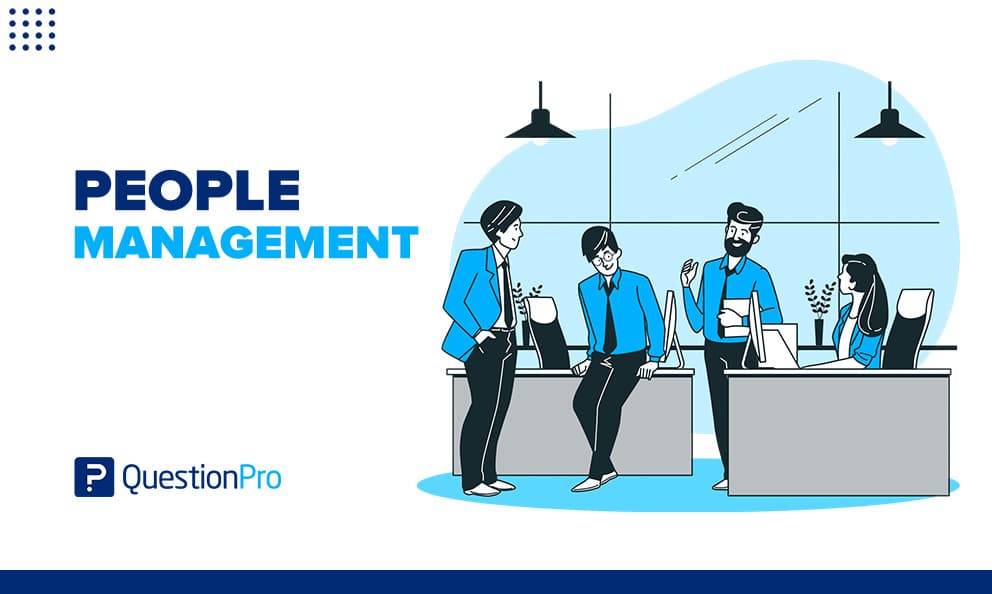
People management is the way managers lead, support, develop, and guide employees so they can do their best work. It is not just about assigning tasks or tracking performance. It covers how managers communicate, build trust, handle conflict, coach employees, recognize progress, and create a workplace where people want to stay.
Good people management matters in every workplace, from small businesses in the USA to global teams. Gallup’s workplace research shows that managers account for a large share of the difference in team engagement, which means the quality of management often shapes how employees feel about their work, their team, and their future at the company.
What does people management mean?
People management means helping employees succeed through clear expectations, regular feedback, trust, coaching, and support. It is the daily practice of managing people, not just projects.
People management includes:
- Hiring and onboarding the right people
- Setting clear goals and expectations
- Giving useful feedback
- Supporting employee development
- Managing performance fairly
- Resolving conflict
- Building trust and accountability
- Listening to employee concerns
- Recognizing strong work
- Helping teams adapt to change
People management is closely connected to human resource management, but they are not the same thing. Human resource management usually refers to broader HR systems such as payroll, compliance, benefits, hiring policies, and workforce planning. People management focuses more on how managers work with employees day to day.
Why is people management important?
People management is important because employees often experience the company through their manager. A strong manager can make work feel clear, fair, and motivating. A weak manager can create confusion, stress, and turnover, even when the company has good pay or benefits.
Strong people management helps organizations improve:
- Employee engagement
- Retention
- Productivity
- Team communication
- Workplace culture
- Employee satisfaction
- Performance consistency
- Conflict resolution
- Trust in leadership
Gallup’s workplace report found that highly engaged business units see better outcomes than low-engagement teams, including higher productivity, stronger customer loyalty, lower absenteeism, and lower turnover in many settings.
For US employers, this matters because labor costs are high, hiring can be slow, and replacing experienced employees often affects team knowledge. People management helps reduce avoidable churn by making the employee experience better before people start looking elsewhere.
How does people management work?
People management works through a cycle of listening, setting expectations, supporting work, measuring progress, and improving based on feedback. It is not a one-time training or annual review process.
A simple people management cycle looks like this:
- Understand the employee’s role.
The manager knows what the employee is responsible for and what success looks like.
- Set clear expectations.
The employee understands goals, deadlines, quality standards, and decision rights.
- Provide support.
The manager removes blockers, shares resources, and helps the employee prioritize.
- Give feedback often.
Feedback is timely, specific, and tied to behavior or outcomes.
- Track performance fairly.
The manager looks at goals, progress, context, and employee input.
- Coach for growth.
The manager helps employees build skills, solve problems, and prepare for future roles.
- Listen and act.
The manager uses employee feedback to improve the way the team works.
This is where tools like an employee feedback platform can support people management. QuestionPro Employee Experience, for example, helps organizations collect employee feedback, run pulse surveys, conduct 360-degree feedback, and view real-time analytics.
What are the key elements of people management?
The key elements of people management are hiring, communication, performance management, development, engagement, conflict resolution, and recognition. Each element supports a different part of the employee experience.
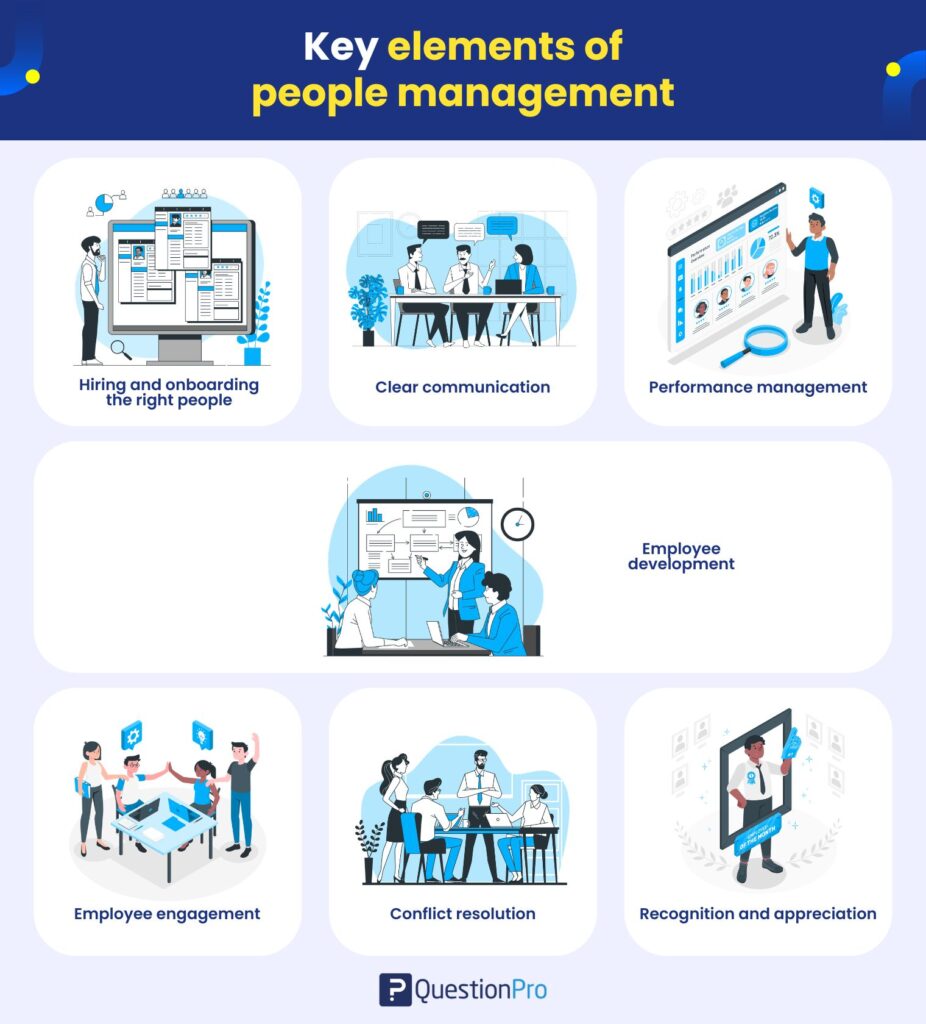
Hiring and onboarding the right people
People management starts before an employee’s first day. Managers need to define the role clearly, hire for skills and values, and help new employees understand how the team works.
A strong onboarding process should answer:
- What is expected in the first 30, 60, and 90 days?
- Who should the employee go to for support?
- How will success be measured?
- What tools, meetings, and workflows matter most?
- How does the role connect to company goals?
Poor onboarding creates confusion early. Strong onboarding gives employees confidence and reduces the time it takes to contribute.
Clear communication
Clear communication is one of the most important people management skills. Employees should not have to guess what matters, what changed, or how their work will be evaluated.
Good managers communicate:
- Priorities
- Deadlines
- Role expectations
- Changes in direction
- Feedback
- Decisions and the reasons behind them
- What is negotiable and what is not
Clear communication is not about talking more. It is about making work easier to understand.
Performance management
Performance management is the process of setting goals, reviewing progress, giving feedback, and helping employees improve. It should not only happen during annual reviews.
Effective performance management includes:
- Specific goals
- Regular check-ins
- Clear feedback
- Documentation of progress
- Fair evaluation standards
- Coaching when performance drops
- Recognition when performance improves
A manager should be able to explain what good performance looks like before judging whether someone has achieved it.
Employee development
Employee development means helping employees build the skills they need for their current role and future opportunities. It can include coaching, training, mentorship, stretch assignments, or career planning.
Managers can support employee development by asking:
- What skill would make your job easier?
- What type of work do you want more exposure to?
- What is blocking your growth?
- What role or responsibility do you want to prepare for?
- What feedback would help you improve faster?
Development does not always require a promotion. Sometimes it means building confidence, improving communication, learning a tool, or taking ownership of a new process.
Also read: What is employee growth & how to promote it
Employee engagement
Employee engagement is the level of connection, motivation, and commitment employees feel toward their work and organization. QuestionPro defines employee engagement as the level of enthusiasm and emotional connection an employee has toward the organization.
People management affects engagement because managers influence everyday work conditions. Employees are more likely to feel engaged when they understand their role, receive feedback, trust their manager, and see that their input matters.
Conflict resolution
Conflict resolution means addressing disagreement before it damages trust, productivity, or morale. Not every conflict is harmful, especially when different opinions lead to better decisions. Different opinions can improve decisions when managers handle them well.
A manager should step in when conflict becomes personal, blocks progress, creates confusion, or makes employees feel unsafe speaking up.
Useful conflict questions include:
- What happened?
- What does each person need to move forward?
- What expectation was unclear?
- What decision needs to be made?
- What behavior should change next time?
The goal is not to prove who is right. The goal is to fix the working relationship and move the work forward.
Recognition and appreciation
Recognition helps employees understand that their work matters. It should be specific, timely, and connected to real contributions.
Instead of saying, “Great job,” a manager can say:
“The way you handled that client issue helped the team avoid delays. You stayed calm, clarified the problem, and followed up quickly.”
Specific recognition works better because it tells the employee what to repeat.
What people management skills do managers need?
Managers need communication, listening, empathy, decision-making, accountability, adaptability, and coaching skills to manage people well.
Communication skills
Managers need to explain expectations, decisions, feedback, and changes clearly. Communication should be direct, respectful, and easy to act on.
A good manager does not hide behind vague phrases like “be more proactive.” They explain what proactive behavior looks like in the role.
Listening skills
Listening helps managers understand what employees are experiencing before making decisions. It also helps catch problems early.
Good listening looks like this:
- Letting the employee finish
- Asking follow-up questions
- Repeating back what you heard
- Not dismissing concerns too quickly
- Separating facts from assumptions
Listening does not mean agreeing with everything. It means taking the input seriously.
Empathy
Empathy means understanding another person’s feelings, context, and point of view. In people management, empathy helps managers respond with fairness instead of frustration.
Empathy is not the same as lowering standards. A manager can care about an employee’s situation and still hold them accountable.
Decision-making
Managers need to make decisions even when they do not have perfect information. Delayed decisions can create stress, duplicated work, and unclear priorities.
Good decision-making includes:
- Listening to the right people
- Reviewing the facts
- Considering risks
- Explaining the decision
- Adjusting when new information proves the decision wrong
Accountability
Accountability means owning outcomes, expectations, and behavior. Managers should hold employees accountable, but they also need to hold themselves accountable.
A manager shows accountability by saying:
- “I should have clarified that sooner.”
- “The goal changed, and I did not communicate it clearly.”
- “Let’s reset expectations.”
- “Here is what needs to happen next.”
Teams trust managers who take responsibility instead of shifting blame.
Adaptability
Adaptability means adjusting your management style when the situation changes. This matters for hybrid teams, remote employees, new technology, and fast-moving business needs.
In the USA, many teams now include a mix of office-based, remote, and hybrid employees. People management has to account for different communication habits, time zones, and work environments.
Adaptable managers focus on outcomes, not just visibility.
Coaching
Coaching means helping employees think through problems, build skills, and improve performance. It is different from simply giving instructions.
A coaching manager asks:
- What have you tried so far?
- What outcome do you want?
- What is getting in the way?
- What option seems most realistic?
- What support do you need from me?
Coaching helps employees become more independent over time.
What are effective people management strategies?
Effective people management strategies include regular one-on-one meetings, clear goals, employee feedback, fair performance reviews, manager training, and recognition.
Use regular one-on-one meetings
One-on-one meetings give managers and employees a consistent space to talk about priorities, blockers, feedback, and growth.
A simple agenda can include:
- What is going well?
- What is blocked?
- What needs a decision?
- What feedback should we discuss?
- What support would help this week?
The meeting should not become only a status update. It should help the employee do better work.
Set clear goals and priorities
Employees perform better when they know what matters most. Managers should define priorities clearly, especially when everything feels urgent.
A useful goal should answer:
- What needs to be done?
- Why does it matter?
- Who owns it?
- When is it due?
- What does good work look like?
- How will progress be checked?
Clear goals reduce rework and prevent avoidable frustration.
Ask for employee feedback
Employee feedback helps managers understand what is working, what is confusing, and what needs to change. Feedback can come from surveys, pulse checks, one-on-one conversations, exit surveys, or 360-degree feedback.
Good people management requires feedback from employees, not only feedback to employees.
Train managers before problems grow
Many employees become managers because they were strong individual contributors. That does not mean they automatically know how to coach, communicate, handle conflict, or run performance conversations.
Manager training should cover:
- Giving feedback
- Running one-on-ones
- Handling conflict
- Setting goals
- Managing remote and hybrid teams
- Supporting employee well-being
- Recognizing bias
- Documenting performance issues
Gallup’s research emphasizes manager hiring and development as a major practice in organizations with stronger engagement cultures.
Recognize progress, not just outcomes
People want to know their effort is seen. Recognition should not be saved only for big wins.
Managers can recognize:
- Improved performance
- Strong collaboration
- Better communication
- Problem-solving
- Customer support
- Consistency
- Learning a difficult skill
- Helping a teammate
Recognition is most effective when it is specific and honest.
What are the pros and cons of people management?
People management helps teams perform better, but it also takes time, training, and consistency. Companies should treat it as a core management responsibility, not an extra task.
Pros of people management
People management can improve:
- Employee engagement
- Retention
- Trust in leadership
- Team performance
- Communication
- Employee development
- Workplace culture
- Conflict resolution
- Manager effectiveness
It also helps organizations spot issues earlier. For example, employee feedback may show that a team is overloaded, unclear on priorities, or missing the tools needed to work well.
Cons of poor people management
Poor people management can cause:
- Low morale
- Higher turnover
- Confusing expectations
- Avoidable conflict
- Burnout
- Weak performance
- Lack of trust
- Low participation in feedback programs
The problem is usually not that managers do not care. Often, they were never trained, they are overloaded, or the company rewards output while ignoring management quality.
Step-by-step guide to better people management
To improve people management, start with clarity, feedback, manager habits, and measurable follow-up.
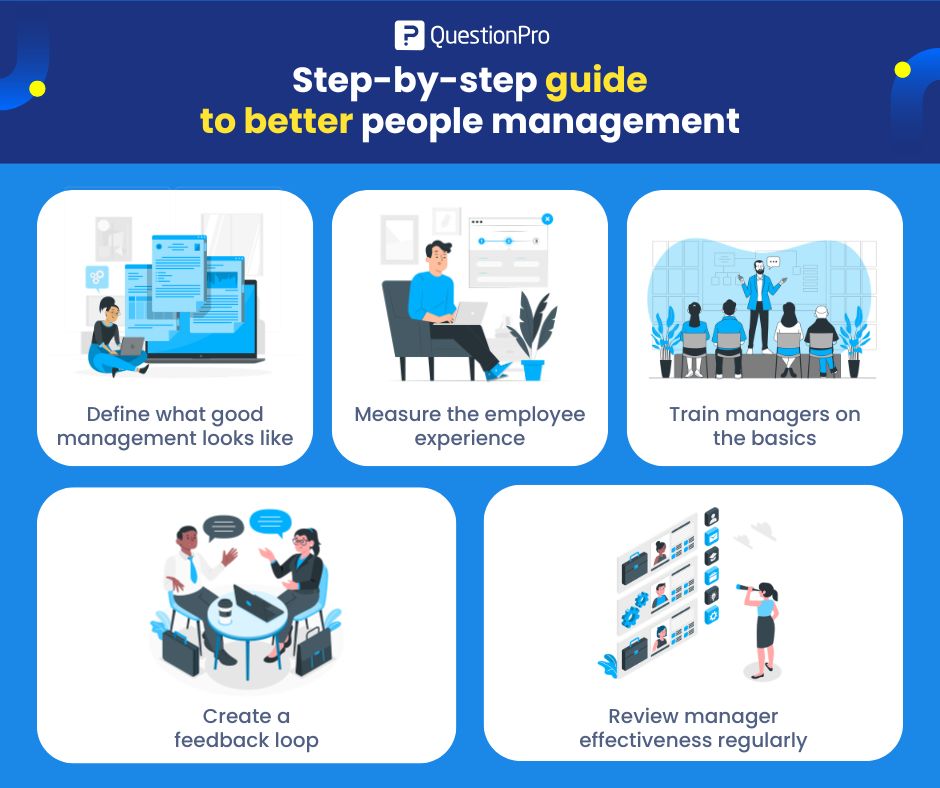
Step 1: Define what good management looks like
Companies should write down what they expect from managers. This can include regular one-on-ones, timely feedback, fair performance reviews, team communication, and employee development.
If the company does not define good management, each manager will invent their own version.
Step 2: Measure the employee experience
Use employee surveys, pulse surveys, and feedback channels to understand how employees experience management.
Ask questions such as:
- I understand what is expected of me at work.
- My manager gives me useful feedback.
- My manager listens to my concerns.
- I have the tools I need to do my job.
- I see opportunities to grow here.
- My work is recognized when I do it well.
These questions help identify patterns across teams, departments, and locations.
Step 3: Train managers on the basics
Start with the daily habits that affect employees most:
- Clear communication
- One-on-one meetings
- Feedback
- Coaching
- Conflict resolution
- Recognition
- Fair performance conversations
Training should include practice, not just slides. Managers need scripts, examples, and support for real situations.
Step 4: Create a feedback loop
After collecting employee feedback, share what was heard, what will change, and what will not change right now.
A simple feedback loop looks like this:
- Ask employees for input.
- Review the results.
- Identify the top issues.
- Share the findings.
- Take action.
- Follow up later.
Employees are more likely to participate when they see that feedback leads to visible action.
Step 5: Review manager effectiveness regularly
Manager effectiveness should be reviewed just like sales, operations, or customer outcomes. That does not mean ranking managers publicly. It means giving managers the information and coaching they need to improve.
Useful signals include:
- Engagement survey results
- Turnover patterns
- Internal mobility
- Absenteeism trends
- 360 feedback
- Team performance
- Employee comments
- One-on-one completion habits
The goal is improvement, not punishment.
How much does people management cost?
People management costs depend on company size, manager training needs, HR tools, and the time managers spend coaching employees. The bigger cost is often poor management, which can show up through turnover, burnout, low engagement, and missed performance goals.
Common people management costs include:
- Manager training programs
- HR or employee experience software
- Employee engagement surveys
- 360 feedback tools
- Coaching or leadership development
- Time spent in one-on-one meetings
- Time spent resolving conflict
- Performance review administration
For a small US business, people management may start with simple manager training, clear goal-setting, and low-cost employee surveys. For larger organizations, it often requires structured programs, analytics, manager dashboards, and dedicated HR support.
How can AI support people management?
AI can support people management by helping teams summarize feedback, identify themes, spot patterns, and reduce manual work. It should support managers, not replace human judgment.
AI can help with:
- Summarizing open-ended employee survey responses
- Identifying common employee concerns
- Grouping feedback by topic
- Drafting manager check-in questions
- Finding patterns across departments
- Creating reports from survey data
- Supporting HR teams with faster analysis
Managers should still make the final call on sensitive issues. Employee feedback can include context, emotions, and workplace dynamics that require human understanding.
AI use in people management should also follow privacy, compliance, and transparency standards, especially for US employers handling employee data. Employees should know how their feedback is collected, analyzed, and used.
What is the difference between people management and performance management?
People management is the full practice of leading and supporting employees. Performance management is one part of people management that focuses on goals, feedback, evaluation, and improvement.
Here is the difference:
| Area | People management | Performance management |
| Main focus | Employee support, communication, engagement, growth, and team health | Goals, feedback, evaluation, and performance improvement |
| Scope | Broad | More specific |
| Timing | Daily and ongoing | Ongoing, with formal review points |
| Owner | Managers, HR, and leadership | Managers and HR |
| Example | Coaching an employee through a role change | Reviewing whether quarterly goals were met |
Both are connected. Performance management works better when people management is already strong.
What is the difference between people management and employee management?
People management and employee management are often used in similar ways, but people management usually has a more human and leadership-focused meaning. Employee management can sound more administrative.
People management focuses on:
- Trust
- Communication
- Development
- Engagement
- Coaching
- Team culture
Employee management may include:
- Scheduling
- Attendance
- Compliance
- Policies
- Records
- Role assignments
- Performance tracking
A healthy workplace needs both. Administrative systems keep work organized, while people management helps employees perform and grow.
What is the difference between people management and team management?
People management focuses on individual employees and how they are supported. Team management focuses on how the group works together.
People management includes individual feedback, coaching, development, and support. Team management includes team goals, collaboration, meeting habits, communication norms, and group accountability.
For example:
- People management: “How can I help this employee grow?”
- Team management: “How can this group work better together?”
Managers need both skills because strong individual performance does not always create a strong team.
What are common people management mistakes?
Common people management mistakes include unclear expectations, delayed feedback, micromanagement, avoiding conflict, and treating every employee the same.
- Giving feedback too late
Feedback loses value when it comes weeks or months after the issue. Employees need feedback while they can still use it.
- Micromanaging
Micromanagement reduces trust and slows work. Managers should clarify outcomes, then give employees room to complete the work.
- Avoiding hard conversations
Avoiding conflict usually makes it worse. A respectful, direct conversation early is better than a frustrated conversation later.
- Treating everyone the same
Fair does not always mean identical. Employees may need different support depending on experience, role, workload, location, or personal context.
- Ignoring employee feedback
Asking for feedback and doing nothing with it can damage trust. If a company asks, it should be ready to respond.
How can US companies improve people management?
US companies can improve people management by training managers, listening to employees, supporting hybrid work clearly, and making manager quality part of business performance.
Practical actions include:
- Train new managers before they lead a team.
- Create a clear manager handbook.
- Use employee pulse surveys to catch issues early.
- Give managers simple dashboards, not overwhelming reports.
- Build fair performance review processes.
- Recognize managers who build healthy teams.
- Support remote and hybrid employees with clear communication rules.
- Review turnover and engagement by team, not only company-wide.
US workplaces often include different generations, work styles, cultures, and employment expectations. Good people management helps create consistency without removing flexibility.
Also learn: What is employee training & its types
How does employee feedback improve people management?
Employee feedback improves people management by showing managers what employees are actually experiencing. It helps leaders move from assumptions to evidence.
Employee feedback can reveal:
- Whether expectations are clear
- Whether managers are communicating well
- Whether employees feel supported
- Whether workload is sustainable
- Whether employees see growth opportunities
- Whether recognition feels fair
- Whether people trust leadership
Feedback is most useful when it is collected regularly and reviewed by the people who can act on it. That includes managers, HR leaders, and senior leadership.
QuestionPro Employee Experience supports this process with employee surveys, 360-degree feedback, pulse surveys, and real-time analytics that help organizations understand employee experience and take action.
Final takeaway
People management is not about controlling every detail of work. It is about creating the conditions where employees understand what is expected, feel heard, receive useful feedback, and have the support to grow.
The strongest managers are clear, consistent, honest, and willing to listen. They set standards without losing empathy, recognize strong work without ignoring problems, and help employees succeed while keeping the team focused on business goals.
For organizations, better people management starts with better listening. When managers have reliable employee feedback and clear action plans, they can build stronger teams, reduce avoidable friction, and create a workplace where people are more likely to stay and do their best work.
People management FAQs
People management means guiding, supporting, and developing employees so they can do their work well. It includes communication, feedback, coaching, trust, accountability, and employee development.
The most important people management skills are communication, listening, empathy, accountability, coaching, decision-making, adaptability, and conflict resolution. These skills help managers support employees while keeping work clear and focused.
No. HR manages broader systems such as hiring policies, benefits, compliance, payroll, and workforce planning. People management is the day-to-day work of leading employees, usually done by managers with support from HR.
People management matters in the USA because many employers face high labor costs, hybrid work challenges, competitive hiring markets, and retention pressure. Strong managers can reduce avoidable turnover and improve the employee experience.
A manager can improve quickly by holding regular one-on-ones, clarifying expectations, giving timely feedback, listening without interrupting, recognizing good work, and asking employees what support they need.
People management tools include employee feedback software, engagement survey platforms, 360-degree feedback tools, performance management systems, HRIS platforms, and workforce analytics tools. The right tool depends on company size, goals, and how often leaders act on employee feedback.