Why look for a SurveyMonkey alternative in India in 2026?
SurveyMonkey has held a dominant position in the online survey market since 1999. Its user-friendly survey tool interface, extensive survey templates, and broad applicability for surveys, quizzes, and polls have made it the default starting point for countless teams. Even in 2026, many organisations in India still reach for SurveyMonkey when they need to create surveys quickly.
But workflows evolve, and so do expectations. In India, this evolution is particularly acute. The country’s research and feedback landscape presents challenges that many global survey tools were not originally built to handle: 22 officially recognised languages, large rural and semi-urban respondent segments that often require offline CAPI fieldwork, a smartphone-first but bandwidth-constrained internet population, and the Digital Personal Data Protection Act (DPDP Act), 2023, which governs how organisations collect, process, and manage digital personal data of Indian respondents. A platform that works adequately for a European market research agency may not always fit a pan-India study spanning metros, tier-2 cities, and rural markets simultaneously.
In this blog, we’ll learn bout 13 concrete SurveyMonkey alternatives, including Qualtrics, Typeform, Google Forms, and Jotform, that address the gaps many Indian teams encounter as they scale or require more advanced capabilities.
Common pain points driving teams away from SurveyMonkey in 2026 include free plan limitations, pricing that escalates quickly once you need advanced features and converts to a significant INR outlay for Indian teams with modest budgets, customization constraints that limit branded experiences, and reporting complexity that frustrates non-experts. Data collection needs have also evolved: privacy regulations like the DPDP Act, alongside GDPR and CCPA for global studies, require survey software with stronger data security controls, clear consent mechanisms, and transparent data handling practices.
This article focuses on survey tools that improve data quality, usability, and cost-efficiency, especially for teams working on customer experience programmes, product feedback loops, and market research projects in India. Whether you need a robust survey platform with enterprise-grade security or a simple free tool for quick polls, you’ll find options here.
Who will benefit from this guide:
- Indian startups needing affordable survey tools without breaking the budget
- Enterprises in BFSI, pharma, and IT services requiring HIPAA, DPDP Act, or GDPR-aligned data handling and advanced analytics
- Educators at IITs, IIMs, and state universities looking for free tools with minimal learning curve
- Market research agencies managing customer feedback across multiple clients, from pan-India FMCG studies to regional rural surveys
- D2C brands and consumer internet companies building continuous product feedback loops
Top SurveyMonkey alternatives in India at a glance
Before looking at the detailed breakdowns, here’s a cheat sheet to help you shortlist the right tool fast. India pricing is shown in INR where available; USD figures apply where local pricing has not been published. Pricing and plan limits can change, so teams should confirm current details directly with each vendor before purchase.
| Tool | Best For | Free Plan | Starting Paid Price (2026) | Notable Strengths |
|---|---|---|---|---|
| Qualtrics | Enterprise CX/EX | No | Custom | iQ predictive intelligence, HIPAA/GDPR |
| Typeform | Marketing engagement | Yes, limited | From around ₹2,400/month | Conversational UI, strong mobile experience |
| Jotform | Flexible form building | Yes, limited | From around ₹2,000/month | 10,000+ templates, payment integration |
| Google Forms | Quick polls/education | Yes | Free | Zero cost, Google Sheets export |
| Zoho Survey | SMBs using Zoho stack | Yes, limited | From around ₹1,650/month | Real-time cross-tabs, Zoho CRM sync |
| SurveySparrow | CX/HR engagement | Yes, limited | From around ₹1,600/month | Chat-like UI, CX and EX workflows |
| Alchemer | Research and workflows | No | USD pricing, varies by plan | 400+ integrations, MaxDiff/Conjoint |
| QuestionPro | Research-grade surveys | Yes, limited | From around ₹6,900/month | NLP sentiment, CAPI, Indian language support, compliance-ready workflows |
| Survicate | In-product feedback | Yes, limited | Volume-based | AI text analysis, product analytics |
| Formstack | Workflow automation | No | USD pricing, varies by plan | E-signatures, document generation |
| HubSpot Forms | CRM lead capture | Yes, basic | Marketing Hub pricing | Progressive profiling, CRM workflows |
| LimeSurvey | Self-hosted/privacy | Yes, open-source | Cloud plans available | Full data control, custom themes |
| SmartSurvey | UK/EU security focus | Yes, limited | Tiered plans | ISO27001, AI sentiment analysis |
How to use this table:
- If you need enterprise compliance, predictive analytics, and support for Indian languages and CAPI fieldwork, start with QuestionPro or Qualtrics.
- If you need a quick free tool for internal polls, classroom surveys at Indian universities, or MSME-scale feedback, start with Google Forms or LimeSurvey.
- If customer satisfaction and engagement are priorities for your D2C brand or BFSI product, consider SurveySparrow or Typeform.
- If you’re already in the Zoho ecosystem, which is common among Indian SMBs and mid-market companies, Zoho Survey offers seamless integration with local pricing.
Why teams in India move away from SurveyMonkey
SurveyMonkey remains a strong option for basic polling and simple feedback collection. However, it may not fit every 2026 workflow, especially for scaling Indian companies that need AI-powered insights, multilingual reach, mobile-first distribution, and clearer compliance controls.
Complex UI for non-experts.
SurveyMonkey’s interface can feel dated and overwhelming when you need advanced logic or sophisticated survey design. Indian teams managing multi-language surveys across Hindi, Tamil, Telugu, and Bengali respondents, or building complex CX programmes for BFSI clients, may face a steeper learning curve when moving beyond basic question types.
Limited reporting on lower tiers.
Without premium upgrades, reporting may lack depth in text analytics and predictive insights. Getting meaningful insights from open-ended responses, particularly important in India’s high-context communication culture where qualitative nuance carries significant weight, can require manual work or plan upgrades that include sentiment analysis and role-based dashboards.
Pricing that balloons quickly.
The free plan’s constraints can push teams toward paid plans when response volume, exports, or advanced logic become important. For Indian teams, USD-based pricing can become a significant INR outlay, especially when multiple users or departments need access.
Customization limits.
Creating personalized surveys with your own branding, themes, and design often requires plan upgrades. The rigid template structure can frustrate teams wanting conversational or heavily branded experiences, particularly D2C brands and ed-tech companies in India that invest heavily in distinct brand identities.
Data control and privacy considerations.
With no self-hosting option, SurveyMonkey may not meet every organisation’s internal data governance needs. Under the DPDP Act, Indian organisations need clear consent practices, purpose disclosure, data retention controls, and vendor transparency. Regulated sectors such as BFSI, healthcare, and pharma should confirm data handling, storage, and cross-border transfer practices with any survey platform before deployment.
No native WhatsApp-first survey distribution.
WhatsApp is a dominant professional and consumer communication channel in India. SurveyMonkey does not offer native WhatsApp survey distribution as a core strength. Platforms that support WhatsApp, SMS, mobile-first links, and offline collection can be more practical for Indian B2B and B2C feedback programmes.
You should seriously consider an alternative if:
- Your response volume regularly exceeds the limits of your current plan.
- You need CRM automation to create dynamic workflows from survey data in Salesforce, HubSpot, or Zoho CRM.
- You prioritize conversational or mobile UX, which is critical for India’s smartphone-first survey population.
- You require research methods like conjoint analysis or MaxDiff for pricing and product research.
- You must meet stricter internal data governance, DPDP Act readiness, or sector-specific compliance expectations.
- You need multilingual survey support covering Hindi, Tamil, Telugu, Marathi, Bengali, Gujarati, and other Indian languages.
13 best SurveyMonkey alternatives and competitors in India in 2026
Each alternative below includes typical use cases, standout features for 2026, and practical pricing guidance with INR equivalents where available. The order isn’t a ranking. We’ve structured this to cover enterprise tools first, then mid-market and SMB solutions, followed by free and lightweight options.
Qualtrics
Qualtrics stands as the enterprise-grade SurveyMonkey alternative for large organisations, universities, and regulated industries. In India, it is relevant for large IT services firms, multinational FMCG companies conducting pan-India brand tracking studies, and business schools or universities running academic research that requires enterprise-grade statistical rigour. It is designed for teams managing customer experience (CX), employee experience (EX), product research, and academic research programmes at scale.

What distinguishes Qualtrics is its iQ engine for predictive intelligence and advanced text analytics. The platform handles sophisticated survey logic, sampling methodologies, and data analysis workflows that go far beyond what mid-market tools offer. For teams conducting serious market research, the depth of actionable insights available is substantial.
Security and compliance are core strengths. Qualtrics supports major compliance requirements such as GDPR, CCPA, HIPAA, and SOC 2. Indian enterprise teams in regulated sectors should verify current DPDP Act readiness, contractual safeguards, and data residency options directly with Qualtrics before deployment.
Pricing is custom and sales-contact only, typically involving large annual contracts. There’s no free plan, and this is not a tool for small teams or budget-constrained Indian startups.
Best for: Large Indian enterprises and MNC Indian subsidiaries needing end-to-end experience management and advanced capabilities, not just simple surveys.
Alchemer, formerly SurveyGizmo
Alchemer bridges the gap between survey tool and feedback operations platform, appealing to power-users who need flexibility without building from scratch. It is suited for both mid-market and enterprise teams that have dedicated research or CX staff. In the Indian context, this typically means market research agencies with technical analysts, and CX programme teams at large BFSI institutions or consumer internet companies.
The platform’s key features include advanced reporting and analytics, workflow automation, and over 400 integrations with CRMs, helpdesks, and marketing tools. For product and pricing research, Alchemer offers MaxDiff and conjoint analysis, methods used by FMCG companies, telecom brands, and market research agencies to model consumer preference trade-offs for new product launches, price point testing, and pack design studies.
Team plans in 2026 typically start in the low hundreds of dollars per month. Compared to SurveyMonkey, Alchemer is more customizable and integrated but comes with a steeper learning curve. Its USD pricing can also be a deterrent for price-sensitive Indian teams compared to locally priced alternatives.
Best for: Research and CX teams at Indian MNCs and large enterprises needing workflow automation alongside robust survey features, particularly where conjoint or MaxDiff research methodology is required.
SurveySparrow
SurveySparrow’s conversational UI sets it apart from traditional grid-style questionnaires. The chat-like format is particularly useful for India’s mobile-first users, who are familiar with messaging-style interactions and may find traditional form-based surveys less engaging.
The platform covers surveys, CX programmes, reputation management, ticketing, and 360-degree employee assessments for HR teams. In Indian IT services and BPO companies, where 360-degree appraisals and employee experience measurement are common HR practices, SurveySparrow’s combined CX and EX capability can reduce the need for separate tools. In 2026, its AI-driven capabilities include insights, sentiment analysis, and automated data summarisation.
Multi-channel distribution spans email, web, mobile, and chat. This is important for reaching respondents in India’s mid-market and SMB segments. Built-in templates for NPS, CSAT, and CES surveys make it an effective tool for Indian teams building structured CX measurement programmes.
Individual plans start around ₹1,600/month, with team and CX-specific plans available at higher tiers. Teams should confirm current response limits and feature access before purchase.
Best for: CX teams at Indian consumer brands, HR departments at IT services companies, and D2C brands wanting both survey collection and action management in one platform.
QuestionPro
QuestionPro is a strong SurveyMonkey alternative for Indian organisations requiring research-grade survey capabilities combined with features suited to India’s research environment. It is a practical fit for Indian market research agencies, FMCG companies, BFSI institutions, academic researchers, and corporate CX teams that need multilingual surveys, offline collection, and advanced analytics.
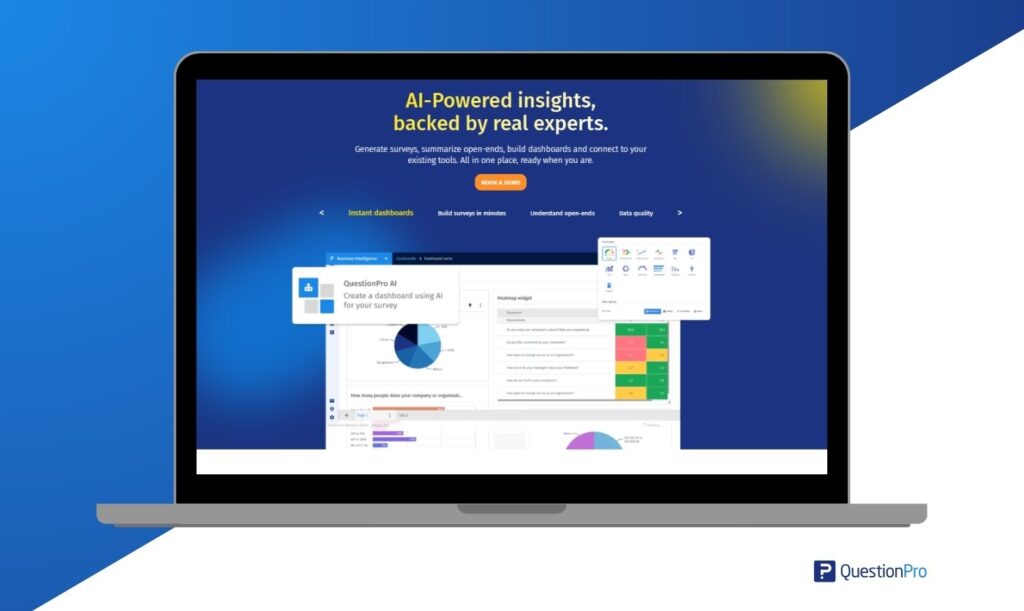
What sets QuestionPro apart in the Indian market is not just feature depth but operational fit. The platform offers:
- Indian language support: Hindi, Tamil, Telugu, Marathi, Bengali, Gujarati, Kannada, Malayalam, and more, with regional script rendering for mobile respondents.
- Offline CAPI mode: Enables fieldwork in rural India and tier-2 or tier-3 cities without constant internet connectivity, with sync when connectivity is restored.
- Compliance-ready workflows: Supports consent collection, purpose-of-data-processing disclosure, data handling controls, and enterprise security practices that help Indian teams prepare for DPDP Act requirements.
- Mobile-first survey design: Responsive layouts for smartphone respondents, including entry-level Android devices commonly used across tier-2 and rural India.
- TextAI: NLP-powered sentiment analysis and keyword extraction from open-ended responses, useful for processing qualitative feedback at scale.
- InsightsHub: A centralised research repository enabling longitudinal analysis across multiple study waves.
- Advanced research methods: Conjoint analysis, MaxDiff, driver analysis, and segmentation tools for FMCG product research, pricing studies, and brand tracking.
- CRM integrations: Salesforce, HubSpot, Zoho CRM, and MS Dynamics for closed-loop CX feedback workflows.
- Security and compliance support: HIPAA, GDPR, CCPA, and DPDP Act-ready workflows across relevant editions.
Compliance support matters for the regulatory landscape Indian organisations must navigate: DPDP Act readiness for Indian respondent data, HIPAA for healthcare and diagnostics clients, and GDPR for studies involving EU respondent populations. This combination is valuable for market research agencies serving multinational clients from Indian delivery centres.
Research plans start around ₹6,900-7,500/month in 2026, with custom enterprise and agency tiers for larger deployments. The 350+ survey templates, including CSAT, NPS, CES, employee pulse, and product feedback templates, allow teams to deploy professional-grade surveys without starting from scratch.
Best for: Indian market research agencies, FMCG and consumer goods companies conducting multilingual pan-India studies, BFSI CX teams, academic researchers at Indian universities, and organisations that need DPDP Act-ready data collection with offline field capability.
Zoho Survey
Zoho Survey fits naturally for the large base of Indian businesses already using Zoho CRM, Desk, or Campaigns. Zoho Corporation is a Chennai-headquartered company, and its SMB-friendly pricing and local support have made the Zoho ecosystem widely adopted across India’s MSME and mid-market segments. Survey data flows directly into CRM contact records and support tickets without manual exports, reducing the data plumbing complexity that slows feedback utilisation at smaller teams.
Compliance coverage includes GDPR, CCPA, SOC 2, and HIPAA. Indian organisations should confirm DPDP Act readiness and data residency options directly with the Zoho team, particularly for studies involving identifiable consumer data. The drag-and-drop interface allows question logic, branding, and theme adjustments through fonts, images, and colours.
Real-time reporting, cross-tabulation, and easy export to Zoho Sheets give teams immediate access to performance metrics. The free plan includes basic features, making it a viable entry point for Indian startups and SMEs doing initial customer feedback without heavy tool investment.
Paid plans start from approximately ₹1,650/month in 2026, representing competitive pricing relative to globally-priced alternatives.
Best for: Indian SMBs and mid-sized companies already operating in the Zoho ecosystem wanting tightly integrated survey data within their CRM and operations stack, at INR pricing that matches Indian budget realities.
Typeform
Typeform focuses on visually engaging, conversational surveys that feel like a dialogue rather than a static questionnaire. This approach can be effective for India’s mobile-first population, especially urban digital consumers who are comfortable with conversational interfaces.
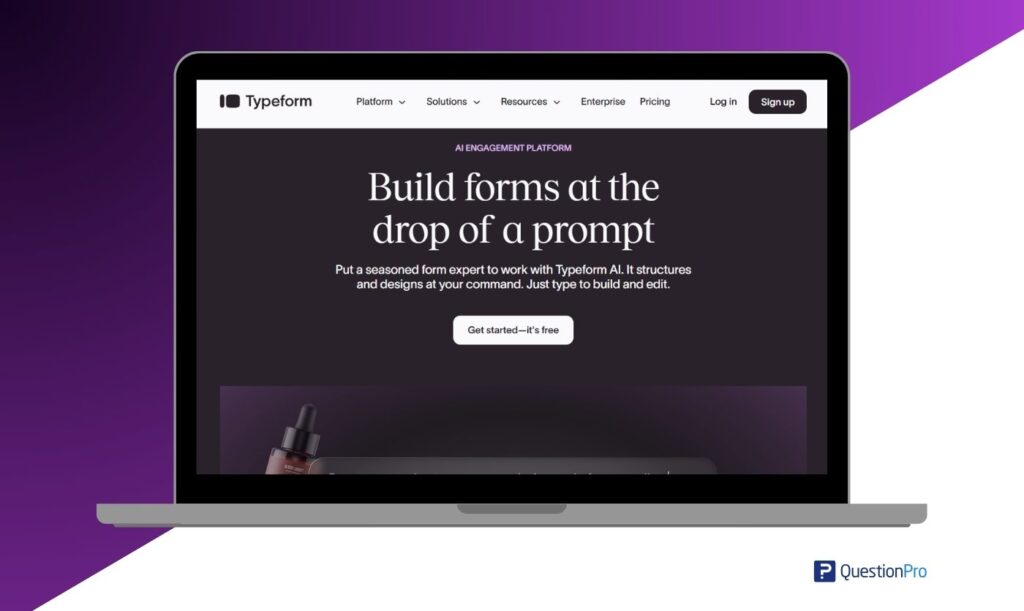
In 2026, Typeform includes AI-assisted question suggestions, personalized follow-up logic, and extensive design customisation with images, video, and custom fonts. Indian D2C brands, ed-tech platforms, and consumer-facing startups often use tools like Typeform for lead generation, onboarding flows, and post-purchase feedback, where engaging design can improve completion rates among brand-aware urban audiences.
Integrations with HubSpot, Slack, Notion, and Google Sheets enable easy data routing. The free tier limits responses and questions, with paid plans starting in the ₹2,400-3,000/month range. Typeform does not natively focus on offline CAPI mode, limiting its applicability for studies that extend beyond digitally connected urban India.
Best for: Lead generation, onboarding flows, product feedback, and interactive quizzes for Indian D2C brands, consumer startups, and marketing teams reaching digitally active urban audiences.
Jotform
Jotform serves as a highly flexible form and survey builder with over 10,000 templates and a large widget library. The platform handles both form creation and survey collection with equal capability. In India, it is useful for event management companies, educational institutions, and organisations needing payment-integrated forms, for example, collecting registrations alongside payment processing for professional conferences, training programmes, and community events.
The drag-and-drop interface supports conditional logic and skip logic, plus payment integrations with PayPal, Stripe, Razorpay, and other processors alongside survey questions. Razorpay integration is particularly relevant for Indian organisations collecting fees or contributions alongside feedback. Mobile apps and offline-capable Mobile Forms support fieldwork at events where internet connectivity is unreliable.
Compliance options include HIPAA-ready forms for healthcare organisations, relevant for Indian hospitals and diagnostics chains collecting patient feedback, with enterprise-grade security features available on higher tiers. The free plan offers limited submissions and storage, with paid plans scaling from approximately ₹2,000/month.
Best for: Indian teams needing versatile form building with payments, offline collection, and healthcare compliance, including event organizers, educational institutions, and hospital feedback programmes.
Formstack
Formstack extends beyond surveys into full workflow and document automation. It is built for operations-heavy teams where form submission triggers downstream processes rather than just capturing feedback. In India, this profile fits large enterprise back-office operations, HR onboarding in IT services companies, vendor onboarding in manufacturing, and patient intake in hospital chains, where manual data entry into multiple downstream systems creates process overhead.
Key capabilities include a no-code form builder, workflow automation, e-signatures, and document generation. Teams use Formstack to reduce manual data-entry processes and approvals. Common use cases span HR onboarding at large IT services firms, healthcare intake at multi-specialty hospitals, financial applications at NBFCs, and internal approvals at conglomerate operations teams.
Starter plans in 2026 fall in the USD pricing range. Formstack’s USD pricing is a consideration for Indian teams evaluating total cost of ownership relative to locally-priced process automation tools.
Best for: Indian enterprises needing process automation and document workflows in addition to collecting feedback, particularly IT services, BFSI back-office, and healthcare administration functions.
HubSpot Forms
HubSpot Forms serves as a natural SurveyMonkey alternative for Indian teams already invested in HubSpot CRM or Marketing Hub. This is a growing segment as India’s B2B SaaS, IT services, and consulting companies scale their inbound marketing operations. Forms and simple surveys feed directly into contact records, lists, and workflows for nurturing and sales follow-up, making it particularly useful for B2B customer feedback that needs to flow into the sales pipeline.
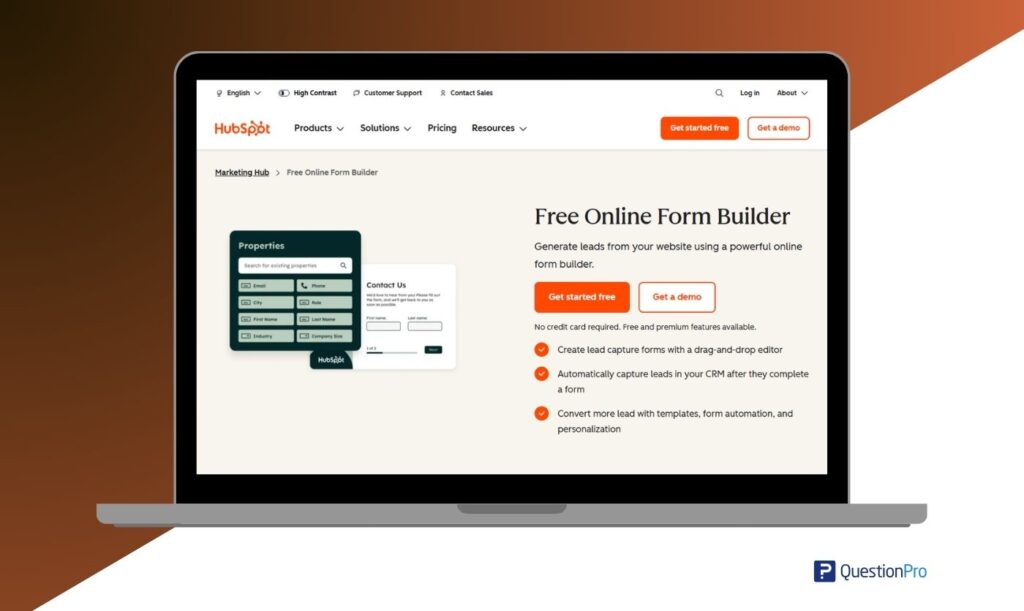
The drag-and-drop builder includes progressive profiling and personalisation tokens to tailor questions to known leads. Basic forms are available on the free CRM tier. More advanced features, including advanced customisation and branching logic, unlock on paid Marketing Hub tiers.
Best for: Lead capture, demo requests, event registration, and simple satisfaction surveys tied to sales pipelines for Indian B2B SaaS and IT services companies running HubSpot. HubSpot Forms is less suited to deep research projects, multilingual studies, or field research compared to dedicated survey platforms.
Survicate
Survicate targets digital products, SaaS applications, and websites with its feedback solution. It is designed to capture feedback exactly where users experience your product, a use case highly relevant for India’s large and fast-growing SaaS ecosystem across Bengaluru, Hyderabad, Pune, Chennai, and other tech hubs.
The platform offers in-product surveys, website popups, email surveys, and templates for NPS, CSAT, and CES that can be deployed at specific touchpoints in the user journey without disrupting the experience. For Indian SaaS product teams managing global user bases, Survicate’s ability to segment feedback by geography, user tier, and in-product behaviour is valuable for separating India-market signals from global noise.
The AI-powered survey builder and qualitative text analysis features help teams process open-ended responses efficiently. Common integrations include HubSpot, Intercom, Mailchimp, Google Analytics, and product analytics tools for closed-loop feedback workflows. Pricing includes a free tier with response limits, with paid packages scaling by monthly responses and channels.
Best for: Product managers and UX teams at Indian SaaS companies needing continuous feedback loops embedded directly into the user journey, particularly for global product development informed by India-market usage patterns.
Google Forms
Google Forms remains the simplest free SurveyMonkey alternative for individuals, teachers, nonprofits, and small teams. In India, it is common in the education sector, including schools, coaching institutes, colleges, and university research programmes for assignment submissions, workshop registrations, and preliminary academic surveys. Anyone with a Google account gets instant access to create surveys at zero cost.
Core capabilities include multiple choice and other question types, basic branching logic, built-in charts, and seamless exports to Google Sheets for additional analysis. The strong adoption of Gmail and Google Workspace among Indian students, professionals, and SMBs ensures respondents can access Google Forms without additional sign-ups or app downloads.
Limitations are real: basic design options, limited advanced analytics, no offline CAPI mode, and limited support for compliance workflows compared with dedicated survey platforms. Manual translation can support Indian languages, but large multilingual studies may need stronger controls for localisation, quality checks, and reporting.
Typical Indian usage includes classroom quizzes, quick internal polls within Google Workspace-enabled organisations, event RSVPs, and small-scale feedback surveys at NGOs and community organisations. Storage counts against your Google account’s available storage.
Best for: Indian educators, NGO workers, MSME operators, and individuals who prioritise speed and zero cost over deep analytics, compliance workflows, and multilingual field capability.
LimeSurvey
LimeSurvey operates as an open-source survey platform favoured by universities, public institutions, and technical teams with specific privacy requirements. In India, its self-hosting option is particularly relevant for government research bodies, public sector undertakings (PSUs), defence-affiliated research organisations, and academic institutions operating under IT security policies that restrict third-party cloud data storage. The ability to control exactly where survey data lives can be important in these contexts.
Extensive customisation includes custom themes, question types, and advanced logic for complex research designs. Indian government agencies and academic institutions that need to demonstrate tighter control over survey infrastructure can use LimeSurvey to host surveys within their own approved environment.
A hosted LimeSurvey Cloud option exists for teams that don’t want to manage servers. Trade-offs are clear: greater flexibility and privacy in exchange for more setup and maintenance effort. IT support or technical comfort is required to maximise the platform’s potential, which may be realistic for government IT teams and university computing centres but a barrier for smaller organisations.
Best for: Indian government agencies, PSUs, defence-affiliated research bodies, academic institutions, and technically capable teams with strict data control requirements who need open-source software with full control over data infrastructure.
SmartSurvey
SmartSurvey is a UK-based SurveyMonkey alternative with strong focus on security, compliance, and customer feedback workflows. Certifications include ISO27001 and Cyber Essentials Plus. While its primary market is the UK and EU, SmartSurvey is relevant for Indian organisations that operate in British and European markets, including Indian IT services companies with UK clients, Indian pharmaceutical companies conducting EU-facing research, and Indian conglomerates with European subsidiaries where UK/EU data handling requirements may be contractual obligations.
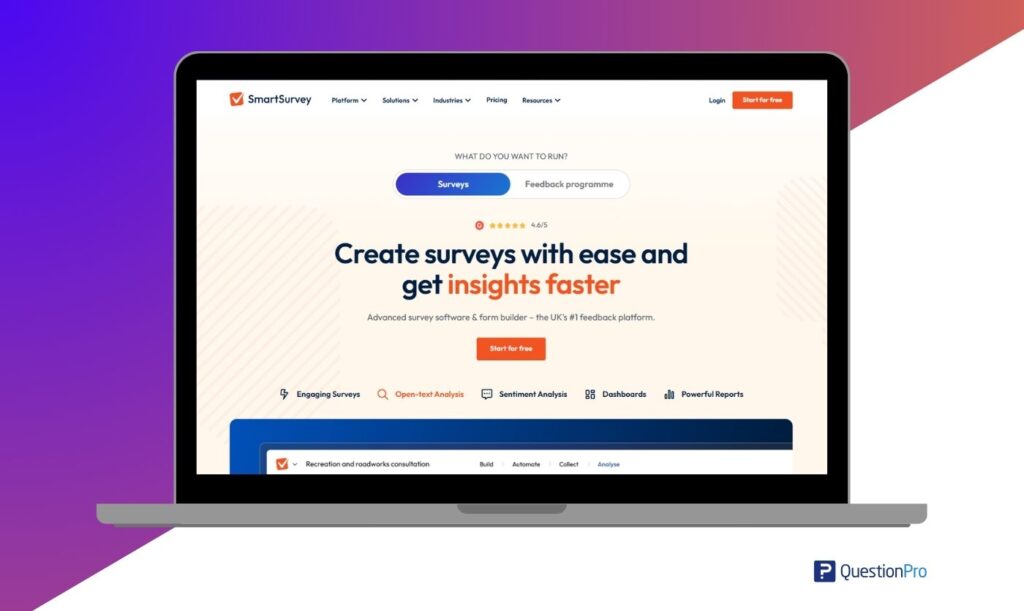
AI-powered sentiment analysis and thematic categorisation speed up open-text feedback review. Built-in case management features allow teams to assign, track, and close feedback-related actions, turning customer satisfaction measurement into operational improvements rather than just reports. Secure UK/EU data hosting can address sovereignty requirements for European client data that some platforms cannot guarantee.
Best for: Indian IT services and professional services firms with UK/EU clients requiring ISO27001-compliant survey data handling and UK-based or EU-based data residency as a contractual condition.
How to choose the right SurveyMonkey alternative in India
No single platform is “best” for everyone. The right choice depends on your goals, budget, technical maturity, and, in India, the specific operational and regulatory requirements your research programme must meet.
Use this simple four-step framework:
- Define goals: Are you focused on CX measurement, market research across Indian languages, lead generation, HR pulse surveys, or internal operations?
- List must-have features: Do you need advanced logic, AI analytics, DPDP Act readiness, WhatsApp or SMS distribution, offline CAPI for rural fieldwork, or multilingual support?
- Set budget: What can you invest monthly or annually in INR? Include hidden costs like per-response charges, add-ons, plan limits, and compliance review.
- Test 2-3 tools: Run real surveys on your shortlist before committing long-term.
Shortlist by segment:
- Enterprise CX and research suites: Qualtrics, QuestionPro Research Suite
- Mid-market CX and feedback: SurveySparrow, QuestionPro, Survicate
- India SMB and Zoho ecosystem: Zoho Survey
- Form and workflow automation: Formstack, Jotform
- Free and lightweight: Google Forms, LimeSurvey
Must-ask questions checklist:
- What integration requirements do you have: Salesforce, HubSpot, Zoho CRM, SAP, or MS Dynamics?
- Where will your data be stored and processed? Confirm storage, transfer, and vendor obligations with every platform.
- What languages must your survey support? If your respondent base includes non-English-speaking consumers in tier-2 cities or rural India, this is non-negotiable.
- Do you need WhatsApp, SMS, or mobile-first distribution to reach India’s respondent population effectively?
- Do you need offline CAPI capability for rural and tier-2 fieldwork?
- What compliance certifications or controls are required: HIPAA for healthcare, DPDP Act readiness for Indian respondent data, SOC 2, or ISO 27001?
- What’s your expected monthly or annual response volume?
- How technical is your team? Can they handle setup complexity?
Take advantage of free trials and freemium tiers. Run at least one live survey on each candidate tool before committing.
Key evaluation criteria when comparing SurveyMonkey alternatives in India
Beyond simple feature lists, these criteria separate adequate survey tools from platforms that deliver lasting value. In India’s research and feedback landscape, several of these criteria carry additional weight that generic tool-comparison guides rarely address.
1. Pricing varies significantly across models.
Some platforms charge per seat, others per response, and many use usage-based tiers. Watch for hidden costs: tools priced in USD can represent a significant INR outlay once volume and features scale. For Indian teams evaluating total cost of ownership, locally-priced tools like QuestionPro, Zoho Survey, and SurveySparrow can offer more predictable budgeting.
2. Advanced capabilities differentiate basic polling tools from research platforms.
Look for AI analytics, advanced research methods, and automation features that eliminate manual work. For Indian market research agencies and FMCG companies, multilingual support, CAPI mode, and India-specific fieldwork needs matter as much as statistical features.
3. User experience impacts adoption and completion rates.
Prioritise intuitive builders, clear reporting dashboards, and mobile-friendly surveys. Given that many Indian survey respondents complete surveys on smartphones, often entry-level Android devices on variable networks, mobile-first design is a core user experience requirement, not an optional enhancement. Conversational formats can help improve completions, particularly among younger, messaging-native audiences.
4. Integrations and ecosystem determine how survey data flows into your stack.
Evaluate whether out-of-the-box connectors cover your CRM, helpdesk, and marketing platforms, including Zoho CRM, Freshdesk, and Indian-origin tools that many global survey platforms may not prioritize. QuestionPro’s integrations with Power BI, Tableau, Salesforce, HubSpot, and Zoho CRM cover many common enterprise stacks used by Indian organisations.
5. Security and compliance is non-negotiable.
In India’s 2026 regulatory environment, DPDP Act readiness, including consent collection, purpose disclosure, retention controls, and vendor transparency, is important for any survey involving identifiable Indian respondents. Add HIPAA for healthcare, GDPR for EU-facing studies, and SOC 2 or ISO 27001 for regulated industry clients. Self-hosting, as offered by LimeSurvey, provides maximum control for organisations that cannot use cloud-hosted platforms. Always verify current certifications and data handling terms directly with vendors before deploying in regulated environments.
Find the SurveyMonkey alternative that fits India’s 2026 research needs
The SurveyMonkey alternative landscape in 2026 spans enterprise suites like Qualtrics and QuestionPro, mid-market tools like SurveySparrow, and free options like Google Forms and LimeSurvey. Each serves distinct needs. There is no universal “best” choice, and this is especially true in India’s uniquely complex research environment.
For Indian organisations, platform selection carries dimensions that generic global tool comparisons often underweight: DPDP Act readiness, multilingual survey capability across Indian languages, offline CAPI for tier-2 and rural fieldwork, WhatsApp or SMS-friendly distribution for mobile-first respondents, and INR pricing that reflects Indian budget realities rather than converted USD rates. A platform that ticks every feature box for a US enterprise team may still be operationally unfit for a pan-India study that requires Hindi, Tamil, and offline rural data collection simultaneously.
Your ideal platform depends on primary use cases. Enterprise CX programmes may demand Qualtrics’ predictive intelligence or QuestionPro’s India-focused research capabilities. Research agencies managing multilingual FMCG and BFSI studies benefit from QuestionPro’s CAPI, multilingual, and compliance-ready stack. Indian SaaS product teams may prefer Survicate’s in-app feedback loops. Marketing organisations at D2C brands and startups may prefer Typeform’s engagement-focused design. Indian educators and SMBs can accomplish plenty with Google Forms’ simplicity.
Looking ahead, 2026 trends for India’s research and feedback market point toward DPDP Act readiness becoming a procurement expectation, mobile-first survey distribution becoming standard practice, AI-driven text analytics becoming more important for processing open-ended responses, and tighter integration between survey platforms and CRM stacks like Zoho, HubSpot, Salesforce, and Freshworks.
Pick two or three tools from different categories on this list, validate them with a pilot project using your actual respondent base, and let real completion and data quality results guide your decision. Compare your current SurveyMonkey setup against at least one India-focused alternative this quarter. The difference in language support, compliance posture, and price-to-value may make the case for switching clearer than any comparison chart.
FAQs about SurveyMonkey alternatives in India
Google Forms is one of the best free alternatives to SurveyMonkey in India for quick polls, educational use, event registrations, and simple SMB feedback. LimeSurvey is another strong free option for technical teams that want open-source control and self-hosting. However, neither is ideal for professional market research that requires advanced analytics, offline fieldwork, compliance workflows, or structured multilingual survey management.
SurveyMonkey can still work for Indian teams with straightforward polling needs, such as internal HR pulse surveys in English or basic NPS surveys for digitally active customer bases. However, Indian teams should compare alternatives when they need stronger INR price-to-value, multilingual support, mobile-first distribution, offline CAPI, advanced analytics, or clearer DPDP Act readiness.
Qualtrics and QuestionPro are strong options for enterprise research in India, but for different profiles. Qualtrics suits large MNCs and Indian conglomerates running global CX/EX programmes where predictive intelligence and existing enterprise contracts justify the investment. QuestionPro is a strong choice for India-specific research requirements such as multilingual studies, CAPI field research, DPDP Act-ready workflows, and pan-India sampling support.
Typeform and Jotform are strong options for marketing use cases in India. Typeform’s conversational format works well for lead capture and onboarding quizzes among urban digital consumers. Jotform’s payment integrations, including Razorpay, make it useful for Indian event management, education, and training companies collecting fees alongside registrations.
Qualtrics, Jotform, QuestionPro, and Zoho Survey offer compliance-focused options for regulated use cases. For Indian organisations collecting identifiable respondent data, DPDP Act readiness should be reviewed carefully, including consent collection, purpose disclosure, retention controls, data storage, and vendor agreements. Always verify current certifications and data residency arrangements directly with vendors before deploying in any regulated Indian sector.