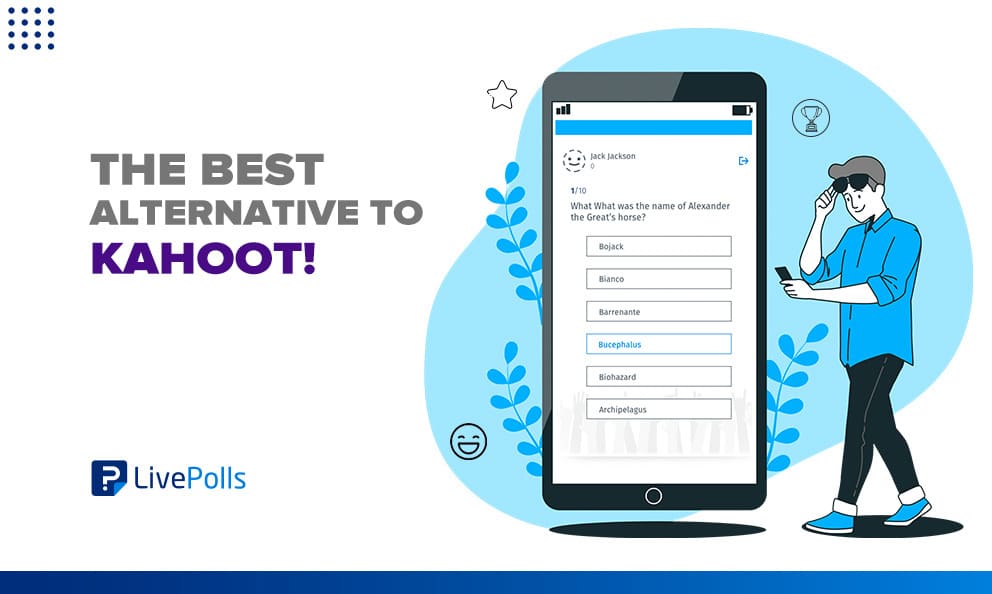
A Kahoot alternative becomes essential the moment your group outgrows 10 people. That is exactly where Kahoot’s free plan now stops. Teachers, trainers, and event hosts now want a live quiz platform that keeps the fun without the caps.
In this blog, we break down why people are switching and the eight best free Kahoot alternatives for 2026. You will also get a comparison table, clear decision criteria, and steps to build your first quiz for free.
What is a Kahoot alternative?
A Kahoot alternative is a live quiz or audience engagement platform that runs real-time quizzes, polls, and trivia games without Kahoot’s participant limits or speed-first scoring. Participants still join from their own devices, and the core experience stays familiar.
Most alternatives keep the parts people love:
- A shared question screen with a simple join code
- Timed questions with a live leaderboard
- Instant results everyone can see and discuss
The difference shows up in the details. Some alternatives add open-ended responses, word clouds, and live comment feeds. Others allow far more participants for free, reward accuracy over reaction time, or map results to named participants instead of throwaway usernames.
Why do people look for Kahoot alternatives?
People switch mainly because of Kahoot’s free plan limits, its speed-based scoring, and its narrow question formats. Kahoot remains a polished game-based learning tool, but four recurring frustrations push users toward Kahoot competitors:
- The 10-player cap.
Kahoot’s free plan allows only 10 participants per session, and paid plans start at $19 per month. A typical US classroom of 25 students hits the wall immediately.
- Speed beats substance.
Points scale with how fast players tap, which encourages guessing over thinking. Research on low-stakes quizzing supports the opposite approach: in a US study of over 1,400 middle and high school students, 92% said retrieval practice helped them learn and 72% felt less test anxiety. Retrieval practice simply means recalling information from memory, such as answering quiz questions, instead of re-reading notes.
- Closed-ended questions only.
Free Kahoot sticks to multiple choice and true or false, so you cannot collect the opinions and open feedback that drive real student engagement.
- Weak progress tracking.
Player nicknames make it tedious to connect quiz results to actual students or employees across sessions.
Quiz apps, polling tools, and game platforms: What is the difference?
These three categories get confused constantly, and picking from the wrong one is the most common reason a switch fails. The table below separates them so you can shortlist the right type first.
| Category | Built for | Typical strengths | Examples |
|---|---|---|---|
| Game-based learning apps | Making practice feel like play | Game modes, power-ups, K-12 appeal | Kahoot, Blooket, Gimkit |
| Live polling and audience response tools | Meetings, lectures, events | Word clouds, open feedback, Q&A, big groups | Mentimeter, Slido, QuestionPro LivePolls |
| Quiz and assessment platforms | Checking understanding | Question banks, reports, self-paced modes | Wayground, Socrative |
Some tools span two categories. QuestionPro LivePolls, for example, mixes scored trivia and open-ended polling in one session. It sits in the polling category but competes directly with the game apps.
What are the best Kahoot alternatives?
The eight tools below appear consistently across 2026 reviews and cover classrooms, corporate training, and live events. Each entry notes who the tool fits best so you can skip straight to your use case.
1. QuestionPro LivePolls
QuestionPro LivePolls is a free live quiz and polling tool. Participants join from any browser with a PIN code, no app download required. Its unified editor blends scored trivia and feedback questions in a single session, something Kahoot’s free plan cannot do.
Standout capabilities include:
- AI question generation: Paste notes or a textbook excerpt and get a ready-to-run quiz in seconds.
- Mixed question types: Multiple choice, true or false, this-or-that, word clouds, and a live feed for open-ended responses.
- Accuracy-friendly scoring: Assign points and difficulty per question instead of letting speed decide everything.
- Leaderboards and instant analytics: See correct answers per question and top scorers in real time.
Best for: Teachers, trainers, and presenters who want quizzes and open feedback in one free tool.
2. Wayground (formerly Quizizz)
Wayground is the closest experience to Kahoot itself. It offers a massive library of ready-made quizzes plus live and self-paced modes. The platform rebranded from Quizizz in 2025, so older reviews may still use the previous name.
Self-paced assignments make it a strong homework companion, and memes between questions keep classroom energy high. It suits K-12 teachers who want Kahoot’s feel plus asynchronous options. The free tier is workable for classes, though advanced reports sit behind paid plans.
3. Mentimeter
Mentimeter treats quizzes as one slide type inside a full interactive presentation. That framing makes it popular for lectures, webinars, and all-hands meetings rather than pure game sessions.
Strengths worth noting:
- Presentation-native: Polls, word clouds, rankings, and quiz slides live inside your deck.
- Professional polish: Clean visuals that fit corporate settings better than arcade-style themes.
- Scales to large audiences: Built for events where hundreds respond at once.
Best for: Presenters who want engagement woven through slides, not a separate game break.
4. Blooket
Blooket wraps quiz content in genuinely different game modes, from tower defense to gold rushes. Younger students keep asking to play it again. Teachers import or create question sets once, then reuse them across every mode. Its playful art style lands best with elementary and middle school audiences, and self-paced modes work for centers or homework.
It is a weaker fit for corporate settings, where the aesthetic can feel childish. The free plan covers everyday classroom use comfortably.
5. AhaSlides
AhaSlides combines quizzes, live polls, and full slide presentations in one budget-friendly package. It is frequently cited as the value pick among Kahoot competitors for work contexts.
Why it earns a spot:
- Broad question variety: Ordering, ranking, category sorting, and spinner-wheel selection go beyond multiple choice.
- Affordable paid tiers: Costs less than Kahoot’s business plans while covering similar ground.
- Free plan for small groups: Enough to trial real sessions before paying.
Best for: Trainers and team leads who need quizzes plus presentations without a big budget.
6. Slido
Slido focuses on Q&A and live polling for meetings and conferences. Cisco ownership brings deep Webex, PowerPoint, and Microsoft Teams integrations. Quizzes exist but play a supporting role next to audience questions, upvoting, and word clouds. That balance makes it the default choice for town halls and panel sessions where questions matter more than points. If your priority is a competitive trivia atmosphere, other audience engagement tools on this list will feel livelier.
7. Gimkit
Gimkit runs quiz questions inside a game-show economy. Correct answers earn in-game cash that students spend on upgrades and power-ups.
Why teachers keep it in rotation:
- Built-in repetition: The economy rewards repeated correct answers, so students revisit the same material several times per session.
- Rotating modes: New formats appear regularly, keeping review fresh across a semester.
- Free-tier caveat: Some premium modes restrict player counts, so check current limits before a big class.
Best for: middle and high school teachers who want strategy layered onto review games.
8. Socrative
Socrative strips away the arcade layer and focuses on quick formative assessment. Formative assessment means checking understanding during learning rather than grading at the end. Exit tickets, space-race quizzes, and instant result grids show teachers who understood the lesson before anyone leaves the room. Reports export cleanly for record-keeping, solving the progress-tracking gap that frustrates Kahoot users.
The trade-off is atmosphere: sessions feel like efficient check-ins, not game nights. It fits teachers who value data over drama.
How do the top Kahoot alternatives compare?
Feature lists blur together quickly. This table isolates what decides most switches: audience fit, free plan generosity, and each tool’s distinct edge.
| Tool | Best audience | Free plan feel | Distinct edge |
|---|---|---|---|
| QuestionPro LivePolls | Classrooms, training, events | Generous, full quiz and poll access | Mixes trivia and open feedback in one session |
| Wayground | K-12 classrooms | Workable for full classes | Self-paced homework modes |
| Mentimeter | Meetings, lectures | Limited slides, fine for trials | Engagement inside presentations |
| Blooket | Elementary and middle school | Covers daily use | Multiple true game modes |
| AhaSlides | Budget-conscious trainers | Small groups only | Quizzes plus full slide decks |
| Slido | Conferences, town halls | Small sessions | Q&A with upvoting, Cisco integrations |
| Gimkit | Middle and high school | Featured modes for full classes | In-game economy drives repetition |
| Socrative | Formative assessment | Solid core features | Clean per-student reporting |
How do you choose the right Kahoot alternative?
Match the tool to your audience size, question needs, and reporting requirements before you compare anything else. Work through these four filters in order:
- Count your real audience.
A 25-student class, a 60-person training, and a 500-attendee conference each eliminate different tools. Verify the free plan’s participant cap against your largest realistic session, not your average one.
- List your must-have question types.
If you only need multiple choice, almost anything works. If you want open feedback, word clouds, or live polls for the classroom mixed with trivia, your shortlist shrinks fast.
- Decide what reporting you need.
Casual icebreakers need nothing. Graded review or compliance training needs named participants and exportable per-question results.
- Run a two-week pilot and measure it.
Aim for at least an 80% join rate and 70% of questions answered per session. Review per-question accuracy to spot which topics need re-teaching. If participation sags by session three, the novelty carried the tool, not the fit.
How do you create a Kahoot-style quiz with QuestionPro LivePolls?
You can build and host a free Kahoot-style quiz in about five minutes. Participants join from any browser at questionpro.io with a 4-digit PIN. Follow these steps:
- Log in to your free or paid QuestionPro account and select LivePolls from the top menu.
- Click New LivePoll, then start from scratch, pick a template, or use Start with AI to generate questions from your own notes or textbook material.
- Add questions from the sidebar. Pick select answer or true or false for scored trivia, and mark the correct option. Leaderboards switch on automatically once a scored question exists.
- Mix in a word cloud, this-or-that, or live feed question wherever you want opinions or open discussion instead of points.
- Set points and difficulty per question in settings, so accuracy can outweigh raw speed.
- Hit Start, share the PIN, and watch responses, comments, and the leaderboard update live.
The ultimate guide to QuestionPro LivePolls walks through every screen in detail, including result analysis after the session ends.
What mistakes should you avoid when switching from Kahoot?
Most failed switches come from copying old habits into a new tool rather than from the tool itself. Watch for these patterns:
- Recreating speed-scoring by default.
If your new platform lets you weight accuracy, use it. Keeping Kahoot-style speed points imports the exact problem you left.
- Skipping the participant-cap check.
Free tiers change often, and several platforms lowered limits between 2024 and 2026. Confirm current caps the week of your event, not months before.
- Ignoring open-ended questions.
Teams that switch and still run only multiple choice miss the biggest upgrade. One trivia session with open team-building questions often reveals more than ten scored rounds.
- Announcing a permanent switch after one session.
Novelty inflates first-session engagement on any platform. Judge a tool on session three, not session one.
Finding the right Kahoot alternative for your audience
The best Kahoot alternative fits your real group size, rewards thinking over speed, and gives you usable data afterward. Kahoot earned its popularity. Even so, its 10-player free cap and speed-first design no longer fit most US classrooms and teams in 2026.
Keep three points in mind as you decide:
- Game-first platforms like Blooket and Gimkit win with younger students, while polling-first tools like Mentimeter and Slido win in professional rooms.
- QuestionPro LivePolls sits usefully between the two, pairing free Kahoot-style trivia and leaderboards with open feedback in the same session.
- Whatever you pick, pilot it, measure participation and accuracy, and let the numbers make the final call.
An online trivia maker is only as good as the conversations it starts. Choose the tool that gets your whole audience in the room and talking.
Frequently Asked Questions (FAQs)
Truly unlimited free tiers are rare, but several tools far exceed Kahoot’s 10-player cap at no cost. QuestionPro LivePolls, Wayground, and Blooket all handle full classroom-sized groups on free plans, so verify current caps before your session.
Yes. Most browser-based platforms work smoothly on video calls. The host shares the question screen while participants answer on their phones or a second tab. Slido goes further with native Webex, PowerPoint, and Microsoft Teams integrations for polls.
Usually not. Browser-based tools like QuestionPro LivePolls, Mentimeter, and Wayground let participants join with a short PIN or link from any device. Only the host needs an account, which keeps setup friction near zero.
Corporate trainers generally prefer tools with professional visuals and exportable reports. Mentimeter and AhaSlides suit presentation-heavy sessions, while Slido fits Q&A-driven town halls. QuestionPro LivePolls covers scored knowledge checks plus anonymous open feedback in one session.
Several now can. QuestionPro LivePolls generates complete quizzes from pasted notes or textbook content, and Kahoot offers AI generation on paid tiers. AI drafts save prep time, but always review generated questions for accuracy before hosting a live session.