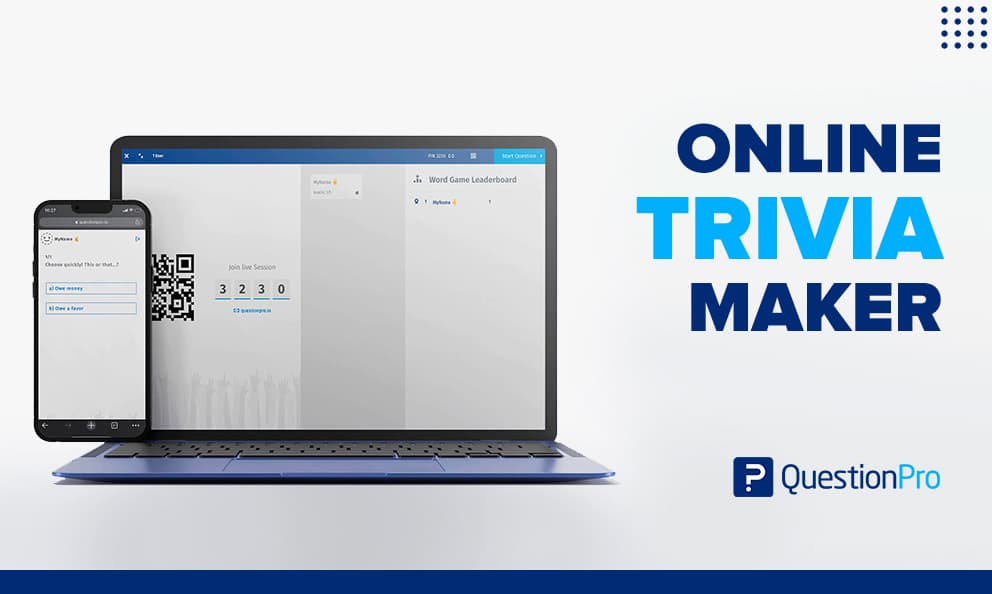
An online trivia maker is a web tool that turns your questions and answers into a playable game with timers, automatic scoring, and a leaderboard. Players join from a phone or laptop using a link, QR code, or join code. Teachers, trainers, HR teams, and event hosts use one to run live rounds.
A good game depends on more than software. Fair questions, sensible timing, and a quick test run decide whether people stay engaged or drift away.
In this blog, we’ll cover how trivia makers work, how to build a game, how free plans compare, and how to measure results.
What is a trivia game maker, and how is it different from a quiz tool?
A trivia game maker is software that builds competitive, timed question rounds and scores them as people play. A quiz maker usually checks understanding, a poll maker collects opinions, and a form builder gathers responses at each person’s own pace. Many products overlap, so compare features instead of labels.
The comparison below separates four tool types that people often confuse.
| Tool type | Main job | Typical features | Choose it when |
|---|---|---|---|
| Trivia maker | Run a competitive game | Timers, points, leaderboard | Energy and fun matter most |
| Quiz maker | Check what people know | Answer keys, score reports | You need results to review |
| Poll maker | Collect opinions live | Vote charts, word clouds | No answer is “correct” |
| Form or survey builder | Gather responses over time | Logic, exports, reports | People answer on their own schedule |
An online trivia quiz maker sits between the first two rows. It adds game energy to a scored quiz, which suits review sessions and team events alike.
How does an online trivia maker work?
An online trivia maker works in four stages: the host builds questions, shares a way to join, runs each round live, and reviews the scores. The software handles timing and points, so the host can focus on reading questions and keeping the room involved.
Most live tools follow the same flow:
- Build: Add questions, mark the correct answers, and set timers and points.
- Invite: Share a link, QR code, or numeric code on screen.
- Play: Players answer on their own devices while results update.
- Review: The leaderboard names winners, and reports show which questions people missed.
About 91% of U.S. adults own a smartphone, according to Pew Research Center’s mobile fact sheet, so phones suit most audiences. Plan a backup for everyone else, such as a shared laptop or paper answer sheets.
Self-paced games work differently. Players open a link and answer alone, which suits remote teams in several time zones but removes the shared excitement of a live leaderboard.
How to make an online trivia game in 7 steps
To make an online trivia game, define your audience, choose a format, write questions with answers, enter them in a trivia maker, set scoring and timers, test on a phone, and then host. Most of the preparation time goes into writing and checking questions, not clicking buttons.
Follow these seven steps from first idea to final score.
- Define your audience and goal.
Decide who will play, what they already know, and whether you want learning, bonding, or entertainment. - Choose a theme and format.
Pick one topic or several rounds, then decide between live and self-paced play. - Write questions and answers.
Draft more questions than you need, verify every answer against a reliable source, and cut weak ones. - Enter the questions into your trivia maker.
Start from a template or a blank game, then mark each correct answer. - Set points and timers.
Give harder questions more points if you like, and allow enough time to read every option. - Test the game on a phone.
Join as a player, check images and wording, and fix anything that scrolls awkwardly. - Host the game and share results.
Show the join code, read questions with energy, announce the leaderboard after each round, and use short pauses for conversation.
Planning a social event takes extra decisions about prizes, pacing, and video calls. Our guide on hosting trivia online with friends covers that side.
How do you write good trivia questions?
Good trivia questions test one verifiable fact, use plain wording, offer believable answer options, and match the audience’s knowledge. Players should be able to read each question in a few seconds. A fair question rewards what people know, while a confusing one rewards guessing and starts arguments.
Write one clear fact per question
A strong trivia question asks about a single fact that has only one defensible answer.
- Ask “In what year did the first Moon landing happen?” instead of “When was the Moon landing?”
- Skip double negatives and “which of these is not” phrasing where possible.
- Verify records, rankings, and “latest” facts on the day you publish, because they change.
Build believable answer options
Believable wrong answers make players think, while obvious throwaways turn four choices into two.
- Use one correct answer and two plausible wrong answers.
- Add one playful fourth option when the event is casual.
- Keep options similar in length, so the longest one does not give away the answer.
- Use true or false sparingly, since a blind guess succeeds half the time.
Balance difficulty across rounds
A balanced game opens with easy wins and saves harder questions for later rounds.
- Try four easy, four medium, and two hard questions in a ten-question round as a starting mix.
- Tailor topics to the group, such as class material for students or company history for new hires.
- Add a few personal facts for friends or family, with each person’s permission.
- Ask two sample players to try the draft, then adjust anything everyone misses.
Writing from scratch takes time. An AI quiz maker online can draft questions quickly, but a person should check every fact and answer key.
What does a sample trivia round look like?
A sample trivia round mixes topics, formats, and difficulty in five short questions, each with one verified answer. Copy the structure below, then swap in your own subject. The example uses general knowledge so that a mixed group can play it without preparation.
The table shows five questions, their answer choices, and the correct response.
| Question | Format | Answer choices | Correct answer |
|---|---|---|---|
| Which ocean is the largest on Earth? | Multiple choice | Atlantic, Indian, Pacific, Arctic | Pacific |
| What is the capital of Australia? | Multiple choice | Sydney, Melbourne, Canberra, Perth | Canberra |
| In what year did humans first land on the Moon? | Multiple choice | 1959, 1965, 1969, 1972 | 1969 |
| The chemical symbol Fe stands for iron. | True or false | True, False | True |
| How many stars appear on the current U.S. flag? | Multiple choice | 48, 50, 51, 52 | 50 |
For themed nights, build each round around one subject, such as food, movies, sports, or your own product.
How long should an online trivia game be?
An online trivia game works well at 10 to 20 questions for most meetings and classes, or about 10 to 20 minutes. Longer social events can use several rounds with breaks. Estimate running time before you invite anyone, because reveals and leaderboards add more minutes than most hosts expect.
Use a simple formula: minutes = questions × (answer seconds + reveal seconds) ÷ 60. In a hypothetical 15-question game with 20-second timers and 25-second reveals, play lasts about 11 minutes. Add a few minutes for joining and announcing winners.
Timers also affect fairness. Some players read slowly, use screen readers, or join on weak connections. The W3C guidance on time limits asks web content to let users turn off, adjust, or extend limits, with exceptions for essential and real-time cases.
For graded or inclusive sessions, lengthen the timer, turn off speed bonuses, or offer an untimed version. Read questions aloud, and use readable text with strong color contrast.
How do free trivia maker plans compare?
Free trivia maker plans differ mostly in player limits, ranging from 10 to 100 participants among the six tools below. Check how many people can join, how many games you can save, and whether team play or exports require payment. Limits change often, so confirm them before event day.
The table compares free player limits, entry paid prices, and typical uses. QuestionPro is our product. Figures come from public vendor pages, checked November 2026.
| Tool | Free plan player limit | Entry paid price | Best suited to |
|---|---|---|---|
| QuestionPro LivePolls | Up to 100 per session | Quote-based | Mixing polls, quizzes, and trivia |
| Trivia Anywhere | Up to 25 per game, 3 saved games | $20 per month for 50 players | Game-show events with bingo |
| Crowdpurr | Up to 20 per experience, 3 experiences | $49.99 monthly, or $24.99 monthly billed yearly, for 100 players | Event trivia with team and survivor formats |
| TriviaMaker | 20 in Crowd mode, limited game styles | $6.99 monthly or $19 yearly for 50 players | Grid and wheel game boards |
| Kahoot! 360 (work plans) | Up to 15 in 15-minute sessions | $15 monthly, billed yearly, for 50 players | Teams that already know Kahoot |
| Slides With Friends | Up to 10 players | $8 monthly, billed yearly, for 50 players | Slide-deck style games |
Teachers and trainers comparing live quiz platforms in more depth can review our list of Kahoot alternatives.
How do you choose the right online trivia maker?
Choose an online trivia maker by matching it to your group size, setting, and need for results. A free plan that fits 25 players will fail a 60-person all-hands. List your non-negotiables first, then run a short test game with two or three people before committing.
A trivia night maker for a bar or fundraiser also needs team scoring and a clear big-screen view.
Check these criteria in order:
- Player limit: Count everyone who might join, including late arrivals and guests.
- Joining: Prefer a browser link, QR code, or short code with no app or account.
- Question types: Confirm multiple choice, true or false, images, and typed answers if you need them.
- Team play: Check whether teams share one device or each person joins individually.
- Reports: Look for question-level results if you will teach or train from them.
- Privacy: Read how the tool stores names, emails, and answers, especially with students.
- Cost: Compare the price for your actual room size, not the headline starting price.
Where can you use an online trivia maker?
You can use an online trivia maker in classrooms, workplace training, team meetings, conferences, and social events. Each setting needs a different tone: students need feedback they can learn from, employees need low-pressure fun, and event audiences need quick rounds that restart attention between sessions.
Classrooms and study review
Trivia turns lesson review into retrieval practice, which means recalling information from memory instead of rereading it.
Across 222 studies and 48,478 students, a Psychological Bulletin meta-analysis found that quizzing raised classroom achievement by a medium amount (g = 0.499). The finding covers testing broadly, not trivia games specifically, and corrective feedback influenced results. A history teacher might end a unit with ten questions, then explain each missed answer.
Best for: Teachers who want quick feedback. A classroom response system fits daily checks better than a game.
Workplace training and meetings
Work trivia refreshes policies, product knowledge, or company history without feeling like a formal exam.
A new-hire group could answer eight questions on tools, benefits, and values at the end of week one. Keep individual scores low-stakes, and avoid questions that rely on personal background or pop culture only some colleagues know.
Best for: HR and training teams who want participation without grading pressure.
Events, conferences, and communities
Event trivia gives attendees a shared activity during breaks, openings, or sponsor segments.
A conference host could run five questions about the morning’s talks after lunch, then recognize the top three players. Use a large screen, a short join code, and a nickname option so shy guests can still play.
Best for: Organizers who need an energy boost that takes under ten minutes.
How do you measure whether a trivia game worked?
Measure a trivia game with participation, completion, question accuracy, and a short feedback rating. Compare the numbers with your goal: a social game succeeds when people stay and ask for another round, while a training game succeeds when missed questions shrink on a later attempt.
The table lists the core metrics, how to calculate them, and what each result suggests.
| Metric | How to calculate it | What the result suggests |
|---|---|---|
| Join rate | Players joined ÷ people invited | Low values point to timing or access problems |
| Completion rate | Players answering the last question ÷ players joined | A sharp drop means the game ran long |
| Accuracy per question | Correct answers ÷ answers submitted | At or below 25% on four options, check wording and key |
| Easy-question share | Questions with over 90% correct ÷ all questions | A high share means the game lacked challenge |
| Repeat score | Second-attempt accuracy minus first | Gains show better recall after review |
| Enjoyment rating | Average of a 1 to 5 post-game rating | Falling averages signal tired themes or formats |
Treat 25% and 90% as starting flags, not rules. A random guess on four options succeeds about one time in four. Send feedback questions after the game, or create a survey form that asks which round players liked most.
What trivia game mistakes should you avoid?
The most common trivia mistakes are unchecked answers, unclear wording, overlong games, and untested technology. Each one is cheap to prevent before game day and awkward to fix while players watch. Run a rehearsal on the same device, network, and screen that you will use live.
Watch for these problems:
- Unverified answers: One wrong key can end trust, so keep a source beside each question.
- Debatable wording: Questions with two correct answers cause arguments.
- Walls of text: Long questions eat the timer, especially on small screens.
- All-hard rounds: Players who score zero stop trying.
- Speed-only scoring: Fast connections can beat better knowledge.
- Open lookups: Short timers, picture questions, and a no-phone-search rule reduce searching, but cannot stop it.
- Surprise data collection: Tell players what you record, and ask only for the details you need.
- No backup plan: Keep a printed question list in case the connection fails.
How do you build a trivia game in QuestionPro LivePolls?
QuestionPro LivePolls is a live polling and quiz app where hosts run timed trivia, scored quizzes, polls, and audience Q&A. You build sessions in one editor, show a QR code and four-digit PIN, and players join in a browser without an app. The free Essentials plan covers 100 participants per session.
According to QuestionPro’s help documentation and product page, checked November 2026, a host can set up a game this way:
- Start the game.
Create a new LivePoll from scratch or pick one of 1,250+ ready-made templates. - Add scored questions.
Use select answer or true or false types, then set correct answers, points, and difficulty. - Mix in opinions.
Add multiple choice polls between scored rounds, since poll answers do not count toward the leaderboard. - Set up teams.
Create up to 10 teams for scored select answer and true or false questions. - Control the pace.
Add a timer to each question, and award speed bonus points if you want them. - Invite players.
Share the PIN or QR code from QuestionPro LivePolls.
Paid Academic and Enterprise plans add unlimited participants, result exports, word clouds, and an AI poll builder that drafts questions from a topic. For formal workshops, a team workspace setting called Essential Mode removes nicknames, scores, and leaderboards.
For follow-up feedback, QuestionPro Survey Software is online survey software that is free to start. It offers conditional logic, real-time dashboards, surveys in more than 100 languages, AI survey drafting, and GDPR, CCPA, ISO 27001, and HIPAA compliance.
A good trivia game starts with the questions, not the tool
An online trivia maker handles timers, scores, and leaderboards, but the host still decides what is worth asking. Verified facts, clear wording, a sensible length, and a quick phone test matter more than animations. Choose a plan that fits your real room size, then rehearse once.
After each game, note which questions confused people and which rounds drew the most energy. Those notes make the next game sharper, whether you host a classroom review, an onboarding session, or a Friday team break.
Frequently Asked Questions (FAQs)
Yes. Several tools offer free plans with different caps. QuestionPro LivePolls Essentials is free for up to 100 participants per session, while some other makers limit free games to 10 to 25 players, as checked in November 2026.
Many browser-based trivia makers let players join with a link, QR code, or short code, with no app or account. QuestionPro LivePolls works this way. Hosts usually need an account to build and save games.
Google Forms can build a self-paced quiz with answer keys, point values, and score release. Google’s quiz help page does not describe a live leaderboard or question timer, so choose a live trivia tool for competitive play.
Player limits depend on the tool and plan, from about 10 on some free tiers to thousands on paid ones. Check the limit per session, add a buffer for guests, and test your network before large events.
Yes. Some tools let a group share one device under a team nickname, while others assign individual players to teams. QuestionPro LivePolls supports up to 10 teams for select answer and true or false quiz questions.