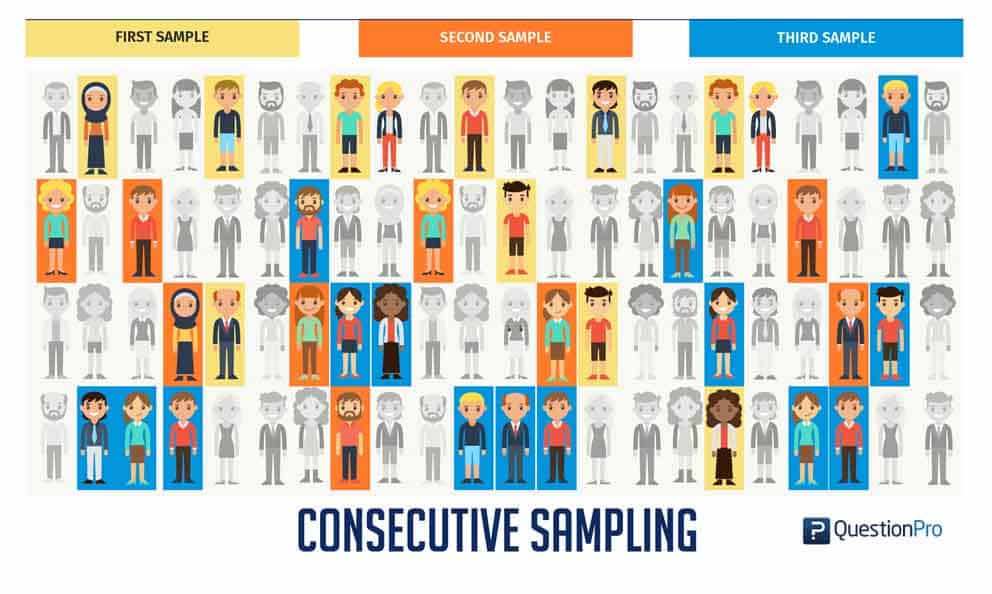
Consecutive sampling is a non-probability method in which a researcher enrolls every eligible person, in the order they appear, until the sample hits its target size. It sits between loose convenience sampling and strict random selection. Clinics, retailers, and survey teams like it because it is fast and easy to document.
It also has a clear weakness. Arrival order decides who gets in, so time patterns can skew your results. Here, we’ll cover how consecutive sampling works, how to size and check a sample, and which mistakes to avoid.
What is consecutive sampling?
Consecutive sampling is a non-probability sampling technique in which a researcher enrolls every person who meets the inclusion criteria, in the order they become available, until the required sample size is reached.
The researcher does not choose who joins. Arrival order and the eligibility rules decide. A hospital team might enroll every adult who visits an outpatient clinic on a weekday until 200 patients complete the study.
Teams reach for this method when no complete list of the population exists. That list is called a sampling frame, and clinics, stores, and events rarely have one in advance. Chance plays no role in selection, so consecutive sampling belongs to the family of non-probability sampling methods. You cannot calculate true sampling error from it, so word your findings with that limit in mind.
Four traits define the method:
- Eligibility rules are fixed before fieldwork.
- Every qualifying person gets an invitation.
- Selection follows arrival order, not researcher choice.
- Enrollment stops at a preset target or end date.
How does consecutive sampling differ from convenience, purposive, and systematic sampling?
Consecutive sampling differs from its neighbors in one way: it removes researcher discretion. With convenience sampling, a researcher can approach whoever looks friendly. In purposive sampling, the researcher picks people on purpose, based on traits. Consecutive sampling replaces both habits with one rule: take everyone eligible, in order.
| Feature | Consecutive | Convenience | Purposive | Systematic |
|---|---|---|---|---|
| Selection rule | Every eligible person, in arrival order | Whoever is easiest to reach | Researcher picks people with set traits | Every nth person from a list |
| Researcher discretion | None once criteria are set | High | High, by design | None after the start point |
| Needs a sampling frame | No | No | No | Yes |
| Sampling type | Non-probability | Non-probability | Non-probability | Probability, if the start is random |
| Main risk | Time and order patterns | Selection bias | Researcher judgment bias | Hidden cycles in the list |
| Best for | Clinics, intercepts, pilot studies | Quick, low-stakes feedback | Expert or case-specific insight | Large, ordered lists |
Use a simple test to tell the first two apart. Ask whether staff could skip an eligible person. If they could, you are running convenience sampling. Reference sources, including the Wikipedia entry above, describe consecutive sampling as better at controlling bias than convenience sampling, though it does not remove bias.
Step-by-step guide to consecutive sampling
Consecutive sampling takes six steps: define the population, write eligibility rules, set a time window, screen every arrival in order, enroll everyone who qualifies, and stop at the target. Each step exists to stop staff from cherry-picking.
- Define the population and question.
Name who you want to learn about, such as adult patients with a first diagnosis or shoppers who bought in the last hour. - Write inclusion and exclusion criteria.
State age, behavior, location, and consent rules before fieldwork starts. - Set the eligibility window.
Choose start and end dates, days of the week, and hours. Cover several shifts so one time slot does not dominate. - Screen every arrival in order.
Log each person, even those who do not qualify. - Enroll all qualifying people.
Record every refusal and its reason. - Stop at the target.
Close enrollment when you reach the planned size or the window ends, and report which one happened.
Consecutive sampling examples
Consecutive sampling shows up wherever people arrive in a steady stream. The three examples below show how the same rule plays out in healthcare, retail, and customer feedback. Each one is illustrative.
Clinical enrollment example
A US emergency department wants to study wait-time satisfaction among adult patients.
- Rule: Enroll every adult discharged home between 8 a.m. and 8 p.m.
- Window: Seven days a week for 12 weeks, so weekends count.
- Stop point: 250 completed surveys.
Staff log every discharge, so the team can show exactly how many were eligible, approached, and enrolled.
Mall intercept example
Promoters hand out leaflets for a luxury car at a mall. The first group of shoppers shows little interest, so the results look inconclusive. A second group, reached later, shows strong buying interest.
This example works as consecutive sampling only if promoters approach every qualifying shopper, such as adults walking past a set spot. If they pick who looks wealthy, it becomes convenience sampling. The gap between the two groups also hints at a time effect, which the team should test before drawing conclusions.
Branch feedback example
A regional bank invites every customer who completes a teller transaction to answer a three-question tablet survey. The window runs four weeks.
- Benefit: The team gets feedback from a steady stream of real customers.
- Risk: Customers who rush out may decline, which skews results toward patient customers.
- Fix: Track the refusal rate by hour and compare busy and quiet periods.
Can you keep sampling if the first results are inconclusive?
Yes, but only if you plan it before fieldwork. The original idea behind consecutive sampling allows a third outcome beyond accepting or rejecting a hypothesis. If results stay unclear, the researcher draws another sample and repeats the study.
That flexibility has a cost. Researchers who check results over and over, then stop when the numbers look good, inflate false positives. Flexible stopping raises the odds of finding an effect that is not real.
Treat a second round as a separate wave. Report both waves, and do not pool them silently. Statisticians call the formal version of this approach sequential analysis, and it adjusts the evidence threshold at each look.
Rule of thumb: write the stopping rule down before the first participant enrolls.
When should you use consecutive sampling?
Use consecutive sampling when you cannot list the population in advance and you can screen every arrival. Switch to another method when you need results that apply to a whole population.
| Situation | Choose consecutive sampling | Choose another method |
|---|---|---|
| Sampling frame | No list exists, and people arrive over time | A full list exists, so use random selection |
| Goal | Pilot study, service review, or observational study | Population estimates or forecasts |
| Population size | Small or hard to reach, such as a rare condition | Large and easy to list |
| Timing | A defined window with steady flow | Sporadic flow you cannot staff |
| Staffing | You can screen every arrival | Staff cannot log every person |
| Risk tolerance | Some bias is acceptable and documented | Bias would change a major decision |
If two or more rows land in the right-hand column, pick a different design.
How large should a consecutive sample be?
Your analysis plan sets the sample size, and your enrollment rate sets the length of the window. Consecutive sampling has no special formula. Run a standard power calculation for your tests, then check whether the window can deliver that number. For a refresher, see our guide to survey sample sizes.
Here is the window math with a clinic example:
- Estimate eligible arrivals per week: 10.
- Estimate the share who consent: 85 percent, so about 8.5 enroll each week.
- Divide the target by weekly enrollment: 200 ÷ 8.5 = 23.5.
- Round up and plan for 24 weeks.
Size matters more here than in random designs. Bujang and colleagues compared consecutive and systematic sampling in simulations and in diabetes clinic records. Systematic sampling was more accurate in most comparisons. Consecutive sampling estimates came close to the true values at about 300 patients, or roughly 15 to 18 percent of the population.
How do you check whether a consecutive sample is trustworthy?
A trustworthy consecutive sample comes with evidence: a complete screening log, a documented refusal rate, and a comparison against known benchmarks. Run these checks before you analyze anything.
| Check | How to run it | Warning sign |
|---|---|---|
| Screening log | Count screened, eligible, approached, and enrolled | Gaps or missing days |
| Refusal rate | Divide refusals by eligible people approached | A rate that climbs during busy hours |
| Time coverage | Chart enrollment by weekday and hour | One shift supplies most respondents |
| Demographic benchmark | Compare age, sex, and income | Large gaps from local census data |
| Order pattern | Run a runs test on the enrollment sequence | A repeating pattern in outcomes |
| Participant flow | Report numbers at each stage | You cannot explain who dropped out |
Set your refusal threshold before fieldwork. A practical rule is to investigate when more than one in five eligible people decline.
Pros and cons of consecutive sampling
Consecutive sampling trades statistical power to generalize for speed, low cost, and clean documentation. Weigh both sides before you commit.
Pros
- Fast and cheap to run with a small team.
- Removes researcher choice once criteria are set.
- Works without a sampling frame.
- Lets you adjust the study early if the process breaks down.
- Suits pilots, rare populations, and short windows.
Cons
- Results do not generalize to a full population.
- Time and seasonal patterns can bias the sample.
- Neighbors in a sequence often resemble each other.
- Refusals can quietly skew who gets counted.
- Tests that assume random samples give only rough guidance.
What mistakes weaken consecutive sampling, and how do you fix them?
Most failures come from small lapses in discipline, not from the method itself. Each mistake below invites sampling bias, and each has a simple fix.
| Mistake | Why it hurts | Fix |
|---|---|---|
| Skipping hard or unpleasant cases | Quietly turns the study into convenience sampling | Use a screening log that staff must complete |
| Sampling one time slot | Weekday daytime visitors differ from evening and weekend visitors | Rotate shifts across all days |
| Ignoring seasons | Holiday or flu-season waves change who shows up | Run the window across a full cycle or note the season |
| Stopping when results look good | Inflates false positives | Fix the stopping rule in advance |
| Overgeneralizing | Readers assume the sample represents everyone | State the population, window, and limits in your report |
| Dropping refusals from the record | Hides non-response bias | Log every refusal and reason |
How can QuestionPro help you run a consecutive sample?
QuestionPro helps most with data capture and cross-checking, two jobs that decide whether a consecutive sample holds up. Use QuestionPro survey software to collect each response as it arrives, then export results in arrival order to test for time patterns.
- Timestamps: Each response carries a date and time, so you can chart coverage by shift.
- Offline collection: Offline surveys let staff collect responses on a tablet in a clinic or store without a stable connection.
- Benchmarking: Compare your in-person sample with a profile-targeted panel from QuestionPro Audience to see whether your results look unusual.
Why consecutive sampling works best as an honest, well-documented method
Consecutive sampling will not give you a random sample, and it never claimed to. What it gives you is a clear rule, a paper trail, and a sample that reflects the people who actually showed up.
That makes it a strong choice for pilots, clinical observation, and service reviews, as long as you state the limits plainly. Pick eligibility rules you can defend, cover several time slots, log every refusal, and write the stopping rule before you start. Do that, and your readers can judge your findings on their merits.
Frequently Asked Questions (FAQs)
Consecutive sampling enrolls eligible people in arrival order until a fixed target is met. Sequential sampling tests results after each observation or batch and decides whether to stop, using preset statistical boundaries. The two names sound alike but serve different goals.
Yes. Enroll eligible people in arrival order, but stop accepting a group once its quota fills. For example, close the 18-to-29 quota at 50 people while you keep enrolling older adults. Document each closure date so readers can follow the process.
Yes. Researchers sometimes interview every eligible participant who arrives until themes repeat, a point called saturation. Sample size then depends on when new interviews stop adding insight, so set a rough range in advance and justify where you stopped.
You can, but treat the results with care. Standard tests assume random selection, which consecutive sampling lacks. Report effect sizes and confidence intervals as descriptive evidence, state the limits clearly, and avoid language that implies the result applies to the whole population.
Studies that collect data from people usually need review by an institutional review board (IRB), a committee that checks that research protects participants. Plan consent wording, privacy protections, and refusal handling with your IRB or compliance team before enrolling the first participant.