
An employee value proposition is what your organization offers employees in exchange for their skills, effort, and commitment. It covers everything from salary and benefits to career growth, culture, and the day-to-day experience of working at your company.
Most leaders already know that taking care of employees pays off. The hard part is turning that intention into something specific, communicated clearly, and actually delivered.
Companies that get this right see measurably lower turnover and stronger candidate pipelines.
In this blog, we’ll explain what an employee value proposition is, how it differs from your employer brand, the five elements that make one work, and how to build it step by step.
What is an employee value proposition?
An employee value proposition is the complete set of benefits, rewards, and experiences an employee receives in exchange for the skills, capabilities, and experience they contribute to an organization. It is the internal promise your company makes to its workforce.
In practical terms, your EVP answers one question for every employee and candidate: what do I get for the work I put in here? When that answer is clear, specific, and genuinely true, you attract people who fit and keep the ones who matter.
Employee value proposition vs. employer brand: What is the difference?
These two terms get confused constantly, but the distinction is straightforward.
| Term | Employee value proposition | Employer brand |
|---|---|---|
| Direction | Internal | External |
| What it defines | What employees actually receive: pay, benefits, growth, culture | How the company is perceived in the job market |
| Shaped by | Policy, leadership, compensation, daily experience | Reviews, word of mouth, candidate messaging |
| Relationship | The foundation | The outward expression of the EVP |
Your employer branding is only as credible as your EVP is real. A company that markets flexibility but does not deliver it will see that gap show up fast in reviews, turnover, and candidates who leave within months.
Why a strong employee value proposition matters
The business case for investing in your EVP is no longer theoretical. Gartner’s research on employee value proposition found that organizations effectively delivering on their EVP can lower annual employee turnover by as much as 69%, while also increasing new hire commitment by close to 30%.
Replacing an employee costs between 50% and 200% of their annual salary once hiring, onboarding, and lost productivity are factored in. For a $70,000 role, that is a potential cost of $35,000 to $140,000 per departure.
Engagement follows the same pattern. Gallup research links highly engaged business units to 23% higher profitability than lower-engagement units, and employees who understand what their organization offers are more likely to apply, accept, and stay.
What drives employees to leave without a clear EVP
Understanding why employees leave shows exactly what an EVP needs to address. McKinsey’s research on workforce attrition found that lack of career development and advancement ranks as the top reason employees quit, with inadequate compensation close behind.
Leadership quality matters just as much. The same McKinsey research found that uncaring or uninspiring leadership was cited by 35% of employees as one of their top three reasons for leaving.
In a labor market where SHRM’s 2026 Talent Trends data shows nearly seven in ten organizations still struggle to fill full-time roles, a clear value proposition has become a competitive differentiator, not a nice-to-have HR initiative.
Five core elements of an employee value proposition
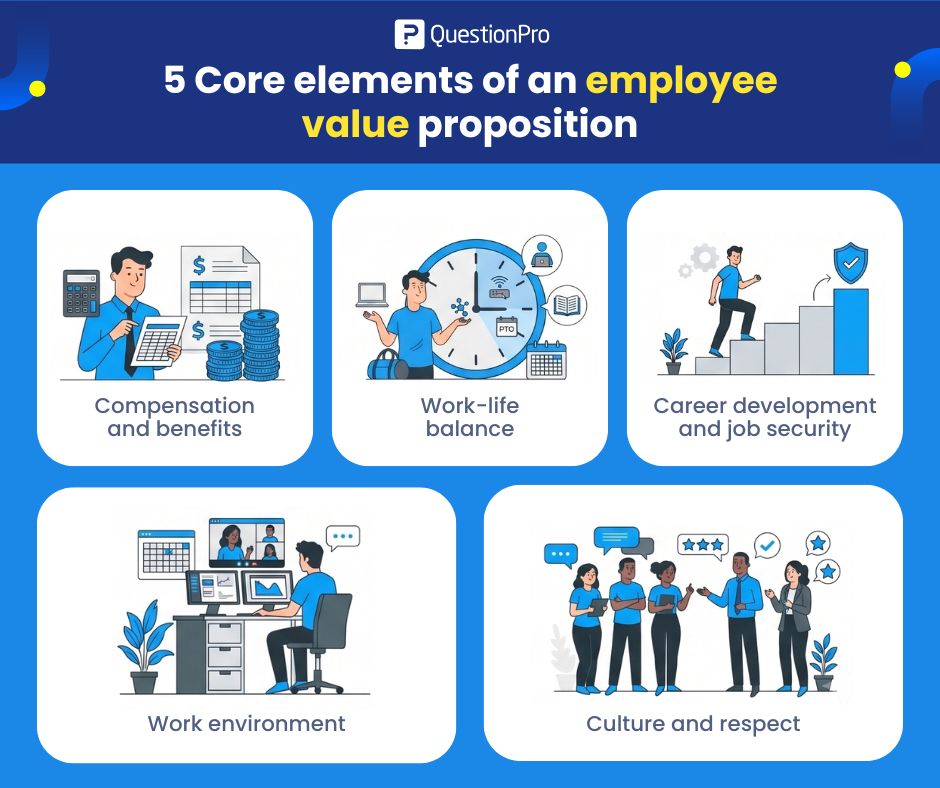
Most frameworks for building an EVP, including the widely referenced Gartner model, break it into five components.
| Element | What it covers |
|---|---|
| Compensation and benefits | Salary, bonuses, equity, fairness of pay relative to performance |
| Work-life balance | PTO, flexible scheduling, remote work, parental leave |
| Career development and job security | Training, mentorship, internal promotion, career stability |
| Work environment | Technology, physical or remote workspace, daily culture |
| Culture and respect | Leadership quality, recognition, team relationships, values |
Harvard Business Review groups EVP into four broader categories instead: material offerings, growth opportunities, connection and community, and meaning and purpose. The two frameworks overlap significantly and describe the same underlying reality from different angles.
Compensation and benefits
This covers salary, bonuses, equity, and how fairly compensation reflects performance. It is the most tangible element and often the first thing candidates evaluate, but it is rarely the only deciding factor.
Compensation matters differently across generations. Younger employees frequently weigh growth opportunities and flexibility alongside pay, while employees closer to retirement place more emphasis on stability.
Work-life balance
Work-life balance includes paid time off, flexible scheduling, remote work options, and parental leave. It has become one of the most heavily weighted factors in EVP since 2020.
There is no universal formula here. New parents prioritize parental leave differently than recent graduates, and employees nearing retirement often weigh healthcare benefits more heavily than flexible hours.
Career development, work environment, and culture
Career development covers stability, growth opportunities, and learning resources, including formal employee engagement strategies built around internal mobility. Younger employees weigh this heavily, even when compensation is comparable to competitors.
Work environment goes beyond physical office space to include technology and daily culture. Culture and respect cover leadership quality and recognition, and this is one of the easiest areas to improve since it costs nothing to fix beyond genuine investment in how managers lead.
How to build an effective employee value proposition
Building an EVP that actually works takes more than writing a few bullet points about benefits. Here is a practical process that produces something specific, credible, and usable.
- Define your goals.
Get clear on what you want your EVP to accomplish, whether that is attracting candidates in a specific skill area, reducing recruitment costs, or improving retention among a specific employee segment.
- Identify your ideal candidate and employee.
Outline the skills and qualities you want, and prioritize cultural fit alongside technical qualifications.
- Outline your specific EVP elements.
Map out what you genuinely offer across the five core elements, and be specific. “Competitive salary” tells a candidate nothing. “Salaries benchmarked annually against the 75th percentile for your role” does.
- Gather data from current employees.
Use employee survey questions to understand what your current employees actually value and where gaps exist between what you offer and what they want.
- Personalize by audience segment.
Segment your workforce by career stage, role type, or location, and tailor how you communicate the value proposition to each group.
- Address the full employee life cycle.
A complete EVP accounts for what your organization offers at every stage, from attraction and onboarding through ongoing development and offboarding.
The first three steps are internal planning. The last three test that plan against reality, which is where most EVPs either hold up or fall apart.
Employee value proposition examples
Real examples make the concept concrete. A few companies are frequently cited for EVPs that hold up under scrutiny.
Patagonia built its EVP around purpose and environmental sustainability, backing public commitments with internal policy like paid environmental training days. WD-40 Company runs a confidential employee survey every two years and has consistently reported engagement scores well above typical US norms, a result the company attributes directly to its people-first culture rather than any single perk.
Trader Joe’s focuses its EVP on an inclusive culture and a reputation for promoting from within. Shopify centers its EVP on personal growth, framing itself as an organization built by people focused on continuous development. Ben & Jerry’s combines social impact and strong benefits in a way that reads as genuine because it ties public activism directly to how it treats its own workforce.
What ties these together is specificity. Each EVP is tied to something the company actually does, not a generic claim about “great culture” with no policy behind it.
How to measure if your EVP is working
An EVP that is never measured cannot be improved. Track employee retention rate, especially among high performers and within the first year of employment, where misaligned expectations show up fastest.
Also watch engagement survey scores tracked over time, offer acceptance rate, and cost per hire, since a strong EVP typically reduces both time and spend required to fill open roles. An employee retention questionnaire run consistently gives you a baseline to measure all of this against.
Review these metrics annually, or whenever compensation, benefits, or policy changes significantly, so the EVP stays grounded in reality rather than becoming a static document nobody revisits.
What makes an EVP worth building
A company’s talent strategy is only as strong as the value proposition behind it. The organizations that get this right do not treat their EVP as a recruiting slogan. They treat it as an ongoing commitment tested every time an employee decides whether to stay or go.
If you are starting from scratch, the fastest path forward is simple. Ask your best employees why they stay, using a structured survey tool like QuestionPro Employee Experience Software if you need one. Their answers will tell you more about your real EVP than any internal planning session.
Frequently Asked Questions (FAQs)
Most organizations review their EVP annually, or whenever compensation, benefits, or workplace policy changes significantly. An EVP written in 2019 rarely reflects what candidates and employees expect from a company today.
Yes. A small business EVP does not need a large budget, just specificity and honesty about what it actually offers, whether that is faster growth opportunities, flexibility, or closer mentorship than a larger competitor can provide.
The most common mistake is writing an EVP that sounds good but does not match daily reality. Employees notice the gap quickly, and it damages trust faster than having no formal EVP at all.
No. Salary is one part of compensation, which is only one of five core EVP elements. An EVP built on pay alone tends to lose to competitors once a candidate finds a similar salary elsewhere.
Employees who genuinely believe in their organization’s value proposition are more likely to refer qualified candidates, since they are effectively vouching for their own experience. Weak or dishonest EVPs tend to suppress referral activity over time.