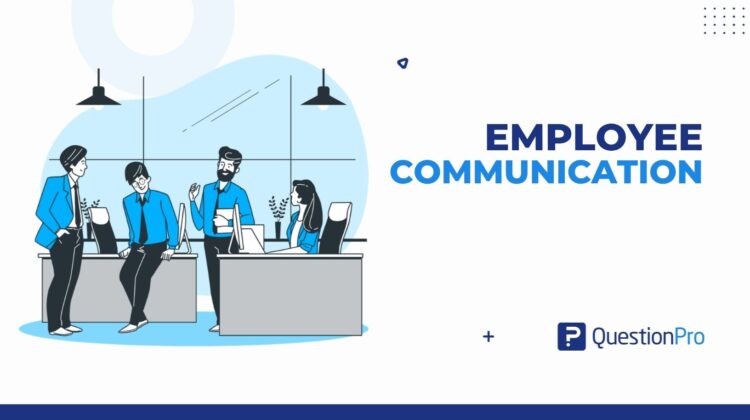
Employee communication is the two-way exchange of information, ideas, and feedback between an organization’s leaders and its employees, and among employees themselves. It covers what people need to know to do their jobs, why decisions were made, and how employees can respond.
Most companies send plenty of messages. Far fewer check whether those messages land, or give employees an easy way to answer back. That gap shows up as confusion during change, repeated questions, and teams that work from different versions of the same plan.
In this blog, we’ll break down the types of employee communication, the channels that suit each message, and a seven-step strategy. You’ll also see examples and the metrics that show whether it works.
What is employee communication?
Employee communication is how an organization shares information with its people and how those people share information back. It includes leadership announcements, manager conversations, peer collaboration, and the feedback employees give about their work and the company.
The older view treated it as a broadcast. Management wrote policies and procedures, then circulated them. That one-way model still has a place for compliance notices, but it rarely builds understanding on its own. Communication is a dialogue, and a dialogue needs a reply.
The channel mix has also changed. A decade ago, most workplace communication happened face to face. Today a single update may travel through email, chat, an intranet, a mobile app, and a team huddle in the same afternoon. Speed went up, and so did the risk of noise, mixed messages, and misread tone.
What works for one organization may not work for another. A 40-person design agency and a 12,000-person hospital system need different channels, cadences, and owners. The goal is the same in both cases: every employee knows what is happening, why it matters to them, and where to ask questions.
What does employee communication include?
Employee communication spans every planned and everyday exchange that helps people do their jobs and feel part of the organization. In practice, that usually means five kinds of content.
- Operational updates: Schedules, process changes, system outages, and safety notices that affect daily work.
- Strategic messages: Company goals, results, priorities, and the reasoning behind major decisions.
- People topics: Benefits, policies, pay cycles, training, recognition, and career opportunities.
- Change communication: Reorganizations, new tools, mergers, return-to-office plans, and leadership transitions.
- Employee voice: Surveys, questions, ideas, concerns, and comments that flow back to leaders.
How is employee communication different from internal communication?
Employee communication is the part of internal communication focused on the relationship between the organization and its people. Internal communication is the wider function that manages every message inside the company, including the systems and team that run it. The terms overlap, so the table below separates them.
| Term | What it covers | Typical owner | Main goal |
|---|---|---|---|
| Employee communication | Messages and feedback between the organization, managers, and employees | HR, internal comms, and every people manager | Employees understand, trust, and act on information |
| Internal communication | The full system of messages, channels, and governance inside the organization | Internal communications team | Information flows to the right people at the right time |
| Corporate communications | How the company presents itself to employees, media, investors, and the public | Communications or PR team | A consistent reputation and brand voice |
| Employee advocacy | Employees promoting their employer, its products, or its culture through their own voices, most often on social media, at events, and through referrals | Marketing, HR, or employer brand | Wider reach and credibility outside the company |
If you need the planning side, such as audiences, calendars, and governance, a written internal communication plan is the document that organizes it. Employee communication is what people actually experience once that plan runs.
What are the four directions of employee communication?
The four types of employee communication are defined by direction: top-down, bottom-up, lateral, and cross-functional. Healthy organizations use all four, and most communication problems come from relying on only one.
- Top-down: Leaders and managers share goals, decisions, and changes with employees. Example: A CEO town hall explaining why the company is entering a new market.
- Bottom-up: Employees share ideas, concerns, and employee feedback with managers and leaders. Example: A quarterly pulse survey that asks whether workloads are manageable.
- Lateral: Peers at the same level share knowledge and coordinate work. Example: Two shift supervisors handing over open issues at the end of a shift.
- Cross-functional: Teams in different departments align on shared work. Example: Sales and product teams agreeing on what a new release can promise customers.
Top-down communication tends to get the most attention and budget. Bottom-up communication is where organizations learn whether their top-down messages made sense. Without it, leaders measure what they sent, not what employees understood.
Why is employee communication important?
Effective employee communication keeps people informed, aligned, and willing to raise problems early. Poor communication rarely causes one dramatic failure. It creates small, repeated costs: rework, duplicated effort, rumors, and employees who stop asking questions.
- Higher engagement: Employees who hear regularly and clearly from the organization tend to feel more connected to their work and hold a more positive attitude toward the company.
- Consistency: When everyone understands the goal, fewer people invent their own interpretation of what leadership meant.
- Better feedback: Regular communication invites discussion. That builds a culture where people share ideas and knowledge instead of keeping them to themselves.
- Goal alignment: Employees can see how their own work fits the bigger picture and connect personal goals to organizational ones.
- Smoother change: People adapt better to change when they hear about it early and honestly. Good communication also reveals change champions, the employees willing to adopt something new and help others follow.
- Stronger external reputation: Employees who trust internal messages are more likely to speak well of the company. That is the foundation of employee advocacy, which depends on an experience worth sharing.
What does the data say about leadership communication?
The evidence shows a wide gap between how leaders see their communication and how employees experience it. Among US workers, only 16% of employees strongly agree their leadership communicates effectively with the rest of the company. Agreement drops further down the organization: 27% of leaders agree, compared with 14% of managers and 15% of individual contributors.
The same research links clear leadership communication to wellbeing. Employees who strongly agreed that leadership communicates effectively were 61% less likely to feel burned out. For HR teams, that turns communication from a soft skill into a measurable risk factor.
What are the main employee communication channels?
Employee communication channels are the tools and settings used to deliver messages and collect replies. No single channel reaches everyone, so match each message to the channel that suits its urgency, sensitivity, and audience.
| Channel | Best for | Watch out for |
|---|---|---|
| Face-to-face meetings and huddles | Sensitive news, change, coaching, team priorities | Hard to scale and easy to forget without a written follow-up |
| Town halls (in person or virtual) | Strategy, results, leadership Q&A | One-way format unless you collect live questions |
| Formal updates, policy changes, records | Overload and misread tone; important notes get buried | |
| Chat tools such as Slack or Microsoft Teams | Quick coordination and team-level updates | Constant noise; key decisions vanish in threads |
| Intranet or employee portal | Policies, benefits, reference content | Low traffic unless people have a reason to visit |
| Mobile apps and SMS | Frontline and deskless workers, urgent alerts | Needs consent, opt-in rules, and short messages |
| Printed memos, posters, and digital signage | Break rooms, plants, safety reminders | Hard to update and impossible to measure directly |
| Surveys and polls | Collecting feedback and testing understanding | Fatigue when results never lead to action |
Email and instant messaging remain the default for daily communication in most organizations. Their advantage is speed and reach. The trade-off is tone: readers fill in the emotion a short message leaves out, so sensitive topics belong in a conversation first.
Most people need to hear an important message more than once. Repeat it across two or three channels so it reaches people in time, rather than relying on a single email.
How do you reach frontline and deskless employees?
Frontline employees, such as nurses, retail associates, drivers, and factory staff, often have no company email and no time at a desk. For them, the phone in their pocket is the most powerful communication tool the company has.
Short mobile messages, QR codes posted at break areas, shift-start huddles, and manager briefings work better than long emails. The same logic applies to feedback: comparing frontline employee survey channels such as SMS, WhatsApp, QR codes, and Microsoft Teams helps you pick the one your workforce will actually open. Keep messages under a minute to read and make the next action obvious.
What makes employee communication effective?
Effective employee communication is clear, relevant, timely, consistent, and open to a reply. These qualities matter more than the channel, because a well-chosen channel cannot rescue a confusing message.
- Clear: Plain language, no unexplained jargon or acronyms, and one main point per message. Overusing technical terms only leads to misunderstanding.
- Relevant: Each audience gets what affects them. A plant operator and a finance analyst rarely need the same update.
- Timely: Employees hear important news from the company before they read it in the press or hear it as a rumor.
- Consistent: Leaders, managers, and HR tell the same story, and today’s message does not contradict last month’s.
- Honest: Messages explain the reasoning, admit what is still unknown, and say when the next update will come.
- Two-way: Every significant message includes a way to ask questions or respond, and someone answers.
- Accessible: Content works on mobile, supports screen readers, and appears in the languages your workforce speaks.
Leadership sets the tone for all of this. Leaders who stay accessible and connect strategic communication to goal achievement give managers a model to follow.
How to improve employee communication: A 7-step strategy
An employee communication strategy is a repeatable plan for who hears what, through which channel, how often, and how you will know it worked. The seven steps below expand the classic advice to communicate clearly, know your employees, use multiple channels, and measure results.
- Audit what you send today.
List every recurring message, its sender, channel, and audience for the last 90 days. Most audits reveal duplicate newsletters and unread channels. - Set two or three communication goals.
Tie each goal to a business outcome, such as “90% of employees can name our top three priorities by Q3.” No communication should exist without an objective. - Segment your audiences.
Group employees by location, role, shift pattern, and access to devices. Desk-based, remote, hybrid, and frontline groups need different formats and timing. - Know your employees by asking them.
You do not need to treat every employee differently, but you do need to understand them. Survey employees regularly about which channels they use, what they want to hear, and what they find confusing. - Match each message type to a channel and owner.
Decide which messages come from executives, which come from direct managers, and which live on the intranet. Personal or sensitive news should come from the manager first. - Set a cadence and cut redundancy.
Publish a simple calendar: weekly team updates, a monthly leadership note, quarterly town halls. Retire any channel that duplicates another or that nobody reads. - Measure, then close the loop.
Track reach, understanding, and sentiment. Share what you learned and what you will change, so employees see that their feedback shaped the next round.
Most teams formalize steps one through six in a written plan. Step seven is where many programs stall, because sending is easy and checking takes effort.
What role do managers play in employee communication?
Managers are the most important employee communication channel because they translate company messages into team priorities. Employees often trust their direct manager more than a company-wide email, and they ask that manager the follow-up questions.
The same US workplace research on leadership communication shows a perception gap at this level, too. In 2026, 44% of managers strongly agreed they clearly communicate company priorities to their teams. Only 26% of individual contributors said the same about their own manager. Leaders also rated themselves higher than their teams did. While 58% of leaders called themselves exceptional or outstanding at communicating clearly, only 33% of managers rated their own leaders that way.
The practical fix is to equip managers, not just inform them. Send a short briefing pack a day before any major announcement, with four parts:
- Key message: The one or two sentences every employee should be able to repeat.
- What changes for the team: Specific effects on roles, schedules, or tools.
- Likely questions: The five questions employees will probably ask, with suggested answers.
- Where to escalate: Who answers what the manager cannot.
Then ask the team, through a quick pulse, whether the message came through clearly.
What do employee communication examples look like in practice?
The examples below are composite scenarios based on common workplace situations. Each shows how direction, channel, and feedback work together.
Example 1: A regional bank announces a reorganization
A bank with 3,000 employees is merging two operations teams. Executives brief managers 24 hours before the announcement and give them a one-page FAQ. The CEO explains the reasons at a virtual town hall and takes live questions.
- Same day: Managers hold 15-minute team meetings to cover what changes for each person.
- Within a week: The intranet hosts a living FAQ that the project team updates every Friday.
- After 30 days: A five-question pulse asks whether employees understand their new reporting lines and where to get help.
Because the bank planned the sequence, employees hear the news from their own manager, not from a forwarded email.
Example 2: A retail chain improves safety updates for store staff
A retailer with 200 stores finds that only a fraction of associates open company email. It rebuilds its safety updates around the channels store staff actually use:
- Send a short SMS alert.
Two sentences describe the change, with a link to a 60-second video. - Repeat it at shift start.
Store managers cover the update in a five-minute huddle. - Confirm understanding.
A QR code in the break room opens a two-question check, plus a field to report problems.
Within a quarter, the company can see confirmation rates by store and follow up with locations that lag.
Example 3: A software company runs a quarterly all-hands
A 600-person software company uses a quarterly all-hands to share results and priorities. Before the event, employees submit and upvote questions. During it, leaders run live polls at the town hall to check whether the priorities make sense.
Afterward, the company publishes the recording, written answers to unaddressed questions, and the poll results. Employees who missed the session get the same information, and leaders get a clear signal of which priorities need more explanation.
How do you measure employee communication?
You measure employee communication by tracking whether messages reach people, whether people understand them, and whether they trust and act on them. Reach alone is a vanity metric, so pair it with understanding and sentiment.
| Metric | How to collect it | Healthy benchmark to aim for |
|---|---|---|
| Reach | Email open rates, intranet views, app reads by segment | 70% or more of each target segment within 48 hours for priority messages |
| Understanding | Two or three quiz-style questions in a pulse survey | 80% or more can correctly state the key point |
| Clarity and trust | Agreement with “I get clear, honest information about changes” | A rising trend quarter over quarter, with no team more than 15 points below the average |
| Channel preference | Survey question on preferred channels by role | Top channels match where you actually invest effort |
| Two-way health | Questions asked, response time, issues closed | Every question answered within five business days |
| Business signals | Errors, repeat questions to HR, change adoption rates | Fewer repeat questions after each major announcement |
These benchmarks are starting points to adapt, not industry standards. Set your own baseline in the first quarter, then track change against it.
Which survey questions measure employee communication?
A short, recurring survey gives you the understanding and trust data that dashboards cannot. An employee pulse survey of five to eight questions, sent quarterly, is usually enough. Useful questions include:
- I feel well informed about what is happening in the company.
Use a five-point agreement scale and track it by team and location. - I can trust the information I receive from leadership.
This item reveals credibility problems that reach metrics hide. - My manager explains how company decisions affect my work.
It isolates the manager layer, where most messages succeed or fail. - Which channel do you rely on most for company news?
Offer a multiple-choice list of your actual channels. - What is one thing we should change about how we communicate?
An open-ended question surfaces issues you did not think to ask about.
For a ready-made starting point, the company internal communications survey template covers information awareness, trust, source usefulness, and open feedback.
What are common employee communication mistakes?
Most employee communication mistakes come from treating communication as a one-time send rather than an ongoing conversation. Many organizations plan carefully how to engage customers and forget their most important audience: employees.
- Broadcast only: Messages go out, but there is no way to ask questions or push back.
- Too much noise: Ten updates a day train employees to ignore all of them, including the urgent one.
- Managers left out: Employees hear major news before their manager does, so the manager cannot answer questions.
- Corporate jargon: Phrases like “operational realignment” hide what is actually changing for people.
- One channel for everyone: Email-only updates miss frontline staff who never sit at a computer.
- Feedback with no follow-up: Surveys run, results disappear, and employees stop answering honestly.
- Silence during uncertainty: Leaders wait until every detail is final, and rumors fill the gap.
- Measuring opens, not understanding: High open rates feel like success even when nobody grasped the message.
How is AI changing employee communication?
AI is changing employee communication mainly on the listening side, by helping teams read large volumes of feedback quickly and spot themes early. It can also draft and translate messages, but the judgment about what to say still belongs to people.
Text and sentiment analysis tools can group thousands of open-ended survey comments into themes, such as workload, unclear priorities, or distrust of leadership. That lets HR see within days what used to take weeks of manual coding. Translation tools make it easier to send the same update to a multilingual workforce.
The risks are real, though. AI-drafted announcements can sound generic, which erodes the trust communication is meant to build. Employees also need to know how their feedback data is used. Be transparent about any AI analysis, keep responses anonymous where you promised anonymity, and have a person review sensitive messages before they go out.
How does QuestionPro Employee Experience help measure and improve employee communication?
QuestionPro helps on the part most programs skip: measuring whether employee communication worked and turning employee replies into action. QuestionPro Employee Experience gives HR and internal communications teams the listening tools for that loop.
- Pulse and engagement surveys: Run short communication pulses after major announcements and track clarity and trust scores over time.
- Delivery where employees work: Integrations with Slack and Microsoft Teams put surveys inside the tools employees already use.
- Text + Sentiment AI: Groups open-ended comments into themes and sentiment shifts, so you can see which messages caused confusion.
- Smart EX Dashboards: Role-based dashboards show results by team, location, and demographic, so you can find groups that are not hearing the message.
- Respondent Anonymity Assurance: Protects identities so employees answer honestly about leadership communication.
- Action planning: Team-level action plans turn survey results into visible next steps that managers can share back.
Used together, these tools let you test understanding after a reorg, compare clarity scores across locations, and show employees what changed because of their feedback.
Employee communication works when employees can answer back
Strong employee communication is less about sending more and more about checking what lands. The organizations that do it well treat every major message as the start of a conversation. They brief managers first, choose channels by audience, and measure understanding rather than opens.
Start small. Audit one quarter of messages, ask employees three questions about clarity and trust, and fix the biggest gap you find. Then repeat. Over a year, that habit does more for alignment and trust than any new channel or tool.
Frequently Asked Questions (FAQs)
Responsibility is shared. Internal communications or HR usually owns the strategy, channels, and calendar. Executives own the major messages. Direct managers own the daily conversations that translate company news into team priorities, which makes them the most important link.
There is no single right frequency, but a predictable rhythm works best. Many organizations use weekly team updates, a monthly leadership note, and quarterly town halls. Urgent operational or safety news should go out immediately through the fastest channel employees actually check.
An employee communication platform is software that delivers company news to employees across email, mobile, chat, and intranet from one place. Most include audience targeting, scheduling, and read analytics. Pair one with a survey tool to measure understanding and collect feedback.
Yes, in most cases. Employees give more honest answers about leadership and trust when they know their names are hidden. Set a minimum group size for reporting, often five or more responses, so small teams cannot be identified from their results.
No. Employee engagement describes how committed and enthusiastic employees feel about their work. Employee communication is one of the strongest drivers of that feeling. Clear, honest, two-way communication supports engagement, while confusing or one-way communication tends to weaken it over time.