A lead generation survey is one of the most overlooked steps in the process of turning website visitors into customers. Teams spend real budget driving traffic to a page, then capture almost nothing beyond a name and an email address once someone actually arrives.
That gap matters because the extra few questions a lead generation survey asks make qualification and follow-up far easier later. A sales rep working from a name and email alone starts cold. A rep working from a survey response that shows budget range, timeline, or specific interest starts with a real conversation to have.
This guide covers what a lead generation survey is, why it matters, and how to build one that respects the visitor’s time while still capturing useful data.
What is a lead generation survey?
A lead generation survey is a short form used to collect information from a specific audience with the goal of turning interested visitors into qualified leads.
It usually combines a small number of questions with the standard contact fields most forms already ask for. Beyond capturing a lead, it also surfaces areas of interest or friction that make it a useful, low-effort source of qualitative data on its own.
Why does a lead generation survey matter for marketing?
A lead generation survey matters because it replaces guesswork about a prospect’s needs with direct input collected at the exact moment they are already engaged.
A few specific benefits stand out:
- Better targeting. Demographic and behavioral answers help refine which segment a lead belongs to.
- Personalization. Knowing what a prospect cares about lets a business tailor its follow-up message instead of sending a generic one.
- Faster qualification. A rep can prioritize leads based on survey answers and basic lead scoring instead of starting from zero on every call.
- Product feedback. Responses often reveal gaps or interests that inform product and content decisions beyond the immediate sale.
What should a lead generation survey include?
A well-designed lead generation survey balances four elements: branding, question selection, completion options, and segmentation.
Branding
A survey that carries your logo and visual identity builds familiarity faster than a generic, unbranded form, which increases the odds a visitor trusts it enough to finish.
Questions
Question choice defines what data you actually collect. Beyond standard contact fields, a mix of a satisfaction question, a “how did you hear about us” question, and one open-ended field usually gives a clearer picture of the visitor’s intent than contact fields alone.
Completion options
What happens right after submission matters. Redirecting a respondent to a relevant next page, or offering a small incentive for completing the form, keeps the interaction going instead of ending it abruptly.
Segmentation
Questions built around demographic or behavioral answers make it possible to route different leads into different nurture paths, which is especially useful for lead qualification at scale.
How long should a lead generation survey be?
A lead generation survey should take two to five minutes to complete, which usually means five to ten questions at most.
Longer surveys see a sharp drop in completion once a visitor senses the form is not going to end soon. Keeping the survey short protects response quality and completion rate at the same time.
What makes a lead generation survey effective?
An effective lead generation survey asks focused questions, mixes open and closed formats, and respects the visitor’s attention.
- Ask good questions.
A mix of closed-ended questions for fast answers and a few open-ended questions to let a lead explain their need in their own words works better than an all-closed or all-open format.
- Dig deeper with follow-ups.
A single closed-ended answer often benefits from one targeted follow-up question rather than stopping there.
- Make it feel worth the time.
Engaging question types and a conversational tone tend to outperform a form that reads like an interrogation.
How do you create a lead generation survey?
Creating a lead generation survey with an online platform takes only a few steps once you know what data you need.
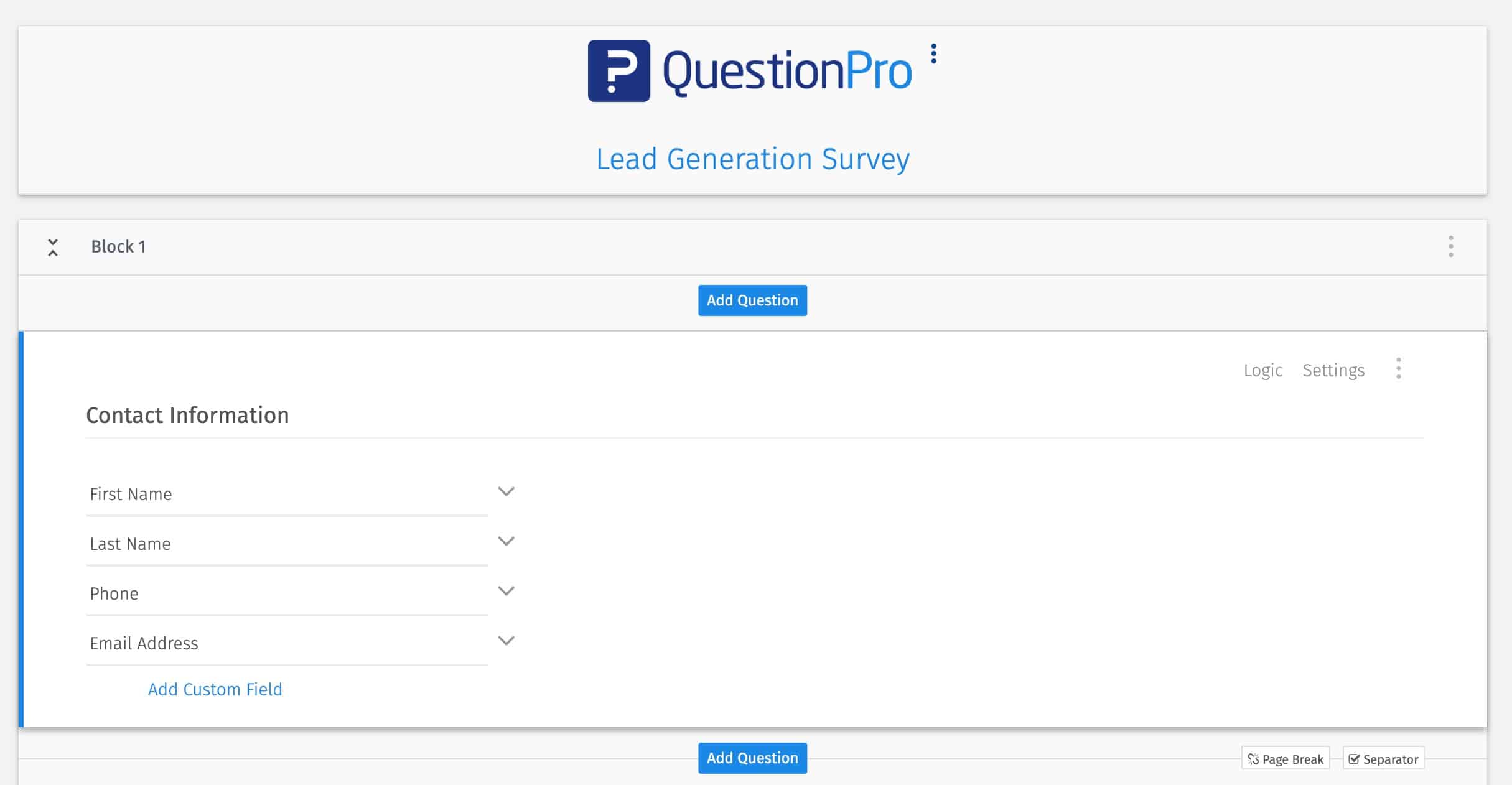
- Start a new survey and add a contact data question type to capture name, email, and phone number in one block.
- Add follow-up questions relevant to your specific offer, such as budget range or timeline.
- Customize the header, footer, and logo to match your brand.
- Set up completion options, such as a redirect page or a small incentive.
QuestionPro’s survey software supports this workflow directly, with a dedicated contact data question type built for this exact use case. Teams building out a full pipeline often start from a lead qualification survey template rather than building from a blank form.
What features make lead follow-up easier?
A few platform features turn a completed survey into an actionable lead rather than a static record sitting in a spreadsheet.
- Automatic alerts. Notifying a sales rep the moment someone completes the survey keeps follow-up time short.
- CRM integrations. Native connections to tools like Salesforce or HubSpot, covered in more detail in this guide to CRM integration, move data into the pipeline without manual entry.
- Distribution options. Email, website embeds, offline collection, and QR codes all widen where a survey can be placed.
- Reporting. Dashboards that break results down by segment make it easier to see which lead sources are producing the strongest prospects.
Common mistakes to avoid
A few habits quietly reduce how effective a lead generation survey turns out to be.
- Asking for too much information before establishing any trust with the visitor.
- Using only closed-ended questions, which limits how much a lead can actually explain about their need.
- Skipping a clear next step after submission, leaving the visitor unsure what happens next.
- Never reviewing which questions actually predict a good lead versus which ones just add length, something a simple survey analysis pass every quarter can catch.
A short survey does more work than a longer form
The instinct to collect everything upfront usually backfires. A short, well-designed lead generation survey captures the handful of data points that matter most, respects the visitor’s time, and gives a sales team a real starting point instead of a cold contact record.
A well-crafted lead generation survey bridges the gap between passive website traffic and actionable sales opportunities. By shifting from static contact forms to dynamic, value-driven surveys, you gain the precise intelligence needed to score, segment, and nurture prospects effectively.
Frequently Asked Questions (FAQs)
Yes, in most cases. A standard form only captures contact details, while a short survey adds qualifying information that helps a sales team prioritize and personalize follow-up, without adding much friction if kept to five or fewer extra questions.
It depends on the offer. Gating a high-value resource behind a short survey tends to produce more qualified leads, while an ungated survey works better for lower-commitment offers where the goal is volume over qualification depth.
Faster is better. Leads contacted within the first hour after completing a survey convert at meaningfully higher rates than those contacted a day or more later, a pattern consistent with lead response research from Harvard Business Review.
Yes. Once a survey exceeds roughly five minutes or ten questions, completion rates drop sharply, and visitors who abandon partway through often will not return to finish it.
A lead generation survey captures initial interest and contact details from a broad audience. A lead qualification survey goes further, asking specific questions about budget, timeline, or authority to determine whether a lead is ready for direct sales follow-up.