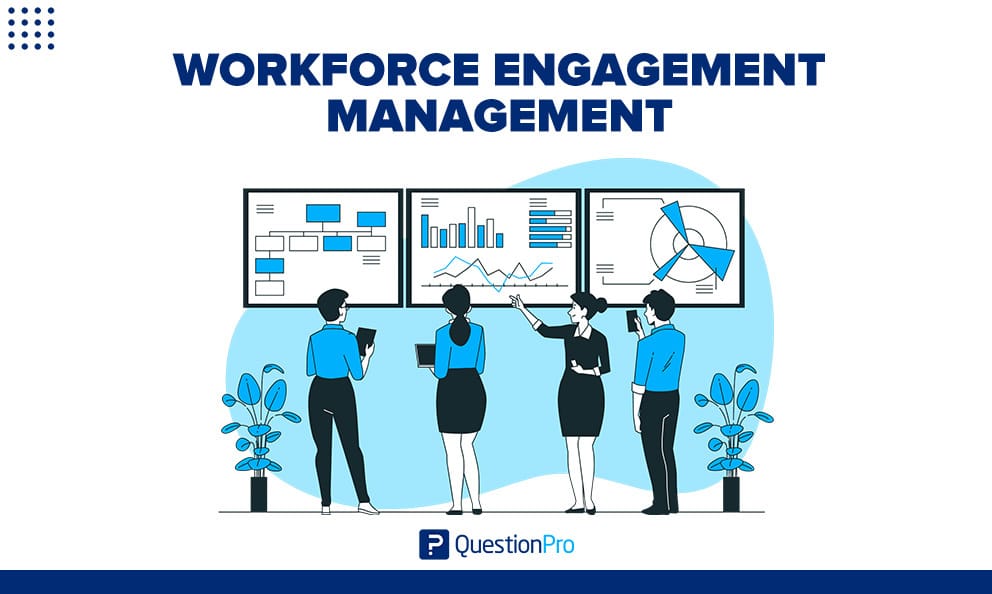
Workforce engagement management is the ongoing practice of building employees’ emotional commitment to their work, team, and company through leadership behavior, feedback, recognition, and growth opportunities. Done well, it turns scattered perks and one-off surveys into a repeatable system HR can actually manage and measure.
Gallup’s most recent workplace data shows why this matters: organizations with highly engaged teams report 18% higher productivity and 23% higher profitability than those with disengaged teams, according to Gallup.
One thing worth clearing up early: if you search this term, you’ll also find results about a specific contact center software category with the same name.
This guide covers the HR meaning of workforce engagement management, how the two uses differ, and how to build, measure, and improve a workforce engagement management program step by step.
What is workforce engagement management?
Workforce engagement management is a documented, repeatable plan an organization uses to build employees’ emotional commitment to their work, team, and company. It goes beyond one-time morale boosts. A real program includes clear ownership, regular measurement, and specific actions tied to what the data shows.
Most workforce engagement management programs rest on a few consistent building blocks: leadership behavior, communication, recognition, growth opportunities, and feedback loops. Companies that treat these as connected parts of one system tend to see more durable engagement gains than those running isolated initiatives like a single wellness week or an annual survey nobody follows up on.
The goal is not to make employees happy in a vague sense. It is to create the conditions- role clarity, a sense of purpose, and trust in leadership, where people choose to bring their full effort to work.
Workforce engagement management vs. contact center WEM software
These two things share a name and get confused constantly online, but they describe different practices built for different audiences. Workforce engagement management, in the HR sense covered in this guide, is a broad leadership practice that applies to any organization trying to build a more committed workforce, from retail to logistics to professional services.
Contact center WEM, by contrast, has become a specific software category. Vendors in that space define it as a suite of tools for agent scheduling, quality monitoring, and coaching, built on top of older workforce management systems, and marketed almost exclusively to call centers and customer service operations.
If your goal is a company-wide plan to raise engagement among office staff, sales teams, or remote employees, you are looking for workforce engagement management in the HR sense, not a WEM platform. If you run a call center and need agent scheduling and quality scoring tools, contact center WEM software is the closer match. Confusing the two can send HR teams shopping in the wrong software category entirely.
Why workforce engagement management matters right now
Engagement is not trending in a good direction on its own. Gallup’s global data shows engagement has been falling in recent years, and low engagement now costs the world economy an estimated $10 trillion annually, roughly 9% of global GDP, according to Gshowallup.
In the United States specifically, engagement sits at 31% as of 2025. That leaves a majority of the workforce not fully engaged, which shows up directly in turnover costs, absenteeism, and inconsistent customer service.
A deliberate program addresses three problems at once:
- High employee turnover and the recruiting costs that come with replacing people
- Rising absenteeism, which quietly drags down team output
- Low motivation among employees who feel disconnected from company goals
Organizations that treat engagement as a strategic function, not an HR afterthought, consistently outperform peers on retention and profitability, based on the same Gallup benchmark data referenced above.
Core elements of an effective workforce engagement management program
Every workforce engagement management program needs a few core components working together. Skipping one usually means the whole plan underperforms, even if the other pieces are strong.
| Element | What it covers |
|---|---|
| Leadership behavior | Managers who set clear expectations and follow through on commitments |
| Continuous feedback | Regular check-ins and surveys instead of a single annual review |
| Recognition | Timely, specific acknowledgment of good work, not just tenure awards |
| Growth and development | Clear paths for skill building and advancement inside the company |
| Well-being support | Benefits and workload practices that protect physical and mental health |
How to build a workforce engagement management program in 6 steps
Building the program is where most organizations either commit or stall. These six steps keep the process grounded in data rather than guesswork.
- Measure the current state.
Run an employee engagement survey to establish a baseline before changing anything.
- Identify the two or three biggest drivers.
Look for specific factors, unclear expectations, weak recognition, limited growth, dragging your scores down.
- Set measurable goals.
Tie targets to business outcomes such as retention rate or eNPS, not vague statements like “improve morale.”
- Assign clear ownership.
Engagement fails as an initiative when it belongs to everyone and no one. Give a named owner accountability for progress.
- Roll out targeted actions.
Match interventions to the drivers you found, for example, manager training if leadership behavior scored low.
- Review and adjust quarterly.
Use short pulse surveys to check whether actions are actually moving the numbers.
What a strong program looks like in practice
Consider a 400-person logistics company that found its warehouse teams had the lowest engagement scores in the business, driven mainly by unclear shift scheduling and little recognition for consistent attendance. The HR team introduced a simple recognition program tied to safety and attendance milestones, gave shift supervisors a short weekly huddle script, and started running a two-question pulse check every other week.
Within two quarters, voluntary turnover in that department dropped noticeably, and supervisors reported fewer last-minute callouts. Nothing about the fix required new software or a large budget. It required identifying the actual driver of disengagement and acting on it directly, which is the core discipline behind any working program.
How to measure whether the program is working
Measurement is what separates a real program from a well-intentioned initiative that fades after a quarter. Without tracking, it is impossible to know if actions are helping or simply keeping the team busy.
Track a small set of indicators consistently rather than a large dashboard nobody reviews:
- Employee Net Promoter Score (eNPS): How likely employees are to recommend the company as a place to work
- Engagement survey scores over time: Trended quarterly, not just an annual snapshot
- Voluntary turnover rate: A lagging but reliable signal of sustained disengagement
- Participation rate: Whether employees are even responding to surveys and check-ins
A 360 feedback process can add another layer by showing how engagement shows up in day-to-day manager and peer interactions, not just in survey responses. Many teams pair this feedback loop with broader survey software so all the data lives in one place instead of scattered spreadsheets.
Common mistakes that quietly sink engagement programs
Even well-funded engagement efforts fail for predictable reasons. Watching for these early can save months of wasted effort.
- Treating the annual survey as the entire program instead of one input into it
- Collecting feedback and never communicating what changed as a result
- Letting managers opt out of accountability for their own team’s scores
- Copying another company’s perks program without checking if it addresses your actual drivers
- Measuring activity, like events hosted, instead of outcomes, like retention
Each of these mistakes shares a root cause: treating engagement as a project with an end date rather than an ongoing management practice.
Choosing the right tools to support the program
Most of the steps above depend on collecting and acting on feedback consistently, which is hard to sustain with scattered forms and spreadsheets. Platforms like QuestionPro Employee Experience let HR teams run engagement surveys, pulse checks, and feedback loops from one place, and connect the results directly to employee engagement ideas that map back to specific drivers. The tool matters less than the discipline of using it consistently, but the right platform removes a lot of the friction that causes engagement programs to quietly stall.
Engagement is a leadership habit, not a one-time project
The organizations that sustain high engagement over years, not just for one good quarter, treat it the same way they treat sales targets or safety metrics: something reviewed regularly, owned by named people, and adjusted when the data says to adjust. A program document sitting in a shared drive does nothing on its own. Consistent measurement and follow-through are what actually move the numbers, quarter after quarter.
Frequently Asked Questions (FAQs)
Satisfaction measures whether employees are content with pay, benefits, and conditions. Engagement measures whether they feel emotionally invested enough to go beyond the minimum. A satisfied employee can still be disengaged and do just enough to get by.
Most US companies combine one in-depth annual survey with shorter pulse surveys every two to four weeks. This mix gives a full picture once a year while catching problems early enough to fix before they show up in turnover data.
An eNPS above 10 is generally considered good, and scores above 50 are excellent. Context matters more than the raw number, so track your own trend over time rather than only comparing against industry benchmarks.
Yes. The logistics example above cost almost nothing beyond staff time. Recognition, clear communication, and listening to feedback drive more engagement impact than expensive perks, especially in companies under 500 employees.
HR typically owns the process and measurement, but line managers own execution with their own teams. Programs that rely solely on HR to fix engagement without manager buy-in rarely produce lasting results.