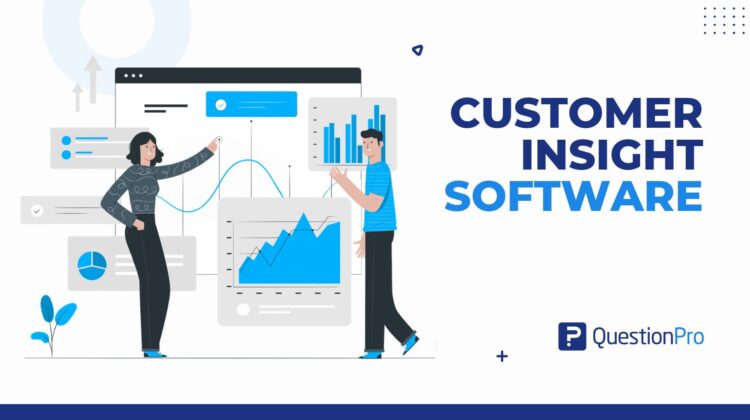
Customer insight software is a category of tools that collects customer data, analyzes it, and turns it into decisions. Companies use it to learn why customers buy, stay, complain, or leave, instead of guessing from sales numbers alone.
The category is broad. A survey tool, a research community, and a text analytics engine all count, and each answers a different question. Picking the wrong one wastes budget and leaves your real questions unanswered.
In this blog, we’ll define the category, compare the main types, and show how to choose, measure, and avoid common mistakes with these tools.
What is customer insight software?
Customer insight software is a set of tools that collects customer feedback and behavior data, analyzes it, and explains the reasons behind customer actions. It answers “why” questions, such as why one segment churns or why a new feature goes unused.
An insight is a finding that explains a behavior and points to an action. A chart showing that your satisfaction score fell five points is data. Learning that late deliveries caused the drop is an insight.
Most tools pull from four kinds of evidence:
- Stated feedback: What customers say in surveys.
- Written comments: Reviews, support tickets, and open-ended answers.
- Behavior: What customers do inside your product or on your site.
- Conversation: What customers discuss in communities or on social channels.
The software then connects those sources. A team can see patterns no single source shows.
How is customer insight software different from similar tools?
Customer insight software is often confused with CRM, customer analytics, and market research tools. The difference is the question each one answers.
| Tool type | Main question | Typical data | Typical output |
|---|---|---|---|
| CRM (customer relationship management) | Who is this customer and what is their history? | Contacts, deals, support tickets | Account records |
| Customer analytics software | What are customers doing, and what will they do next? | Transactions, behavior logs | Churn scores, funnels |
| Market research software | What does a wider market think? | Panel and prospect surveys | Segment sizes, concept scores |
| Business intelligence (BI) | What happened across the business? | Sales, finance, operations | Dashboards |
| Customer insight software | Why do customers think and act this way? | Surveys, comments, communities, behavior | Themes, drivers, recommendations |
Vendors also say customer insight platform for the same category. A platform usually implies a broader suite with several modules. In practice, the categories overlap, so choose by the question you ask most often.
What are the main types of customer insight software?
Six types cover most of the market. Each one collects a different kind of evidence, so most teams combine two or three.
Survey and feedback platforms
These tools ask customers directly through surveys, Net Promoter Score (NPS) questions, and satisfaction questions. They give structured numbers you can compare over time.
- Best for: Tracking satisfaction and benchmarking segments
- Watch out for: Scores alone rarely explain the cause
- Examples: QuestionPro, Qualtrics, SurveyMonkey
A solid survey software option is usually the first building block, because it creates data you own.
Voice of customer platforms
Voice of customer (VoC) is the practice of capturing what customers say across every channel. VoC platforms combine surveys, support tickets, reviews, and call transcripts in one place, which makes voice of customer analytics possible at scale. Medallia, InMoment, and Qualtrics are well-known examples, and they suit companies with feedback scattered across many channels.
Text and sentiment analytics
Text analytics software reads open-ended comments and groups them into themes with a sentiment score. Sentiment analysis labels each comment as positive, negative, or neutral. Together they turn thousands of comments into a ranked list of issues.
- Best for: Teams drowning in comments no one has time to read
- Examples: Thematic, Chattermill, Enterpret
Research communities
An online research community is a private group of customers who agree to answer surveys, join discussions, and test ideas over time. It supports follow-up questions that a one-off survey cannot. Concept testing, product ideas, and ongoing dialogue are the strongest uses, and QuestionPro Communities is one example.
Behavior and product analytics
These tools record what customers do inside an app or website, such as clicks, funnels, and drop-off points. They show what happened but not why.
- Best for: Finding where users struggle
- Examples: Mixpanel, Amplitude, Hotjar
Social listening tools
Social listening tools track brand mentions and conversations across public channels. They give early warning of reputation problems. They also show how people talk about you when nobody asked them. Brandwatch and Sprout Social are common examples, and they suit brand monitoring and campaign reaction best.
Why do businesses need customer insight software?
Businesses need it because customer behavior changes faster than quarterly reports can show. Insight software shortens the time between a customer problem and a fix.
The link to results is well documented. A McKinsey survey of 400 senior managers found that 50 percent of customer-analytics champions reported sales well above their competitors, compared with 22 percent of laggards. The study shows an association, not proof of cause, and it dates from 2014. Treat it as directional evidence.
The practical benefits are easier to see in daily work:
- Faster product decisions: Teams see demand and friction before launch, not after.
- Earlier churn warnings: Falling scores and negative comments flag at-risk accounts.
- Sharper targeting: Segments are built on stated needs, not only demographics.
- Closed-loop recovery: Unhappy customers get a follow-up before they leave.
- Lower research cost: Past findings get reused instead of repurchased.
How do online communities turn customer conversations into insight?
Online communities turn conversations into insight by letting a company ask questions, listen to the answers, and follow up. Customers stop being an audience and become contributors.
Social support is the first signal. It goes beyond a help desk or a brand page. In a community, customers answer each other’s questions, share workarounds, and explain how they really use a product. A support team sees one ticket at a time. A research team sees the pattern across hundreds of threads.
Idea sharing adds a second signal. When members post product ideas and others rate and comment on them, you see demand ranked by the people who would use the feature. That tells you more than a single survey question asking what features people want.
A survey gives you a snapshot. A community gives you a conversation.
Engagement also pays off outside research. Customers who feel heard are more likely to recommend a brand to others. If you plan to build one, start with a clear picture of how online research communities recruit, reward, and retain members.
Real-world examples of customer insight software in action
These illustrative scenarios show how different teams move from a signal to an action. They are composites, not client case studies.
| Team | Signal | Software used | Insight | Action |
|---|---|---|---|---|
| Online retailer | Repeat purchase rate drops | Survey platform plus text analytics | Customers say packaging damage, not price, drives returns | Change packaging supplier |
| SaaS company | Trial users stop after day three | Product analytics plus a short in-app survey | A confusing import step blocks setup | Rewrite onboarding flow |
| Regional bank | Branch satisfaction scores slip | VoC platform | Wait times spike at lunch hour | Adjust staffing schedule |
| Hospital group | Patient comments mention discharge confusion | Text and sentiment analytics | Instructions differ between units | Standardize discharge paperwork |
Each row follows the same path. A number raised a question, a second source explained it, and a named owner acted on it.
What features should customer insight software have?
The right features depend on your questions, but eight capabilities separate useful tools from basic survey forms. Use this list as a checklist when you compare vendors.
- Multichannel data collection: Surveys, email, web, mobile, and imported tickets or reviews.
- Text and sentiment analysis: Automatic theme detection for open-ended comments.
- Segmentation: The ability to split results by customer type, region, or product line.
- Real-time dashboards and alerts: Role-based views and notices when a score drops.
- Integrations: connections to your CRM, help desk, and BI tools so data flows both ways.
- Closed-loop workflows: Routing of unhappy responses to a named owner.
- Governance and privacy controls: Permissions, data retention settings, and audit trails.
- AI search and summaries: Natural language questions answered with links to the source.
Step-by-step guide to choosing customer insight software
Choose by starting with your questions, not with vendor demos. This process keeps the shortlist honest and the decision defensible.
- Write down your three most important customer questions.
Examples: why do customers cancel, which feature should we build next, where does onboarding fail.
- Match each question to a data type.
Survey answers, comments, behavior logs, or community discussion.
- Audit what you already own.
Your CRM and help desk may already hold usable data.
- Score three vendors on a weighted scorecard.
One workable split: fit with your questions (30), integrations (20), ease of use (20), analysis depth (15), cost (15).
- Run a 30-day pilot on one real question.
Set the success test before you start, such as “find the top three churn drivers.”
- Check security, privacy, and support.
Ask where data lives and who can see it.
- Name an owner.
Software without an owner turns into shelfware.
If you want a narrower comparison of single products, the customer insight tool guide covers evaluation criteria in more detail.
How much does customer insight software cost?
Pricing runs from free tiers to custom enterprise contracts, so the better question is what drives the price. Vendors rarely publish enterprise rates, which makes written quotes essential.
Even within one vendor comparison from SentrequireiSum, plans range from free tiers on product analytics tools to enterprise suites that need a custom quote. Four pricing models appear most often:
- Per seat: You pay for each user who logs in.
- Per response or volume: Cost scales with surveys sent or comments analyzed.
- Module license: You buy survey, text analytics, and community features separately.
- Custom enterprise quote: Pricing depends on data volume, channels, and support level.
Ask for total cost, not list price. Include implementation, training, integrations, extra data connections, and the renewal increase.
How do you measure whether customer insight software is working?
Measure it by whether insights lead to actions and whether customer outcomes improve. Three scores recur below. NPS (Net Promoter Score) measures willingness to recommend. CSAT (customer satisfaction score) measures satisfaction with a specific interaction. CES (customer effort score) measures how easy a task felt.
| Metric | What it shows | How to track it |
|---|---|---|
| Time to insight | Speed from question to answer | Days from request to finished finding; target a 50% cut against your baseline |
| Action rate | Whether insights change anything | Insights acted on divided by insights delivered; set a threshold such as 50% |
| Active usage | Whether teams adopt the tool | Share of licensed users active monthly; aim for 70% or more |
| Outcome movement | Whether fixes work | NPS, CSAT, CES, or churn for the segment you changed, before and after |
| Data coverage | How much of the customer voice you capture | Share of tickets, reviews, and responses analyzed |
| Cost per acted insight | Return on spend | Total annual cost divided by insights acted on |
Targets here are starting points. Adjust them to your baseline after the first quarter.
Common mistakes and risks when using customer insight software
Most failures come from process, not technology. Knowing the failure patterns helps you avoid them before you buy.
- Buying before defining the question.
Tools get chosen for features and then searched for a use.
- Collecting data nobody owns.
Dashboards go unread when no one is accountable for action.
- Treating scores as insight.
A rising NPS tells you nothing about the cause.
- Ignoring sample bias.
Only vocal customers answer, so quiet segments disappear from the picture.
- Keeping sources in silos.
Survey data in one tool and tickets in another hide the link between them.
- Over-surveying.
Too many requests lower response rates and annoy loyal customers.
- Overlooking privacy rules.
The California Consumer Privacy Act lets California residents ask what data a business collects, request deletion, and opt out of its sale or sharing. Your tool must support those requests.
How is AI changing customer insight software?
AI changes customer insight software by automating the slowest work: reading comments, tagging themes, and searching past research. Analysts spend less time sorting and more time deciding.
Most of the gains come from natural language processing (NLP), which is software that reads and interprets human language. NLP groups comments into themes, scores sentiment, and writes short summaries. Newer tools accept a plain question, such as “why did enterprise satisfaction fall last quarter?” They return an answer with links to the underlying data.
AI also brings risks. Summaries can miss nuance or state something the data does not support. Look for tools that cite their sources, and have a person check a sample of AI-tagged comments each month before you trust the output.
How QuestionPro supports customer insight work
QuestionPro covers customer insight work through three connected tools: customer experience feedback, research communities, and a searchable library of past research. Each one handles a different step, from collecting evidence to reusing it.
- QuestionPro Customer Experience: QuestionPro Customer Experience gathers feedback from surveys, tickets, reviews, and digital behavior. Its AskWhy question pairs each score with the customer’s own reason, so you do not need to guess the cause. Text analytics adds sentiment and themes, and closed-loop routing sends detractor responses to an owner.
- QuestionPro Communities: Members take part in Live Discussions, where they post product ideas that other members rate and comment on. Gamification and rewards keep members active over time.
- QuestionPro InsightsHub: QuestionPro InsightsHub connects surveys, community discussions, reports, and files from Google Drive or SharePoint. Teams ask questions in plain language and get source-backed answers, which stops the same study from being run twice.
Insight only matters when someone acts on it
The best customer insight software is the smallest set of tools that answers your most important question reliably. A modest survey platform used well beats a large suite that no one opens.
Start with the question, pick the data that can answer it, and give one person responsibility for the follow-through. Then review results each quarter. Add a second source, such as text analytics or a community, only when the first one stops explaining the numbers.
Customers tell you a great deal when you ask well and respond visibly. The software is only the channel. The advantage comes from how quickly your team turns what customers say into something they can see.
Frequently Asked Questions (FAQs)
Yes, when it answers a specific question. Small teams often begin with a survey tool or a free product analytics plan. They add text analysis or a community once comment volume exceeds what one person can read manually.
No. A CRM stores records such as contacts, deals, and tickets, while insight software explains why customers behave as they do. Most insight tools integrate with a CRM so account data and feedback appear together for sales and support.
It depends on integrations. A survey-based tool can launch within days. Suites that connect several data sources take longer because of data mapping, user permissions, and team training. Pilot one question first to prove value early.
The US has no single federal privacy law, so rules vary by state. California’s CCPA gives residents access, deletion, and opt-out rights. Check consent capture, retention limits, and vendor data processing terms before you collect personal data.
A research or customer experience team usually owns it, with product, marketing, and support as regular users. Assign one named owner who runs a monthly review and tracks whether insights have turned into shipped changes.