Employee benefits are a core part of any competitive compensation package today, not an optional extra. From legally required insurance to flexible schedules, the right mix of benefits directly affects whether a company attracts and keeps strong talent.
In this blog, we break down what employee benefits are, why they matter, the main types available, how to choose the right ones, and real examples that improve retention.
What are employee benefits?
Employee benefits are forms of compensation employers provide in addition to regular pay, covering things like insurance, retirement savings, paid leave, and flexible work arrangements.
Common categories include:
- Group insurance (health, dental, life)
- Retirement contributions
- Tuition or student loan assistance
- Paid time off
- Flexible work arrangements
Since the workforce is an organization’s most valuable asset, understanding what employees actually value, rather than assuming, is what separates a benefits package that works from one that doesn’t. Regular employee engagement surveys are one of the most direct ways to find out, since assumptions made by leadership frequently diverge from what employees actually report wanting when asked directly.
Globalization has expanded what “flexible” benefits mean in practice. A company with teams across multiple time zones, for example, often needs to offer flexible working hours just to keep communication functional across regions, which counts as a benefit even though it costs nothing to provide.
Why are employee benefits important?
Employee benefits matter because they directly affect whether a company can attract and keep skilled employees in a competitive labor market.
MetLife’s 2026 Employee Benefit Trends Study found that employees who feel genuinely cared for by their employer are about 1.3 times more likely to stay and 1.2 times more productive. That gap alone justifies real investment in a benefits strategy beyond the legal minimum.
A few reasons benefits matter specifically:
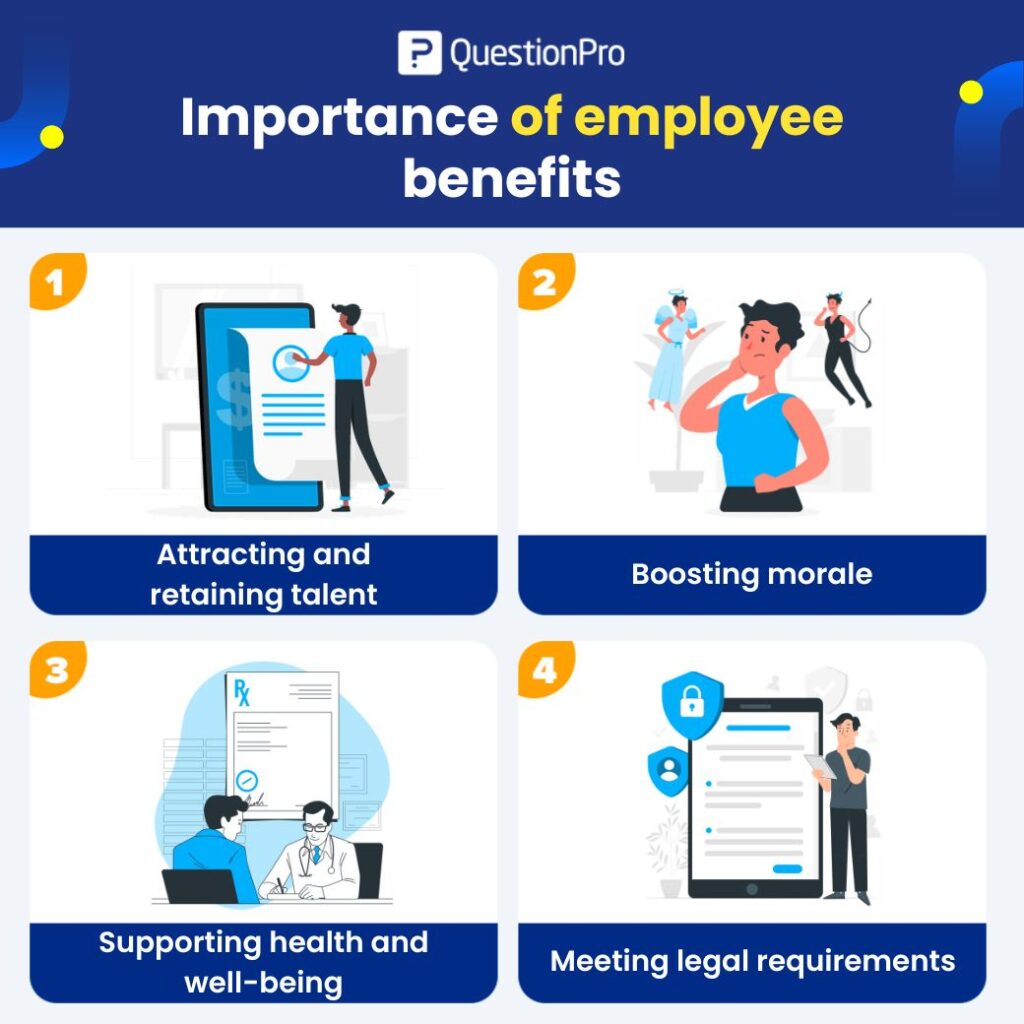
- Attracting and retaining talent: Competitive benefits help a company compete for skilled candidates who have more options than ever, which is central to any talent management strategy.
- Boosting morale: Employees who feel cared for through health insurance, PTO, or retirement contributions tend to show more loyalty.
- Supporting health and well-being: Wellness programs and health coverage directly support employee productivity.
- Meeting legal requirements: Certain benefits, like workers’ compensation, are legally mandated, and skipping them creates real legal exposure.
Well-being has become inseparable from compensation in employees’ own minds. Wellhub’s 2026 Work-Life Wellness Report found that 86 percent of employees consider their well-being as important as their salary, which is a meaningful shift from treating benefits as a secondary consideration.
That shift changes how benefits conversations should happen internally. A benefits package pitched purely as a cost center misses the point. Framed correctly, it’s one of the more direct levers a company has over retention and morale, alongside pay itself.
What are the most common types of employee benefits?
Employers choose from a range of benefit types depending on company size, industry, and budget.
| Benefit type | What it covers |
|---|---|
| Health insurance | Medical, dental, and vision costs for employees and dependents |
| Retirement plans | 401(k), IRA, or pension contributions |
| Paid time off | Vacation, sick days, and personal days |
| Flexible work arrangements | Remote work, flexible schedules, or part-time options |
| Disability insurance | Income replacement if an employee can’t work due to illness or injury |
| Life insurance | Financial support for a beneficiary’s family |
| Wellness programs | Gym memberships, fitness classes, or health coaching |
| Education assistance | Tuition reimbursement or student loan repayment |
| Employee assistance programs | Counseling, legal, or financial planning support |
Most companies combine several of these rather than offering just one, since different employees value different benefits depending on their life stage and personal circumstances. Two categories deserve a closer look, since demand for both has grown noticeably in recent years.
What do family and caregiving benefits include?
Family and caregiving benefits help employees manage responsibilities outside of work, an area where employer support has historically lagged behind demand.
- Childcare support or subsidies
- Backup childcare for last-minute coverage
- Parental and caregiver leave
- Eldercare support
- Fertility and adoption assistance
Caregiving support has become more urgent as employees juggle work with responsibilities for children, aging parents, or family members needing care. Recent reporting found that many U.S. workers still struggle with caregiving demands, while only a small share of employers currently offer eldercare-specific support, making this an area where offering something meaningful can set an employer apart.
What do learning and development benefits include?
Learning and development benefits help employees build skills and grow within the organization, which ties directly into retention.
- Tuition reimbursement
- Certification and licensing support
- Conference or learning budgets
- Mentorship programs
- Internal mobility support
These benefits signal that a company is investing in an employee’s future, not just their current role, which is a meaningful driver of long-term retention beyond what compensation alone achieves.
Which employee benefits are legally required and which are optional?
Legally required benefits are ones employers must provide under applicable law, while optional benefits are additional offerings employers choose to attract and retain talent.
| Category | Examples | What to know |
|---|---|---|
| Legally required | Workers’ compensation, unemployment insurance, certain leave protections | Requirements vary by location, company size, and employee classification |
| Optional | Health insurance, retirement contributions, wellness programs, education assistance | These drive competitiveness but aren’t legally mandated |
| Location-dependent | Paid sick leave, parental leave, disability coverage | Required in some regions, optional in others |
This distinction matters more than it might seem. Employees experience every benefit as part of their total compensation regardless of which bucket it falls into, so treating the “required” ones as the bare minimum rather than the whole strategy is what separates a merely compliant employer from a genuinely competitive one.
How do you choose the right employee benefits for your team?
Choosing the right benefits mix starts with understanding your specific workforce’s needs and budget realities, not copying a competitor’s package.
A few factors worth weighing before finalizing a benefits strategy:
- Budget reality. The Bureau of Labor Statistics estimates benefits cost roughly 29 percent of total compensation on average, so a realistic budget needs to account for this from the start, not as an afterthought.
- Workforce demographics. A younger workforce may prioritize student loan assistance, while a workforce with more caregivers may value childcare support or flexible scheduling more.
- Industry norms. Some benefits are close to mandatory in certain industries simply because every competitor offers them.
- Actual employee input. Guessing what employees want, rather than asking directly, is one of the most common and costly mistakes in benefits planning.
Rolling out an expensive new benefit nobody asked for, while ignoring a cheaper one employees have been requesting, is a common and avoidable mistake. Direct employee input consistently outperforms internal assumptions about what a workforce actually wants.
A mid-sized company that assumed its workforce wanted a fancier health plan, only to find through a survey that flexible scheduling mattered far more, is a common story. The health plan upgrade cost significantly more and moved satisfaction scores less than the scheduling change would have.
What are real examples of strong employee benefits programs?
A few concrete program examples show how companies put these benefit types into practice, without necessarily needing a massive budget to do it.
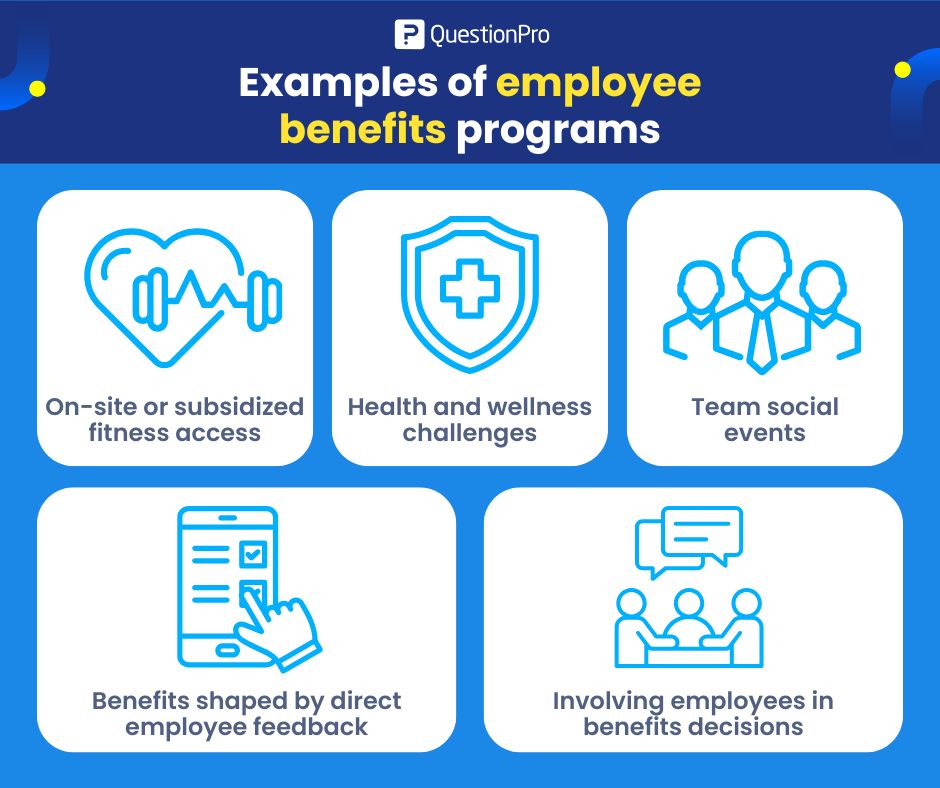
- On-site or subsidized fitness access: Some companies convert unused office space into a workout area or cover gym membership costs, reducing sick days and supporting a healthier workforce.
- Health and wellness challenges: Organizing fitness competitions or health awareness sessions builds engagement around wellness benefits that might otherwise go unused.
- Team social events: Recurring team dinners, game nights, or casual Friday activities help reduce workplace stress and build cohesion outside of formal work tasks.
- Benefits shaped by direct employee feedback: Companies that survey employees specifically about benefits, rather than guessing, tend to design packages that actually get used. Structured employee feedback channels make this a repeatable process instead of a one-time guess.
- Involving employees in benefits decisions: Regular check-ins where employees weigh in on upcoming policy changes build a sense of ownership that a top-down rollout never achieves.
The common thread across all five examples is that none of them require a massive budget. What they require is actually asking employees what they need, then following through.
What survey questions measure employee benefits satisfaction?
The most useful benefits survey questions ask employees directly about satisfaction, awareness, and gaps, rather than assuming leadership already knows the answers.
A few questions worth including in a benefits survey:
- How satisfied are you with our current benefits package overall?
- Which benefits do you use most regularly?
- Are there benefits we currently offer that you were not aware of?
- What benefit would have the biggest impact on your day-to-day work life if we added it?
- On a scale of 0 to 10, how likely are you to recommend this organization to a friend or colleague, considering your overall experience?
- How well do our current benefits fit your life outside of work?
Running this kind of survey once a year, or even once every six months, reveals patterns in satisfaction and utilization that a single annual open-enrollment period never surfaces on its own. Pairing benefits satisfaction data with broader employee retention strategies gives a fuller picture of why people actually stay or leave.
How does QuestionPro help measure employee benefits satisfaction?
QuestionPro Employee Experience Software helps HR teams track whether satisfaction with a specific benefit is improving or declining over time, rather than relying on a single annual snapshot.
Segmenting responses by department, tenure, or benefit type reveals patterns a single aggregate satisfaction score hides, like a wellness program that’s popular with one team but completely unused by another. That kind of segmented tracking turns a benefits survey from a once-a-year checkbox into an ongoing signal HR can actually act on.
A benefits team running the same six questions quarterly, rather than once a year, can catch a satisfaction drop within a single quarter instead of discovering it eight months later at the next open enrollment period.
Getting your benefits strategy right
Employee benefits are more than workplace perks. They are a core part of compensation, employee experience, and talent strategy.
A strong benefits package is never really finished. Employee needs shift as the workforce changes, and a package that worked two years ago can quietly stop fitting the people it’s meant to support.
A few habits keep a benefits program from going stale:
- Re-survey satisfaction at least once or twice a year, not just at open enrollment
- Track utilization, not just enrollment, to spot benefits nobody actually uses
- Act on what feedback reveals, rather than filing it away
- Revisit the mix whenever the workforce demographics shift meaningfully
Regularly surveying employees and acting on what comes back, not just collecting the data, is what keeps a benefits package genuinely competitive rather than just technically compliant.
Frequently Asked Questions (FAQs)
Compensation refers to direct pay, like salary or hourly wages. Employee benefits are additional forms of value provided on top of pay, such as insurance, retirement contributions, and paid time off.
Some are. Workers’ compensation and unemployment insurance are legally mandated in most cases, while benefits like wellness programs or education assistance are optional additions employers choose to offer.
Benefits typically account for around 29 percent of total compensation on average, though this varies by industry, company size, and the specific mix of benefits offered.
Most organizations benefit from reviewing their benefits package at least annually, with a shorter satisfaction survey run more frequently to catch shifts in employee needs sooner, rather than waiting for the next full annual review cycle to surface a problem.
No. Small businesses can compete effectively with a smaller, well-chosen set of benefits that genuinely fits their workforce, rather than trying to match every benefit a large company offers. A smaller, well-used package often beats a larger one nobody understands or actually takes advantage of.