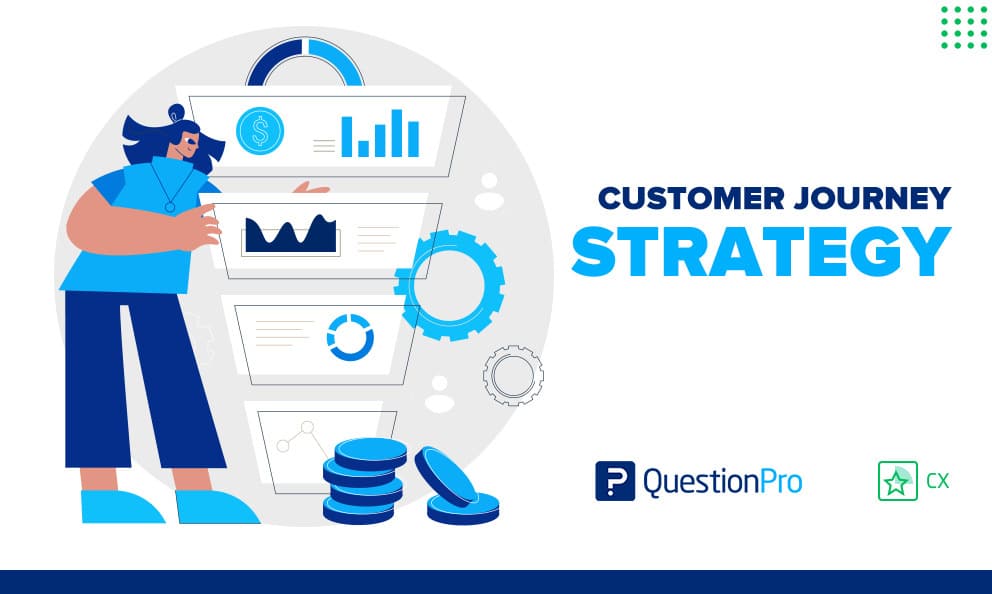
More than half of customers will switch brands after a single bad experience, and most of that damage happens long before checkout. A customer journey strategy is the plan a business uses to shape how customers feel at every stage, from the first search to the post-purchase follow-up. Done well, it turns scattered touchpoints into one connected experience.
This matters even more in the US market, where customers move fluidly across web, mobile, in-store, and support channels and expect each one to remember the last.
In this article, we’ll explore what a customer journey strategy actually includes, why it drives loyalty and revenue, and 10 ways to strengthen yours starting now.
What is a customer journey strategy?
A customer journey strategy is a documented plan for improving how customers experience every interaction with a brand, from awareness through advocacy. Unlike a one-time project, it sets ongoing priorities: which touchpoints to fix first, who owns each stage, and how success gets measured.
It differs from simply “being customer friendly” because it ties every improvement to a number. That could be conversion rate, retention, or customer effort score (CES), a metric that measures how much work a customer had to do to get an issue resolved. A strategy without a metric is just a set of good intentions.
Most strategies also connect to a broader customer experience strategy, the company-wide approach to service, product, and support that the customer journey sits inside. The journey is where that larger strategy becomes visible to the customer, one touchpoint at a time.
Customer journey strategy vs. Customer journey map: What is the difference?
A customer journey strategy is the plan. A customer journey map is one of the tools used to build it. Teams often use the terms interchangeably, then stop improving anything once the mapping workshop ends.
| Term | What it is | When to use it |
|---|---|---|
| Customer journey map | A visual snapshot of touchpoints, emotions, and pain points at one point in time | To diagnose where friction currently exists |
| Customer journey strategy | An ongoing plan for prioritizing fixes, owning stages, and tracking metrics | To decide what to act on and in what order |
| Customer experience strategy | The company-wide approach to product, service, and brand that shapes every journey | To set the standards every touchpoint should meet |
If you are starting from scratch, build a customer journey map first, then lean on established customer journey mapping tools to keep the process visual and easy for other teams to follow.
Why does a customer journey strategy matter?
A connected journey keeps customers loyal and willing to pay more. A disjointed one pushes them toward a competitor, often without any complaint first.
Personalization is one of the clearest examples. McKinsey research found that 71% of consumers expect personalized interactions and 76% get frustrated when they do not receive them. The same research shows personalization can lift revenue by 5% to 15% when it is built into the journey rather than bolted on afterward.
The bigger risk is structural. Forrester’s 2026 research on journey management points to fragile handoffs between marketing, sales, onboarding, and customer success as the reason journeys break down even at companies that care about the customer. Each handoff is a place where a customer can fall through the cracks, and in a US market full of fast-moving competitors, those cracks get wider every quarter they go unaddressed.
How to build a customer journey strategy: 10 ways to improve it
Building the strategy comes down to fixing the stages that cause the most friction first, then expanding from there. These 10 tactics cover the touchpoints that shape whether a customer stays or leaves.
01. Personalize the experience
Start by using data you already have, without waiting on a new platform to get going. Purchase history, browsing behavior, and past support interactions all signal what a customer needs next.
- Offer behavior-based discounts tied to real purchase history, not broad segments
- Serve product recommendations based on what a customer actually did, not just their demographic
- Use a short preference questionnaire so customers can tell you directly what they want
If customers cannot find what they came for, nothing else in the journey matters. Use clear calls to action, a logically arranged menu, and a search bar that returns relevant results on the first try.
Test navigation changes with real users before rolling them out. A UX survey placed after key tasks, like checkout or account setup, will show exactly where people hesitate.
03. Optimize for mobile
Mobile devices generate roughly half of all global website traffic, according to Statista, and that share climbs higher in the US during peak shopping periods.
- Reduce page weight so mobile pages load in a few seconds, not longer
- Make every element responsive across screen sizes rather than just scaled down
- Trim on-screen information and enlarge tap targets so nothing gets missed by accident
Nielsen Norman Group testing found sites built specifically for mobile scored a 64% task success rate, compared to 53% for desktop sites simply squeezed onto a phone screen.
04. Offer self-service and automated support
Many customers would rather solve a problem themselves than wait for an agent. A searchable help center and an AI-assisted chat tool can resolve common questions immediately, at any hour, without adding headcount.
Automation should handle first-line triage and simple questions, then route anything complex to a human agent with full context already attached. Nobody should have to repeat themselves after being transferred.
05. Test and refine with real customer data
Opinions about what customers want are far less reliable than data about what they actually do.
- A/B test checkout flows, pricing pages, and email subject lines against real behavior
- Pair the results with direct customer feedback to understand why a version won, not just that it did
- Retest after any major change instead of assuming an old fix still holds
06. Reduce friction at checkout
Every extra step at checkout is a chance for a customer to leave. Baymard Institute found the average cart abandonment rate sits at 70.22% across ecommerce, and unexpected costs revealed late in the process are the single biggest reason shoppers cited for walking away.
Show shipping costs and taxes early, offer guest checkout, and support more than one payment method. Small US-specific additions, like Apple Pay or buy-now-pay-later, can close the gap for mobile shoppers in particular.
07. Win back customers who abandon their journey
Not every abandoned cart or dropped signup is a lost customer. Baymard’s research puts $260 billion in recoverable US and EU orders on the table for brands that follow up well.
- Send the first follow-up within a few hours, since timing matters more than the offer itself
- Offer help finishing the purchase, not just a generic reminder
- Test whether a small incentive actually changes the outcome before adding it everywhere
08. Deliver a consistent omnichannel experience
Customers do not think in channels. They think in one continuous relationship with your brand, whether they are on your app, your website, or talking to a support agent.
An omnichannel customer journey requires connected data behind the scenes so a customer never has to re-explain their situation after switching from chat to phone. Disconnected systems, not lack of effort, are usually why this breaks down.
09. Protect customer trust and data
Security is part of the journey, not separate from it. A site without proper encryption, or a company that mishandles customer data, damages trust in a way that speed and personalization cannot fix afterward.
- Encrypt customer data end-to-end and monitor for unusual access
- Comply with state-level rules like the California Consumer Privacy Act (CCPA)
- Stay transparent about what data gets collected and why
10. Align teams across the full journey
A customer journey strategy fails when marketing, sales, support, and product teams each optimize their own numbers without talking to each other. The handoffs between departments are exactly where Forrester’s research shows most journeys break down.
Give every team visibility into the full journey, not just their piece of it, and assign clear ownership for each stage. Shared metrics work better than department-specific ones because they force collaboration instead of competition.
Real-world customer journey strategy examples
Sephora connects loyalty data across its app, website, and physical stores, so a shopper’s purchase history and preferences follow them into whichever channel they use next. That consistency is a core reason its loyalty program remains one of the most cited examples in retail.
Amazon built its journey strategy around personalized recommendations shown at nearly every stage, from browsing to post-purchase emails. The recommendations are based on real behavior rather than broad customer segments, which keeps them relevant instead of generic.
Zappos invested heavily in self-service resources and a support team empowered to solve problems without a script. Customers can find answers themselves for routine questions, and when they do need a human, that interaction is treated as a chance to build loyalty rather than just close a ticket.
For a broader set of walkthroughs across industries, see these customer journey examples with templates you can adapt.
How to measure a customer journey strategy
A journey strategy only works if you can tell whether it’s working. Pair qualitative feedback with behavioral data so you see both what customers say and what they actually do.
| Metric | What it measures | Best used for |
|---|---|---|
| Net Promoter Score (NPS) | Overall likelihood a customer would recommend you | Tracking loyalty trends over time |
| Customer Satisfaction (CSAT) | Satisfaction with a specific interaction | Evaluating individual touchpoints |
| Customer Effort Score (CES) | How much effort a task required | Spotting friction in support or checkout |
| Conversion rate | Percentage of visitors completing a goal | Measuring the impact of journey changes |
| Churn rate | Percentage of customers lost over a period | Judging long-term journey health |
Customer journey analytics brings these metrics together so you can see which stage is actually driving churn instead of guessing based on isolated reports.
Common mistakes to avoid in a customer journey strategy
Even well-intentioned teams run into the same traps. Watch for these before they undo the rest of your work.
- Treating the strategy as a one-time project instead of an ongoing practice
- Mapping the journey but never assigning ownership for fixing what it reveals
- Skipping employee alignment, so front-line teams cannot deliver on what the strategy promises
- Personalizing based on too little data, which feels intrusive instead of helpful
- Ignoring mobile checkout friction because desktop metrics still look acceptable
- Collecting feedback without closing the loop, so customers stop bothering to respond
Turning journey insights into lasting loyalty
A strong customer journey strategy is never really finished. Customer expectations shift, new channels emerge, and the touchpoints that mattered last year may not be the ones causing friction today.
What stays constant is the discipline behind it: map what customers actually experience, prioritize the stages causing the most damage, and measure whether your changes actually move the numbers. Teams that treat this as an ongoing practice, not a one-time workshop, are the ones that turn journey insights into real loyalty.
Platforms like QuestionPro’s Journey Mapping Tool support this kind of ongoing work by combining journey mapping, feedback, and analytics in one place, which makes it easier to spot where a strategy needs attention before customers start leaving quietly. For teams building a broader program, QuestionPro CX extends that same data across the full customer experience.
Frequently Asked Questions (FAQs)
Start by mapping current touchpoints and pulling in support tickets, NPS scores, and analytics to find where customers already struggle. Prioritize the single stage with the highest drop-off before expanding the strategy to other parts of the journey.
Small teams often manage the journey manually with spreadsheets and one shared inbox. Enterprises typically need dedicated software to unify data across regions, product lines, and multiple support channels serving customers across different US time zones.
Review the strategy quarterly, and after any major change to a website, pricing page, or support channel. Customer expectations and shopping technology shift faster than most annual planning cycles account for.
Yes, though B2B journeys usually involve more stakeholders, longer sales cycles, and account-based touchpoints like renewals and onboarding. B2B strategies tend to weight retention and expansion metrics more heavily than one-time conversion numbers.
Most US benchmarks put a strong customer effort score between 5 and 6 on a 7-point scale. A lower score usually signals structural friction that a journey strategy should fix before layering on personalization or new channels.