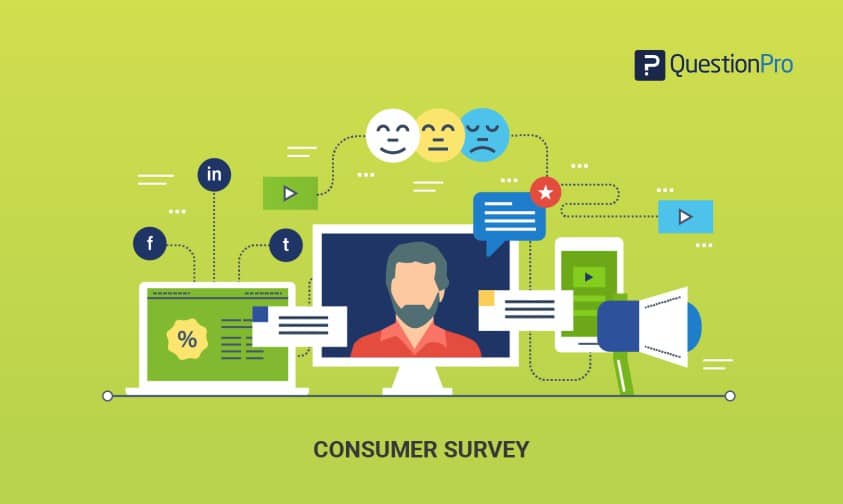
A consumer survey is a structured set of questions that asks people what they buy, why they buy it, and how they feel about it. Brands use the answers to fix products, price with confidence, and spot demand before competitors do.
Done well, a consumer survey replaces guesswork with evidence. Done badly, it produces confident numbers that point the wrong way.
In this guide, we break down the main methods, sample questions, sample sizes, and mistakes to avoid.
What is a consumer survey?
A consumer survey is a research method that collects structured feedback from consumers about their purchases, preferences, attitudes, and expectations. Companies run one to learn what people actually want, not what the company assumes they want.
Most consumer surveys measure one or more of these areas:
- Awareness: Which brands and products people know
- Preferences: Which features, prices, and designs people favor
- Behavior: How often, where, and why people buy
- Satisfaction: How well a product or service met expectations
- Demographics: Age, income, location, and household details that explain differences between groups
Because the questions are fixed, you can count the answers and compare groups. That is what separates a survey from an open conversation.
A consumer survey asks a defined group of consumers structured questions, while neighboring terms differ in who they ask or how broad they are. The table below separates the five terms people confuse most often.
| Term | Who it asks | Main goal | Typical format |
|---|---|---|---|
| Consumer survey | Target consumers, including non-buyers | Understand preferences and behavior | Structured questionnaire |
| Customer survey | Existing customers only | Measure satisfaction and loyalty | Post-purchase CSAT or NPS |
| Market research survey | Broader market, B2C or B2B | Size demand and map competitors | Mixed methods |
| Consumer research | Any consumers | Umbrella for all methods | Surveys, interviews, observation |
| Poll | Anyone | Quick opinion snapshot | One to three questions |
Consumer research is the larger discipline, and a consumer survey is one tool inside it. For the wider picture, see this guide to consumer research.
Why run a consumer survey?
A consumer survey gives teams direct evidence for decisions that would otherwise rest on opinion. The most common payoffs are below.
- Product development: Test a concept or feature list before you build it.
- Pricing: Find the price range consumers accept for a product.
- Marketing: Learn which channels and messages reach each segment.
- Brand tracking: Measure awareness and perception over time.
- Retention: Spot dissatisfaction before customers leave.
- Market entry: Gauge demand in a new region before you commit budget.
The strongest surveys start from a decision, not from curiosity. If no decision depends on the answer, drop the question.
What are the main types of consumer surveys?
Consumer surveys fall into six common types, each built around a different business decision. Pick the type first, then choose questions and a method.
- Customer satisfaction surveys: These ask how well a purchase met expectations. See these customer satisfaction survey examples for how well-known brands structure them.
- Brand awareness and perception surveys: These ask which brands people recall and which words they associate with each. A beverage brand might run one before and after a campaign to see whether recall moved.
- Concept and product testing surveys: These show a product idea, package, or name and ask for reactions. They catch weak ideas before launch costs pile up.
- Pricing surveys: These estimate what consumers will pay. The Van Westendorp method, for example, asks four price questions (too cheap, cheap, getting expensive, too expensive) to find an acceptable range.
- Usage and attitude surveys: These map how people use a category and what they believe about it.
- Consumer sentiment surveys: These track how people feel about spending and the economy. The University of Michigan has run its Surveys of Consumers since 1946 and now collects roughly 900 to 1,000 web interviews per month.
Step-by-step guide to designing a consumer survey
A consumer survey works best when you decide the objective, audience, and method before writing a single question. Follow these six steps in order.
- Set one clear objective.
Write it as a decision, such as “Decide whether to launch a smaller pack size.” - Define the target consumer.
List who qualifies and who does not, using age, location, and recent purchase behavior. - Choose the method.
Match it to your audience and budget using the sections below. - Draft the questions.
Keep each one to a single idea and group related questions together. - Pilot the survey.
Send it to 10 to 20 people from the target group and fix any confusing wording. - Launch, monitor, and close.
Watch early responses for quality problems, then stop fielding when quotas fill.
What are the main consumer survey methods?
Four methods cover most consumer survey work: online, telephone, mail, and in-person, including focus groups. Each trades cost, speed, and depth differently.
Online surveys
An online consumer survey reaches people through email, social media, a website embed, or a research panel. A research panel is a pre-recruited group of people who agree to take surveys.
- Pros: Fast, low cost per response, supports skip logic and live dashboards.
- Cons: Reaches only internet users, and self-selected samples can skew results.
Telephone surveys
Telephone surveys use live interviewers to call a sample of consumers. They reach people without reliable internet access, and interviewers can clarify questions on the spot.
The weakness is participation. Research shows telephone poll response rates fell to 6% in 2018, down from 7% in 2017. Costs per completed interview run higher as a result.
Mail and in-person intercept surveys
Mail surveys go to a home address, while intercept surveys stop shoppers in a store or at an event.
- Mail pros: Suits older or rural audiences and longer, more considered answers.
- Mail cons: Slow turnaround and low return rates.
- Intercept pros: Captures reactions in the moment of purchase.
- Intercept cons: Reaches only people who happen to be there.
Focus groups
A focus group is a moderated discussion, usually with 6 to 10 participants, that explores attitudes in depth. It tells you why people feel a certain way, not how many feel that way. Read more on focus groups and when they fit.
How do you choose the right consumer survey method?
Start with the decision the survey must support, then match the method to the question, the audience, and the budget. These rules of thumb cover most situations.
- Need numbers fast across a large audience: Run an online survey.
- Audience is offline or older: Use mail or phone, or mix modes.
- Need to understand why, not how many: Hold focus groups or interviews first.
- Need reactions at the moment of purchase: Use an in-store intercept or a QR code on the receipt.
- Need a nationally representative read: Use a probability-based sample, such as an address-based sample that invites randomly selected households.
- Unsure what to ask: Go qualitative first, then quantify the findings with a survey.
Many strong studies combine two methods. A short round of interviews shapes the questions, and a larger online survey measures them.
What are good consumer survey questions and examples?
Good consumer survey questions are specific, neutral, and tied to one decision. Mixing closed-ended questions (fixed answer options) with a few open-ended ones (free text) gives you both numbers and explanations.
Screening and demographic questions
Screening questions confirm that a respondent belongs in your target group. Demographic questions let you compare groups later.
- Have you purchased [product category] in the past three months? (Yes / No)
- Which age range applies to you?
- In which state do you live?
- How many people live in your household?
- Which range best describes your annual household income?
Place sensitive questions such as income near the end, after respondents are invested.
Purchase behavior questions
Purchase behavior questions follow the path people take to a decision, often called the consumer decision journey. Use one or two questions per stage.
| Stage | Example question | Answer type |
|---|---|---|
| Awareness | Which of these brands have you heard of? | Multiple choice |
| Consideration | Which features matter most when choosing a product like this? | Ranking |
| Purchase | Where did you buy it last time? | Single choice |
| Usage | How often do you use it? | Frequency scale |
| Advocacy | How likely are you to recommend it to a friend? | 0 to 10 scale |
The last row is the Net Promoter Score (NPS) question, a 0 to 10 rating that measures willingness to recommend.
Attitude and satisfaction questions
Psychographic questions explore values, lifestyle, and attitudes rather than facts. They usually use a Likert scale, a rating scale that runs from “strongly disagree” to “strongly agree.”
A typical item reads: “I prefer brands that use recyclable packaging.” Respondents pick one of five agreement options. Satisfaction works the same way: “How satisfied were you with your most recent purchase?” rated from very dissatisfied to very satisfied.
Open-ended questions
Open-ended questions capture reasons that fixed options miss. Use two or three per survey, because each one raises the effort for respondents.
- What is the one thing we could change to make this product better for you?
- What almost stopped you from buying?
- How would you describe this product to a friend?
How many responses does a consumer survey need?
Many consumer surveys aim for roughly 400 to 1,100 completed responses, depending on how much error you can accept. The margin of error is the range, in percentage points, within which the true population value likely falls.
Research found that a simple random sample of 1,067 people carries a margin of error of plus or minus 3 percentage points at 95% confidence. The standard formula gives the other rows below for a large population.
| Completed responses | Approximate margin of error |
|---|---|
| 100 | ±9.8 points |
| 250 | ±6.2 points |
| 385 | ±5.0 points |
| 600 | ±4.0 points |
| 1,067 | ±3.0 points |
Subgroups carry wider margins. Pew’s example shows a subgroup of about 160 cases has a margin near plus or minus 8 points, so plan enough completes for each segment you want to compare.
Track quality alongside quantity. Check the completion rate, remove respondents who finish implausibly fast, and report your response rate with the results.
How do you reach the right respondents and raise response rates?
Reaching the right respondents matters more than reaching many of them. A large sample of the wrong people still gives wrong answers.
- Screen first: Qualify people with one or two questions before the main survey.
- Set quotas: Cap completes by age, gender, and region so the sample mirrors your target market.
- Choose the source: Use your customer list for existing buyers and a panel for non-buyers or hard-to-reach groups.
- Design for mobile: Many consumers open invitations on a phone, so test every question on a small screen.
- Time the send: Avoid major holidays and test which days your audience answers.
- Send one or two reminders: A nudge after a few days recovers many non-responders.
- Match incentives to effort: A small, consistent reward works better than a large, unpredictable one.
How can QuestionPro help you run a consumer survey?
QuestionPro covers two of the hardest parts of consumer survey work: finding the right people and showing each of them only relevant questions. Both save time that teams otherwise spend on manual clean-up.
QuestionPro Audience lists a panel of 22 million panelists with more than 300 profile data points per member. That depth lets you target specific groups, such as small business owners or mobile users, instead of paying for broad reach.
Inside the survey, QuestionPro survey software supports skip logic, branching, and piping, which adapt later questions to earlier answers. QuestionPro AI can also draft a first version of a survey from a plain-language prompt, so you edit instead of starting blank.
How do you analyze consumer survey results and act on them?
Analysis turns raw answers into decisions by cleaning the data, comparing groups, and tying every finding to an owner. Many teams run this step in market research software rather than spreadsheets, because charts and cross-tabs update as responses arrive.
- Clean the data: Remove duplicates, speeders, and straight-liners, meaning respondents who pick the same answer down a whole grid.
- Segment the results: Compare age groups, regions, and heavy versus light users using cross-tabulation, which shows how answers differ between groups.
- Code the open ends: Group free-text comments into themes and count them.
- Track over time: Repeat core questions with identical wording so trends are real.
- Assign actions: Attach each finding to a decision, an owner, and a date.
A finding without an owner rarely changes anything.
What are the most common consumer survey mistakes?
The most common consumer survey mistakes come from poor question wording and weak sampling, and both are fixable before launch. The table pairs each mistake with its fix.
| Mistake | Why it hurts | Fix |
|---|---|---|
| Leading questions (“How much do you love our new design?”) | Pushes respondents toward one answer | Use neutral wording; see how to avoid survey bias |
| Double-barreled questions (“Is our price and quality good?”) | Two ideas, one answer | Split into two questions |
| Surveying only your email list | Misses non-buyers and lapsed customers | Add a panel or quotas |
| Overlong surveys | Drop-off and careless answers | Cut every question without a decision behind it |
| Skipping the pilot | Confusing wording surfaces too late | Test with 10 to 20 target consumers |
| Ignoring non-response | Low participation means responders may differ from everyone else | Report response rate and weight the data |
| Relying on stated intent alone | People overstate what they will buy | Pair intent with past behavior questions |
What a good consumer survey really delivers
A good consumer survey does not produce a pile of charts. It narrows a decision, such as which pack size to launch, which message to run, or which segment to prioritize, and it shows you how sure you can be.
The quality of that answer depends on choices made before launch: a clear objective, the right respondents, neutral questions, and enough completes to trust each comparison. Get those right and a modest survey beats a large, careless one.
Frequently Asked Questions (FAQs)
Yes. Collect only the personal data you need, state how you will use it, and honor deletion requests under laws such as the California Consumer Privacy Act. Surveys of children under 13 also need verifiable parental consent under COPPA.
A small incentive usually lifts participation, but never tie rewards to positive answers, because that biases results. Offer the same reward to everyone who completes the survey, disclose it upfront, and keep its value proportional to the time requested.
Run one before major launches, then repeat core questions on a fixed schedule, such as quarterly. Keep wording identical so trends are real. The University of Michigan’s sentiment survey runs monthly for exactly this reason.
Yes. You can survey your customer list, website visitors, or social followers at low cost. The catch is that results describe your own audience, not the wider market, so avoid presenting them as market-wide findings.
No single benchmark applies, because rates vary by channel and audience. Pew’s telephone polls fell to 6% in 2018 and still informed research. Judge quality by how well respondents match your target group, and report your rate openly.