Ecommerce survey questions are the structured prompts online stores use to find out why shoppers buy and why they leave. They also reveal what would bring a shopper back. A single well-placed question can explain a drop in conversion rate faster than weeks of staring at analytics dashboards.
Most online stores only get one shot at a first impression. A shopper who hits a confusing checkout page or an out-of-stock item rarely leaves a review explaining why. They just leave. The right survey question, asked at the right moment, turns that silence into usable feedback.
In this blog, we’ll explore 45+ ecommerce survey questions by stage. It covers everything from pre-purchase browsing to post-delivery support, plus how to choose, distribute, and act on the answers.
What Are Ecommerce Survey Questions?
Ecommerce survey questions are questions an online store asks shoppers to measure satisfaction and uncover friction. The answers guide product and website decisions. They cover the full shopping journey: browsing, product research, checkout, delivery, and support.
Unlike a generic customer satisfaction survey, ecommerce survey questions are tied to a specific moment in the buying journey. A question about shipping speed means little if it is asked before checkout. A question about product discovery means little if it is asked after delivery. Matching the question to the moment is what makes the data usable.
Online stores typically mix three question formats:
- Closed-ended questions (multiple choice or rating scale): produce data that is easy to compare over time.
- Open-ended questions: explain the reasoning behind a score.
- Scored metrics (NPS, CSAT, CES): track trends over months, not just one visit.
NPS vs. CSAT vs. CES: Which Metric Fits Your Ecommerce Survey?
These three metrics get confused constantly because they all use a numbered scale, but each answers a different question. Picking the wrong one means collecting data that does not match the decision you are trying to make.
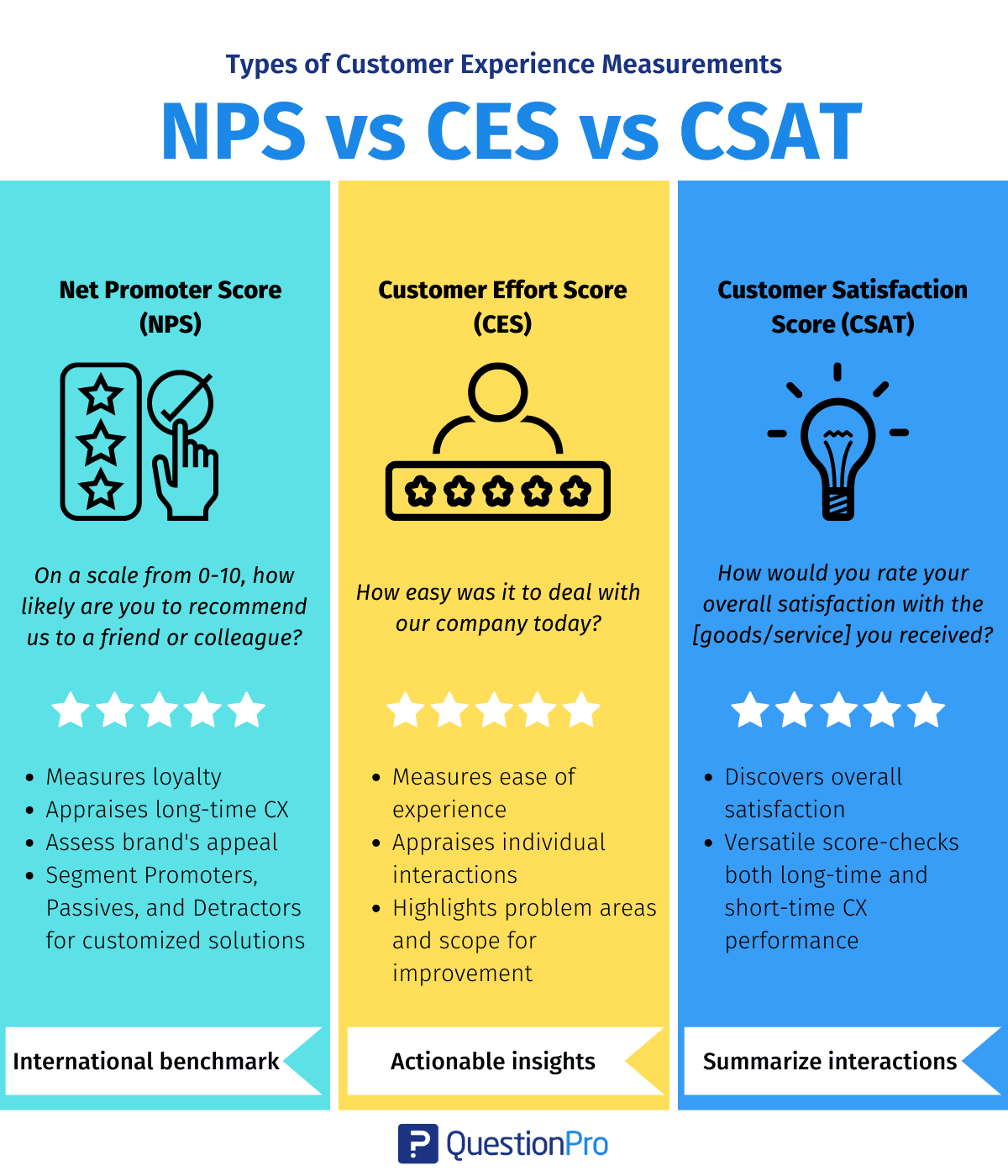
| Metric | What it measures | Sample question | Best moment to ask |
|---|---|---|---|
| Net Promoter Score (NPS) | Overall loyalty and willingness to recommend the store | “How likely are you to recommend us to a friend or colleague?” | Post-purchase, or on a recurring relationship survey |
| Customer Satisfaction Score (CSAT) | Satisfaction with one specific interaction | “How satisfied were you with your recent order?” | Right after checkout, delivery, or a support ticket |
| Customer Effort Score (CES) | How much effort a task took to complete | “How easy was it to complete your purchase?” | Checkout, returns, or account setup |
NPS tracks the relationship over time. CSAT and CES diagnose a single touchpoint. Most ecommerce programs need at least one relationship metric and one interaction-level metric, not just one or the other.
You can read the NPS vs CSAT vs CES blog to learn more about those three metrics and their differences.
Pre-Purchase and Website Experience Survey Questions
Not every visitor buys. Some browse and leave, and understanding what they were looking for matters as much as understanding why customers convert. Ask these questions before or during the shopping session, since post-visit follow-up rarely reaches non-buyers.
General and NPS questions
- Considering your complete experience with our site, how likely are you to recommend us to a friend or colleague?
- How satisfied did you feel with your visit overall?
- Please tell us how we could improve your experience.
- Did you find what you were looking for today?
- How did you first hear about our website (search engine, social media, a friend’s recommendation, an ad)?
- What were you shopping for today, and did you find it?
- How easy was it to navigate the site?
- How does our website compare to competitors on pricing, product information, and checkout experience?
- What other information would you want to see on this product page?
Product catalog and review questions
- Did you find enough variety within this product category?
- Did the product page give you enough detail to decide?
- How much do you trust the reviews shown on this page?
- How much does the average star rating influence your decision to buy?
Post-Purchase Ecommerce Survey Questions
Once someone converts, the goal shifts from removing friction to protecting the relationship. These questions surface issues before they turn into refund requests or negative reviews.
- How satisfied are you with the quality of the product you received?
- How does this product’s quality compare with similar products you have bought elsewhere?
- Were you notified when an out-of-stock item became available again?
- What other products would you like to see us carry?
- How safe did you feel entering your payment details at checkout?
- How would you rate the overall checkout experience?
- On a scale of 0 to 10, how likely are you to purchase from us again?
Send this set within 24 to 48 hours of delivery, while the experience is still fresh. Waiting longer than a week noticeably lowers response accuracy, since shoppers start to conflate this purchase with others.
Shipping and Delivery Survey Questions
A great product can still lose a customer at the doorstep. Shipping questions catch problems that live outside your website entirely, in the hands of couriers and fulfillment partners.
- Did your order arrive within the timeframe promised at checkout?
- Would you pay extra for a faster shipping option?
- Did the order arrive at the correct address?
- Did your invoice match the billing address on file?
- How easy was it to update your shipping address after placing the order?
- How would you rate your experience with the delivery carrier?
Customer Support Survey Questions for Ecommerce
Support interactions are high-stakes moments. A shopper who contacts support is already frustrated, and how that conversation goes often decides whether they buy again.
- How would you rate your experience with the support representative, on a scale of 1 to 10?
- Did the representative resolve your issue on the first contact?
- How helpful was the support team overall?
- How many separate contacts did it take to resolve your issue?
First-contact resolution is worth tracking on its own. A support team that resolves issues in one interaction generally keeps far more customers than one that requires repeat contact. This holds true even when the final CSAT scores look similar.
Cart Abandonment and Exit-Intent Survey Questions
Cart abandonment is one of the biggest, most measurable revenue leaks in ecommerce. Baymard Institute’s meta-analysis of dozens of studies puts the average cart abandonment rate at roughly 70%. That means most stores lose seven out of every ten shoppers who add an item to their cart. Exit-intent feedback is one of the highest-value surveys a store can run because of that gap.
Trigger a short survey the moment a shopper starts to leave the checkout page. Send a follow-up email instead if they abandon after providing an email address.
- What almost stopped you from completing your order today?
- Was the total cost higher than you expected at checkout?
- Did you run into any technical issues while checking out?
- Were you comparing prices with another store before you left?
- What would need to change for you to complete this purchase?
Keep this survey to one or two questions. A shopper who is already leaving will not stop to answer ten more.
Branding, Marketing, and Vendor Feedback Questions
Feedback here shapes messaging and partner decisions rather than the product itself. It still belongs in a full ecommerce survey program because it explains the reasoning behind a purchase decision.
- Which factor mattered most in your purchase decision (brand reputation, price, product quality, local sourcing, or another reason)?
- Would you like to receive updates on future discounts or promotions?
- Would you be interested in a paid membership for priority shipping or exclusive access?
- How satisfied are you with the range of vendors we offer?
- How satisfied are you with the products from this specific vendor?
- What additional vendor information would help you decide what to buy?
If your store operates a marketplace model with multiple third-party vendors, treat vendor feedback as a vendor satisfaction survey in its own right. Do not fold it into general product questions. Vendor performance and product quality are related but separate problems. Mixing them makes it harder to tell whether a low score is about the product or the seller behind it.
How to Choose the Right Ecommerce Survey Questions for Your Store
Not every store needs all 45+ questions above. Start by identifying your biggest unknown, then work outward.
- Find your highest-friction moment first. Check your analytics for the step with the steepest drop-off, whether that is product pages, cart, or checkout, and start your survey program there.
- Match the metric to the goal. Use CES for anything involving a task (checkout, returns), CSAT for a single interaction (support, delivery), and NPS for the overall relationship.
- Limit each survey to 3 to 7 questions. Shorter surveys consistently get better completion rates than long ones, especially on mobile.
- Rotate rather than stack. If you have multiple question sets, show different blocks to different customer segments instead of asking everyone everything.
How to Distribute and Measure Ecommerce Survey Results
Getting a representative sample matters as much as writing good questions. A survey with 12 responses from your most loyal customers will not tell you why casual shoppers leave.
Split larger customer lists into groups before sending different question sets. For example, say 200 customers agreed to give feedback. Send website and product questions to one group of 100, and shipping and support questions to the other 100. This keeps each individual survey short while still covering every stage across your full sample.
Common distribution channels include:
- Post-checkout email, sent automatically after an order confirmation
- On-site pop-up or embedded widget, triggered by exit intent or time on page
- SMS, for shipping and delivery follow-ups
- QR code on packing slips, for post-delivery feedback
Aim for at least 100 to 200 responses per question set before drawing conclusions for a store with meaningful traffic. Smaller stores can work with fewer responses but should treat single-digit response counts as directional, not conclusive.
Common Mistakes to Avoid When Running Ecommerce Surveys
A few recurring errors quietly wreck otherwise well-designed ecommerce survey programs.
- Asking everything in one survey.
Long surveys after checkout push down completion rates and bias your results toward only the most patient customers.
- Sending the survey too late.
A satisfaction survey sent two weeks after delivery captures memory, not experience.
- Skipping the open-ended follow-up.
A number alone does not explain why a shopper gave a low feedback score. Always pair a scored question with a short “why” prompt.
- Ignoring non-buyers.
Surveys sent only to purchasers miss the majority of visitors who left without converting, and often the reason is fixable.
- Never closing the loop.
Customers who leave detailed feedback and see no change stop responding to future surveys.
How QuestionPro Supports Stage-Specific Ecommerce Surveys
Running the right question at the right journey stage is as much a logistics problem as a question-writing one, especially once you add customer segments into the mix. QuestionPro Customer Experience uses skip logic and audience segmentation for this. It shows shipping questions only to buyers, exit-intent questions only to abandoners, and vendor questions only to marketplace shoppers, without building a separate survey for every segment.
QuestionPro’s AskWhy question type handles the open-ended “why” behind abandoned carts or low CSAT scores. It prompts respondents to explain a low score in their own words, then groups similar responses so patterns surface without manually reading every comment. Both features run on the same survey software platform used for the templates covered above.
Turning Ecommerce Survey Answers Into Repeat Purchases
The value of ecommerce survey questions shows up after the survey closes, not during it. Segment responses by device, location, and purchase stage before acting on them, since a checkout complaint from mobile users often points to a different fix than the same complaint from desktop users.
Watch for trends, not just single scores. A single bad support rating is an isolated incident. Ten similar ratings in a week, tied to one product or one shipping carrier, is a pattern worth fixing immediately. Feed the resulting changes back into the parts of the business the data points to:
- Product pages, when the complaint is about missing information
- Checkout flow, when the complaint is about cost or friction
- Support scripts, when the complaint is about resolution time
Then re-survey in a month to confirm the fix worked.
Frequently Asked Questions (FAQs)
Keep individual surveys to 3 to 7 questions. Longer surveys see sharply lower completion rates, particularly on mobile checkout flows where shoppers are already trying to finish quickly and leave.
Response rates for post-purchase ecommerce surveys typically fall between 5% and 30%, depending on channel and incentive. Email surveys sent immediately after delivery tend to outperform generic newsletter-embedded surveys by a wide margin.
Send it 24 to 48 hours after delivery confirmation. This window is late enough that the customer has used the product, but early enough that the details of the purchase and delivery experience are still accurate in memory.
Yes, but only as a one- or two-question exit-intent prompt or a short follow-up email. Long surveys sent to someone who already abandoned checkout rarely get answered, since the shopper has already mentally moved on.
A pre-purchase survey captures browsing intent and friction before checkout, often from visitors who never buy. A post-purchase survey measures satisfaction with a completed order, product quality, and delivery, and only reaches customers who already converted.